VoteNet
VoteNet detection model.
Classes:
-
VoteNetOutput–Decoded VoteNet proposals for a batch of \(B\) scenes with \(K\) proposals each.
-
VoteNetBackbone–PointNet++ single-scale-grouping backbone (set abstraction + feature propagation).
-
VotingModule–Hough voting: each seed predicts a vote offset and a residual feature.
-
VoteNetProposalModule–Vote aggregation and proposal generation.
-
VoteNetDetection–VoteNet 3D object detector (packed point format).
Bases: TypedDict
Decoded VoteNet proposals for a batch of \(B\) scenes with \(K\) proposals each.
VoteNetBackbone(
    in_channels: int,
    *,
    sa_channels: Sequence[Sequence[int]],
    sa_npoints: Sequence[int],
    sa_radii: Sequence[float],
    sa_num_neighbors: Sequence[int],
    fp_channels: Sequence[Sequence[int]],
    act: Union[str, Callable, None] = "relu",
    act_kwargs: Optional[Dict[str, Any]] = None,
    norm: Union[str, Callable, None] = "batch_norm",
    norm_kwargs: Optional[Dict[str, Any]] = None,
)
Bases: Module
PointNet++ single-scale-grouping backbone (set abstraction + feature propagation).
Reuses SAModule /
FPModule; every layer width, sample count,
radius and neighbor cap is a constructor argument (no hardcoded sizes). The seeds are the points at
the second SA resolution, recovered by the feature-propagation layers. Their indices into the
original packed input are tracked through the first two SA samplings (idx1[idx2]) for the voting
loss, so the SA samplings of those two blocks are computed here and threaded in.
Parameters:
-
in_channels(int) –Input feature channels per point (excluding xyz).
-
sa_channels(Sequence[Sequence[int]]) –Per-SA-block MLP channel lists, e.g.
[[64, 64, 128], ...]. -
sa_npoints(Sequence[int]) –Per-SA-block farthest-point-sample counts.
-
sa_radii(Sequence[float]) –Per-SA-block ball-query radii.
-
sa_num_neighbors(Sequence[int]) –Per-SA-block neighbor caps.
-
fp_channels(Sequence[Sequence[int]]) –Per-FP-block MLP channel lists. The \(i\)-th FP block skips to the \((\text{n\_sa} - 2 - i)\)-th SA output, so two FP blocks recover the SA2 resolution.
-
act(Union[str, Callable, None], default:'relu') –Activation for every block.
-
act_kwargs(Optional[Dict[str, Any]], default:None) –Extra activation arguments.
-
norm(Union[str, Callable, None], default:'batch_norm') –Normalization for every block.
-
norm_kwargs(Optional[Dict[str, Any]], default:None) –Extra normalization arguments.
VotingModule(
    vote_factor: int,
    seed_feature_dim: int,
    *,
    act: Union[str, Callable, None] = "relu",
    act_kwargs: Optional[Dict[str, Any]] = None,
    norm: Union[str, Callable, None] = "batch_norm",
    norm_kwargs: Optional[Dict[str, Any]] = None,
)
Bases: Module
Hough voting: each seed predicts a vote offset and a residual feature.
Mirrors the reference VotingModule. Because the residual is added to the seed feature, the input
and output feature dims are equal.
Parameters:
-
vote_factor(int) –Number of votes generated per seed.
-
seed_feature_dim(int) –Channel count of the seed features.
-
act(Union[str, Callable, None], default:'relu') –Activation type or callable.
-
act_kwargs(Optional[Dict[str, Any]], default:None) –Extra activation arguments.
-
norm(Union[str, Callable, None], default:'batch_norm') –Normalization type or callable.
-
norm_kwargs(Optional[Dict[str, Any]], default:None) –Extra normalization arguments.
VoteNetProposalModule(
    num_classes: int,
    num_heading_bin: int,
    num_size_cluster: int,
    num_proposal: int,
    sampling: str,
    seed_channels: int,
    *,
    vote_aggr_channels: Sequence[int],
    vote_aggr_radius: float,
    vote_aggr_num_neighbors: int,
    act: Union[str, Callable, None] = "relu",
    act_kwargs: Optional[Dict[str, Any]] = None,
    norm: Union[str, Callable, None] = "batch_norm",
    norm_kwargs: Optional[Dict[str, Any]] = None,
)
Bases: Module
Vote aggregation and proposal generation.
Mirrors the reference ProposalModule: cluster the votes with a single set-abstraction layer
(SAModule), then a 3-layer linear head
decodes objectness, center, heading and size bins/residuals and semantic class per proposal.
Parameters:
-
num_classes(int) –Number of semantic classes.
-
num_heading_bin(int) –Number of heading-angle bins.
-
num_size_cluster(int) –Number of size templates.
-
num_proposal(int) –Number of proposals (= aggregation centroids) per scene.
-
sampling(str) –Aggregation-center sampling,
"vote_fps"or"seed_fps". -
seed_channels(int) –Channel count of the (vote) input features.
-
vote_aggr_channels(Sequence[int]) –MLP channels of the vote-aggregation set-abstraction layer.
-
vote_aggr_radius(float) –Ball-query radius of the vote-aggregation layer.
-
vote_aggr_num_neighbors(int) –Neighbor cap of the vote-aggregation layer.
-
act(Union[str, Callable, None], default:'relu') –Activation type or callable.
-
act_kwargs(Optional[Dict[str, Any]], default:None) –Extra activation arguments.
-
norm(Union[str, Callable, None], default:'batch_norm') –Normalization type or callable.
-
norm_kwargs(Optional[Dict[str, Any]], default:None) –Extra normalization arguments.
Methods:
-
decode–Splits the flat head output into the per-proposal box attributes.
decode(
    preds: Tensor,
    pos_aggr: Tensor,
    batch_aggr: Tensor,
    mean_sizes: Tensor,
) -> Dict[str, Tensor]
Splits the flat head output into the per-proposal box attributes.
Centers are predicted as offsets from the aggregation centroids, and heading and size residuals are denormalized by the bin width and the size templates respectively.
Parameters:
-
preds(Tensor) –Flat head output, shape \((B \cdot Q, C)\).
-
pos_aggr(Tensor) –Aggregation centroid positions, shape \((B \cdot Q, 3)\).
-
batch_aggr(Tensor) –Per-centroid scene index, shape \((B \cdot Q,)\).
-
mean_sizes(Tensor) –Size templates, shape \((S, 3)\).
Returns:
-
Dict[str, Tensor]–The per-proposal objectness, center, heading, size and semantic predictions, each of shape
-
Dict[str, Tensor]–\((B, Q, \ldots)\).
VoteNetDetection(
    in_channels: int,
    num_classes: int,
    *,
    num_heading_bin: int,
    num_size_cluster: int,
    mean_sizes: Union[Tensor, List[List[float]]],
    num_proposal: int,
    vote_factor: int,
    sampling: str,
    sa_channels: Sequence[Sequence[int]],
    sa_npoints: Sequence[int],
    sa_radii: Sequence[float],
    sa_num_neighbors: Sequence[int],
    fp_channels: Sequence[Sequence[int]],
    vote_aggr_channels: Sequence[int],
    vote_aggr_radius: float,
    vote_aggr_num_neighbors: int,
    act: Union[str, Callable, None] = "relu",
    act_kwargs: Optional[Dict[str, Any]] = None,
    norm: Union[str, Callable, None] = "batch_norm",
    norm_kwargs: Optional[Dict[str, Any]] = None,
)
Bases: DetectionModel
VoteNet 3D object detector (packed point format).
Reference: Qi et al., 2019. Reference implementation: facebookresearch/votenet.
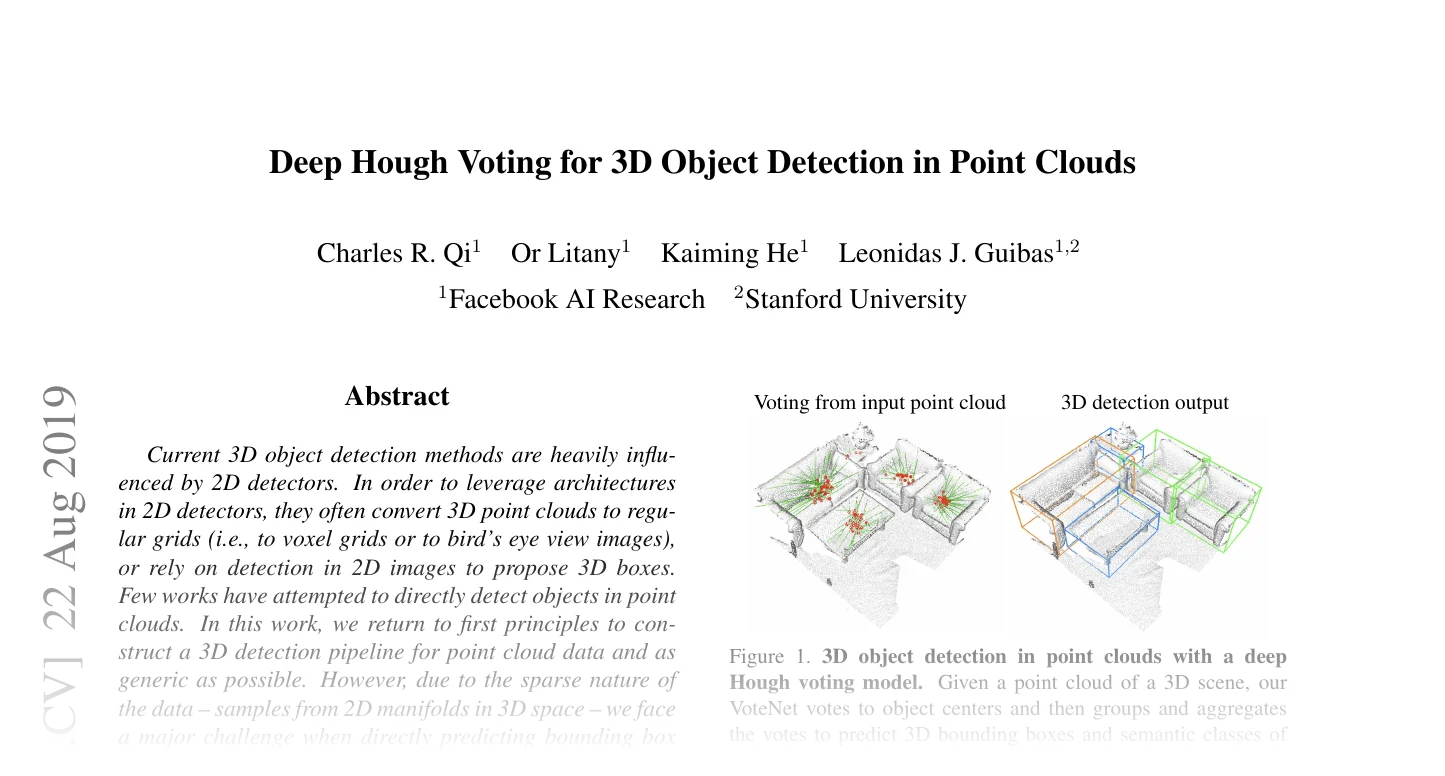
A PointNet++ backbone extracts seed points; a voting module shifts each seed toward its object center; a proposal module clusters the votes and decodes a fixed number of oriented (or axis-aligned) box proposals per scene.
Parameters:
-
in_channels(int) –Input feature channels per point excluding xyz (e.g. \(1\) for a floor-relative height feature, \(4\) for height + RGB).
-
num_classes(int) –Number of semantic classes.
-
num_heading_bin(int) –Number of heading-angle bins (\(1\) for axis-aligned ScanNet boxes, \(12\) for oriented SUN RGB-D boxes).
-
num_size_cluster(int) –Number of size templates (one per class here).
-
mean_sizes(Union[Tensor, List[List[float]]]) –Per-template mean box size, shape \((\text{num\_size\_cluster}, 3)\).
-
num_proposal(int) –Number of box proposals per scene.
-
vote_factor(int) –Votes generated per seed.
-
sampling(str) –Aggregation-center sampling,
"vote_fps"or"seed_fps". -
sa_channels(Sequence[Sequence[int]]) –Per-SA-block MLP channel lists for the backbone.
-
sa_npoints(Sequence[int]) –Per-SA-block farthest-point-sample counts.
-
sa_radii(Sequence[float]) –Per-SA-block ball-query radii.
-
sa_num_neighbors(Sequence[int]) –Per-SA-block neighbor caps.
-
fp_channels(Sequence[Sequence[int]]) –Per-FP-block MLP channel lists for the backbone.
-
vote_aggr_channels(Sequence[int]) –MLP channels of the proposal vote-aggregation layer.
-
vote_aggr_radius(float) –Ball-query radius of the vote-aggregation layer.
-
vote_aggr_num_neighbors(int) –Neighbor cap of the vote-aggregation layer.
-
act(Union[str, Callable, None], default:'relu') –Activation type or callable.
-
act_kwargs(Optional[Dict[str, Any]], default:None) –Extra activation arguments.
-
norm(Union[str, Callable, None], default:'batch_norm') –Normalization type or callable.
-
norm_kwargs(Optional[Dict[str, Any]], default:None) –Extra normalization arguments.
Methods:
-
configure_backbone–Build the PointNet++ seed backbone.
-
configure_vgen–Build the voting module.
-
configure_proposal–Build the proposal module.
-
decode–Decode a forward output into raw per-proposal detections (no NMS, threshold, or filtering).
Attributes:
-
num_features(int) –Channel count \(C\) of the per-seed backbone features entering the voting head.
property

Channel count \(C\) of the per-seed backbone features entering the voting head.
decode(out: VoteNetOutput) -> Detection3D
Decode a forward output into raw per-proposal detections (no NMS, threshold, or filtering).
Builds one oriented box per proposal from the predicted heading/size bins, scores it by objectness,
and labels it by the argmax semantic class. The heading head predicts negated angles, so the decoded
heading is negated to return counter-clockwise headings (the library box convention). The result is
the full unfiltered proposal set; the evaluation pipeline applies point-count filtering, NMS, score
thresholding, and the indoor per-class expansion (driven by the returned class_probs) via the
torch_pointcloud.utils.box3d utilities.
Parameters:
-
out(VoteNetOutput) –A
VoteNetOutputfromforward.
Returns:
-
Detection3D–Packed proposals
{"boxes", "scores", "labels", "batch", "class_probs"}(PyG layout), where the -
Detection3D–per-proposal score is objectness, the label is the argmax semantic class, and
class_probsholds -
Detection3D–the softmaxed semantic-class probabilities.
Shape
- boxes: \((B \cdot P, 7)\)
- scores / labels / batch: \((B \cdot P,)\)
- class_probs: \((B \cdot P, C)\)