Semantic3D
The Semantic3D dataset.
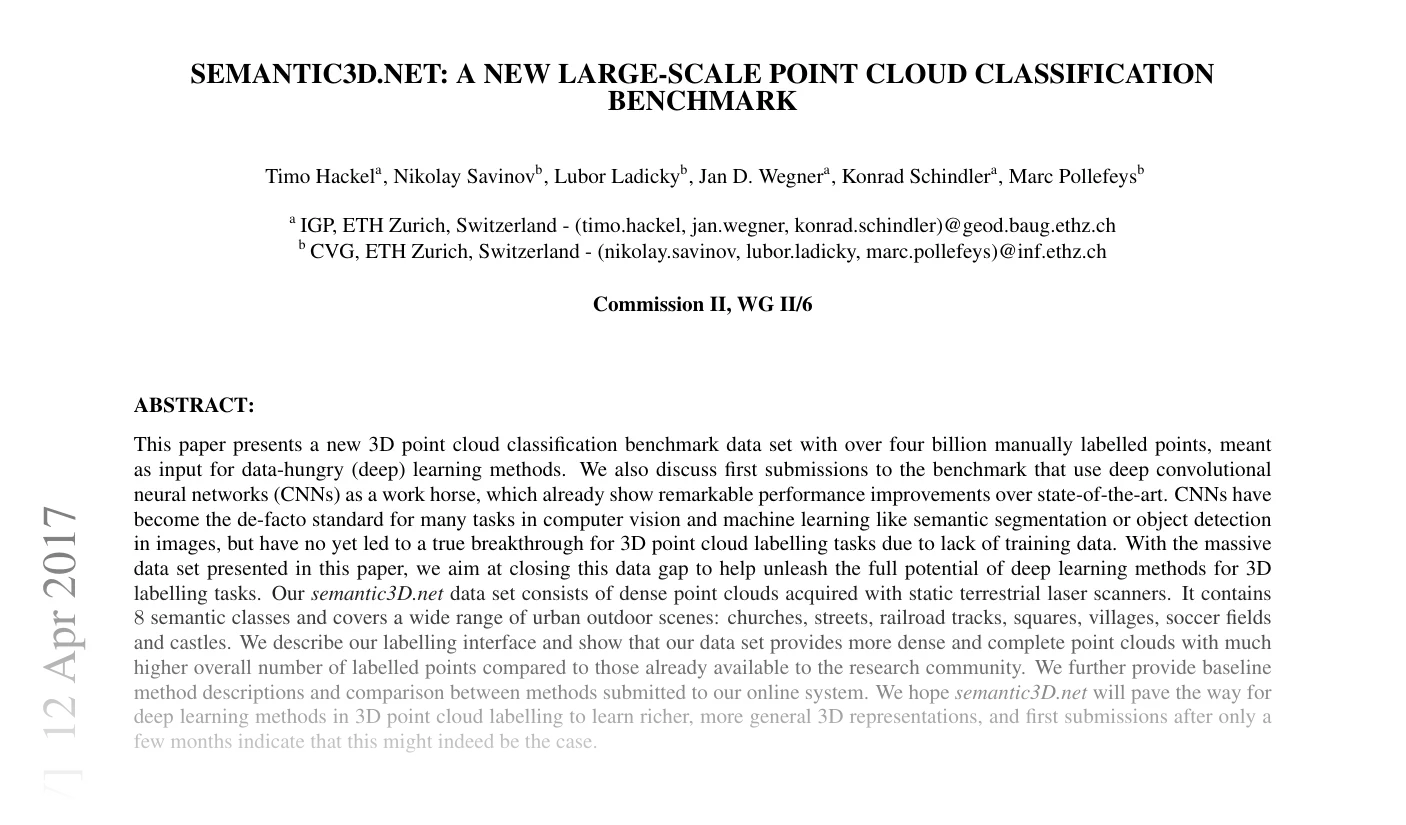
Semantic3D.net: A new Large-scale Point Cloud Classification Benchmark by Hackel, Savinov, Ladicky, Wegner, Schindler and Pollefeys (2017).
Each scene is distributed as a pair of plain-text files:
<scene>.txt- one row per point withx y z intensity r g b(white-space separated, ASCII, no header). XYZ are float64 meters; intensity is float; RGB areuint80-255.<scene>.labels- one row per point with the integer class id (\(0\) = unlabelled, \(1\)-\(8\) = the eight benchmark classes)..labelsis only present for thereduced-8andtrainingsplits.
Classes:
-
Semantic3D–The Semantic3D dataset.
Functions:
-
load_semantic3d_data–Parse a Semantic3D
<scene>.txt(and optional<scene>.labels) file pair.
Semantic3D(
    root: PathLike,
    *,
    split: Semantic3DSplit = "train",
    scenes: Optional[Sequence[str]] = None,
    transform: Optional[
        Callable[[Dict[str, Any]], Dict[str, Any]]
    ] = None,
)
Bases: PointCloudDataset
The Semantic3D dataset.
Each sample is a single ASCII-text scene, returned as a dictionary:
| Key | Shape | Dtype | Meaning |
|---|---|---|---|
pos |
\((N, 3)\) | float32 | XYZ |
intensity |
\((N, 1)\) | float32 | LiDAR intensity |
color |
\((N, 3)\) | uint8 | RGB (0-255) |
segment |
\((N,)\) | int64 | Raw class id 0-8 (0 = unlabelled, ignored). Absent for held-out scenes. |
name |
str | Source scene name |
Parameters:
-
root(PathLike) –Dataset root. Files are read from
<root>/Semantic3D/raw/<scene>.txt. -
split(Semantic3DSplit, default:'train') –One of
"train"/"test"/"all". Defaults to"train"."test"returns the fourreduced-8benchmark scenes (without labels). -
scenes(Optional[Sequence[str]], default:None) –Optional explicit list of scene names (without the
.txt/.labelssuffix). Overridessplit. -
transform(Optional[Callable[[Dict[str, Any]], Dict[str, Any]]], default:None) –Callable applied to each loaded sample dict at
__getitem__time.
Note
The dataset must be downloaded manually from
semantic3d.net (a license must be accepted). The
expected layout under <root>/Semantic3D/raw/ is one <scene>.txt (and
matching <scene>.labels for training scenes) per scene.
Warning
Loading is done with np.loadtxt, which reads the (often 100M+-row) ASCII
files into RAM in a single shot. Each scene needs ~5 GB of RAM to parse;
consider extracting only the scenes you need for evaluation.
Methods:
-
download–Semantic3D must be downloaded manually (a license must be accepted).
Attributes:
-
name(str) –Name of the dataset directory.
-
data_dir(str) –Path to the dataset directory
<root>/<name>. -
raw_dir(str) –Path to the raw download directory.
-
processed_dir(str) –Path to the processed cache directory.
Semantic3D must be downloaded manually (a license must be accepted).
Parameters:
-
force(bool, default:False) –Unused; present to mirror the other datasets'
downloadsignature.
Raises: RuntimeError: Always; automatic download is not supported.
load_semantic3d_data(
    path_txt: PathLike,
    /,
    path_labels: Optional[PathLike] = None,
) -> Dict[str, Tensor]
Parse a Semantic3D <scene>.txt (and optional <scene>.labels) file pair.
The .txt files are large ASCII (often 100M+ rows) - we use np.loadtxt
which is slow but free of compiled dependencies. The segment key is only
populated when path_labels is provided and exists (held-out test scenes
receive no segment key).
| Key | Shape | Dtype |
|---|---|---|
pos |
\((N, 3)\) | float32 |
intensity |
\((N, 1)\) | float32 |
color |
\((N, 3)\) | uint8 |
segment |
\((N,)\) | int64 |