PointNeXt
PointNeXt classification and segmentation models.
Classes:
-
PointNeXtIntermediate–Input features and point cloud of one encoder block, recorded before it downsamples.
-
PointNeXtEncoderBlock–One encoder stage: an optional set-abstraction downsampling followed by
depthinverted residual blocks. -
PointNeXtEncoder–Stack of
PointNeXtEncoderBlockstages, each preceded by a set-abstraction downsampling. -
PointNeXtDecoder–The PointNeXt decoder, using the Feature Propagation (FP) module from the PointNet++ architecture.
-
PointNeXtPartDecoder–PointNeXt decoder for part segmentation (ShapeNetPart).
-
PointNeXtPartSegmentation–PointNeXt part segmentation model for ShapeNetPart.
-
PointNeXtClassification–PointNeXt classification model as described in the paper
-
PointNeXtSegmentation–PointNeXt segmentation model as described in the paper
Bases: NamedTuple
Input features and point cloud of one encoder block, recorded before it downsamples.
PointNeXtEncoderBlock(
    spatial_dim: int,
    channels: int,
    depth: int,
    expansion: int,
    radius: float,
    num_neighbors: int,
    act: Union[str, Callable, None] = "relu",
    act_kwargs: Optional[Dict[str, Any]] = None,
    act_first: bool = False,
    norm: Union[str, Callable, None] = "batch_norm",
    norm_kwargs: Optional[Dict[str, Any]] = None,
    bias: Union[bool, List[bool]] = True,
    add_self_loops: bool = False,
    aggr: AggrType = "max",
    downsample: Optional[PointNeXtSetAbstraction] = None,
)
Bases: Module
One encoder stage: an optional set-abstraction downsampling followed by depth inverted residual blocks.
PointNeXtEncoder(
    channels: Sequence[int],
    *,
    spatial_dim: int = 3,
    depths: Sequence[int],
    expansion: Union[int, Sequence[int]] = 4,
    ratios: Sequence[float],
    radiuses: Sequence[Union[float, Sequence[float]]],
    num_neighbors: Sequence[Union[int, Sequence[int]]],
    sa_layers: int = 1,
    sa_use_res: bool = True,
    act: Union[str, Callable, None] = "relu",
    act_kwargs: Optional[Dict[str, Any]] = None,
    act_first: bool = False,
    norm: Union[str, Callable, None] = "batch_norm",
    norm_kwargs: Optional[Dict[str, Any]] = None,
    bias: Union[bool, List[bool]] = True,
    add_self_loops: bool = False,
    aggr: AggrType = "max",
)
Bases: Module
Stack of PointNeXtEncoderBlock stages, each preceded by a set-abstraction downsampling.
When return_intermediates=True is passed to forward, the pre-downsampling features of every
stage are returned in coarse-to-fine order, ready to be consumed as decoder skips.
Note
radiuses and num_neighbors hold one entry per channel: entry \(i\) configures the
set-abstraction of block \(i\) and entry \(i+1\) its residual blocks.
Parameters:
-
channels(Sequence[int]) –Channels of the stem output followed by the output of each encoder block.
-
spatial_dim(int, default:3) –Spatial dimension of the input point cloud.
-
depths(Sequence[int]) –Number of residual blocks in each encoder block.
-
expansion(Union[int, Sequence[int]], default:4) –Bottleneck expansion factor of the residual blocks.
-
ratios(Sequence[float]) –Sampling ratio of the set-abstraction preceding each encoder block.
-
radiuses(Sequence[Union[float, Sequence[float]]]) –Ball-query radius for each channel level.
-
num_neighbors(Sequence[Union[int, Sequence[int]]]) –Maximum number of neighbors for each channel level.
-
sa_layers(int, default:1) –Number of MLP layers inside each set-abstraction.
-
sa_use_res(bool, default:True) –Whether the set-abstractions use a residual connection.
-
act(Union[str, Callable, None], default:'relu') –Activation function to use for the encoder blocks.
-
act_kwargs(Optional[Dict[str, Any]], default:None) –Keyword arguments for the activation function.
-
act_first(bool, default:False) –Whether to apply the activation function before the normalization.
-
norm(Union[str, Callable, None], default:'batch_norm') –Normalization function to use for the encoder blocks.
-
norm_kwargs(Optional[Dict[str, Any]], default:None) –Keyword arguments for the normalization function.
-
bias(Union[bool, List[bool]], default:True) –Whether to use a bias for the encoder blocks.
-
add_self_loops(bool, default:False) –Whether the neighborhood graphs include self-loops.
-
aggr(AggrType, default:'max') –Aggregation used to pool neighbor features.
PointNeXtDecoder(
    channels: Sequence[int],
    skip_channels: Sequence[int],
    depths: Sequence[int],
    *,
    spatial_dim: int = 3,
    dropout: float = 0.0,
    act: Union[str, Callable, None] = "relu",
    act_kwargs: Optional[Dict[str, Any]] = None,
    act_first: bool = False,
    norm: Union[str, Callable, None] = "batch_norm",
    norm_kwargs: Optional[Dict[str, Any]] = None,
    bias: Union[bool, List[bool]] = True,
    plain_last: bool = True,
)
Bases: Module
The PointNeXt decoder, using the Feature Propagation (FP) module from the PointNet++ architecture.
Note
The number of channels should be equal to the number of decoder blocks + 1.
Parameters:
-
channels(Sequence[int]) –List of channels for each FP block. The first element should correspond to the last channel of the encoder.
-
skip_channels(Sequence[int]) –List of channels for the skip connections. This is usually the same as the first \(N-1\) channels of the encoder, in reverse order.
-
depths(Sequence[int]) –List of depths for each FP block.
-
spatial_dim(int, default:3) –Spatial dimension of the input point cloud.
-
dropout(float, default:0.0) –Dropout rate before the classification head.
-
act(Union[str, Callable, None], default:'relu') –Activation function to use for the FP blocks.
-
act_kwargs(Optional[Dict[str, Any]], default:None) –Keyword arguments for the activation function.
-
act_first(bool, default:False) –Whether to apply the activation function before the normalization.
-
norm(Union[str, Callable, None], default:'batch_norm') –Normalization function to use for the FP blocks.
-
norm_kwargs(Optional[Dict[str, Any]], default:None) –Keyword arguments for the normalization function.
-
bias(Union[bool, List[bool]], default:True) –Whether to use a bias for the FP blocks.
PointNeXtPartDecoder(
    channels: Sequence[int],
    skip_channels: Sequence[int],
    depths: Sequence[int],
    *,
    global_conv1_in: int,
    global_conv2_in: int,
    num_categories: int = 16,
    spatial_dim: int = 3,
    dropout: float = 0.0,
    act: Union[str, Callable, None] = "relu",
    act_kwargs: Optional[Dict[str, Any]] = None,
    act_first: bool = False,
    norm: Union[str, Callable, None] = "batch_norm",
    norm_kwargs: Optional[Dict[str, Any]] = None,
    bias: Union[bool, List[bool]] = True,
    plain_last: bool = True,
)
Bases: Module
PointNeXt decoder for part segmentation (ShapeNetPart).
Uses the same FP block layout as PointNeXtDecoder, with two
global feature convolutions and shape-category conditioning. At the
shallowest decoder stage, the skip features are augmented with max-pooled
global features from two encoder levels and a shape-category one-hot
vector before the FP layer.
This matches the reference PointNextPartDecoder with
cls_map='curvenet'.
Parameters:
-
channels(Sequence[int]) –List of channels for each FP block.
-
skip_channels(Sequence[int]) –List of channels for the skip connections.
-
depths(Sequence[int]) –List of depths for each FP block.
-
global_conv1_in(int) –Input channels for global_conv1 (typically
encoder_channels[-2]). -
global_conv2_in(int) –Input channels for global_conv2 (typically
encoder_channels[-1]). -
num_categories(int, default:16) –Number of shape categories (16 for ShapeNetPart).
PointNeXtPartSegmentation(
    in_channels: int,
    num_classes: int,
    *,
    num_categories: int,
    stem_channels: Optional[
        Union[int, Sequence[int]]
    ] = None,
    stem_plain_last: bool = False,
    encoder_channels: Sequence[int],
    encoder_depths: Sequence[int],
    encoder_expansion: Union[int, Sequence[int]] = 4,
    sa_layers: int = 1,
    sa_use_res: bool = True,
    decoder_channels: Sequence[int],
    decoder_depths: Sequence[int],
    decoder_plain_last: bool = True,
    ratios: Sequence[float],
    radiuses: Sequence[Union[float, Sequence[float]]],
    num_neighbors: Sequence[Union[int, Sequence[int]]],
    add_self_loops: bool = False,
    spatial_dim: int = 3,
    act: Union[str, Callable, None] = "relu",
    act_kwargs: Optional[Dict[str, Any]] = None,
    act_first: bool = False,
    norm: Union[str, Callable, None] = "batch_norm",
    norm_kwargs: Optional[Dict[str, Any]] = None,
    bias: Union[bool, List[bool]] = True,
    dropout: float = 0.0,
    head_channels: Optional[Sequence[int]] = None,
)
Bases: SegmentationModel
PointNeXt part segmentation model for ShapeNetPart.
Uses the same encoder as PointNeXtSegmentation but replaces the
decoder with PointNeXtPartDecoder (global feature conditioning
on shape category) and adds a head with global max+avg pooling.
Parameters:
-
in_channels(int) –Number of input feature channels.
-
num_classes(int) –Number of part classes (50 for ShapeNetPart).
-
num_categories(int) –Number of shape categories (16 for ShapeNetPart).
-
stem_channels(Optional[Union[int, Sequence[int]]], default:None) –Stem MLP channel sizes.
-
encoder_channels(Sequence[int]) –Encoder channel dimensions per stage.
-
encoder_depths(Sequence[int]) –Residual block depths per encoder stage.
-
encoder_expansion(Union[int, Sequence[int]], default:4) –InvResMLP expansion ratio.
-
sa_layers(int, default:1) –Number of SA conv layers per block.
-
sa_use_res(bool, default:True) –Whether SA blocks use residual connections.
-
decoder_channels(Sequence[int]) –Decoder channel dimensions per stage.
-
decoder_depths(Sequence[int]) –FP block depths per decoder stage.
-
ratios(Sequence[float]) –FPS downsampling ratios.
-
radiuses(Sequence[Union[float, Sequence[float]]]) –Ball-query radii.
-
num_neighbors(Sequence[Union[int, Sequence[int]]]) –Max neighbors per ball query.
Methods:
-
configure_stem–Build the stem MLP lifting the input features, or
Nonewhenstem_channelsis unset. -
configure_encoder–Build the
PointNeXtEncoderbackbone. -
configure_decoder–Build the
PointNeXtPartDecoderupsampling the coarsest features back through the encoder skips.
Attributes:
-
num_features(int) –Channel count \(C\) entering the head: decoder features concatenated with their global max and mean pools.
property

Channel count \(C\) entering the head: decoder features concatenated with their global max and mean pools.
Build the stem MLP lifting the input features, or None when stem_channels is unset.
configure_decoder() -> PointNeXtPartDecoder
Build the PointNeXtPartDecoder upsampling the coarsest features back through the encoder skips.
PointNeXtClassification(
    in_channels: int,
    num_classes: int,
    *,
    stem_channels: Optional[
        Union[int, Sequence[int]]
    ] = None,
    stem_plain_last: bool = False,
    encoder_channels: Sequence[int],
    encoder_depths: Sequence[int],
    encoder_expansion: Union[int, Sequence[int]] = 4,
    sa_layers: int = 1,
    sa_use_res: bool = True,
    ratios: Sequence[float],
    radiuses: Sequence[Union[float, Sequence[float]]],
    num_neighbors: Sequence[Union[int, Sequence[int]]],
    add_self_loops: bool = False,
    spatial_dim: int = 3,
    act: Union[str, Callable, None] = "relu",
    act_kwargs: Optional[Dict[str, Any]] = None,
    act_first: bool = False,
    norm: Union[str, Callable, None] = "batch_norm",
    norm_kwargs: Optional[Dict[str, Any]] = None,
    bias: Union[bool, List[bool]] = True,
    dropout: float = 0.0,
    global_pool: PoolLike = "max",
    head_channels: Optional[Sequence[int]] = None,
    global_sa_channels: Optional[Sequence[int]] = None,
)
Bases: ClassificationModel
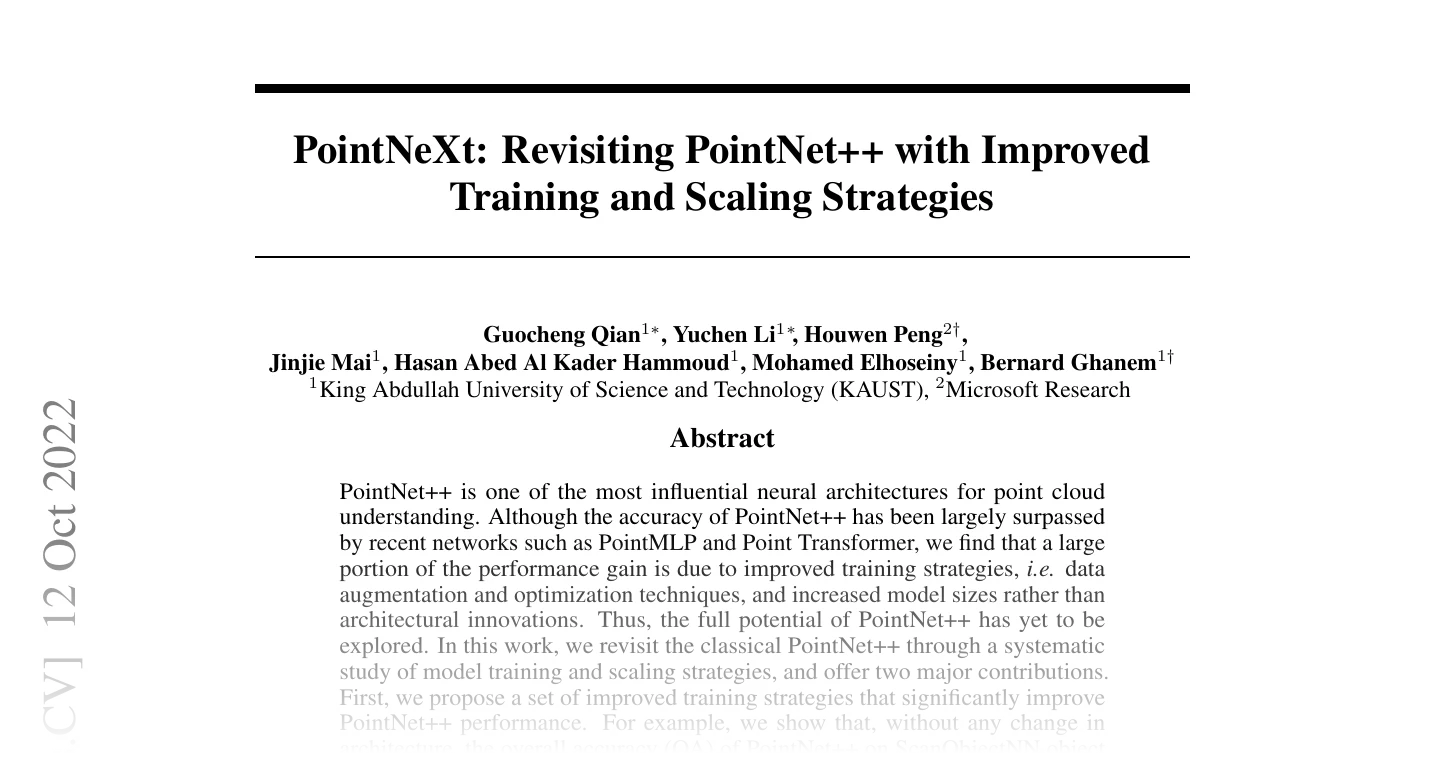
PointNeXt classification model as described in the paper PointNeXt: Revisiting PointNet++ with Improved Training and Scaling Strategies by Guocheng Qian, Yuchen Li, Houwen Peng, Jinjie Mai, Hasan Abed Al Kader Hammoud, Mohamed Elhoseiny, Bernard Ghanem.
PointNeXt modernizes PointNet++ through improved training strategies and architectural enhancements, achieving state-of-the-art performance while maintaining efficiency. The model introduces Inverted Residual MLP (InvResMLP) blocks, separable MLPs, and relative position normalization to enable effective model scaling.
Parameters:
-
in_channels(int) –Number of input channels (typically 3 for XYZ coordinates, or 6 for XYZ + RGB, or more with additional features like normal).
-
num_classes(int) –Number of output classes for classification.
-
stem_channels(Optional[Union[int, Sequence[int]]], default:None) –Number of channels in the stem MLP layer(s) that map input to higher dimension. If None, no stem is used.
-
encoder_channels(Sequence[int]) –Channel dimensions for each encoder block. The number of channels should be equal to the number of blocks + 1.
-
encoder_depths(Sequence[int]) –Number of blocks in each encoder stage after the initial SA block.
-
encoder_expansion(Union[int, Sequence[int]], default:4) –Expansion ratio to determine the hidden channels of the encoder blocks.
-
ratios(Sequence[float]) –Downsampling sampling ratios for each encoder stage. The number of ratios should be equal to the number of blocks.
-
radiuses(Sequence[Union[float, Sequence[float]]]) –Query radius for neighborhood grouping in each stage. The number of radiuses should be equal to the number of blocks + 1.
-
num_neighbors(Sequence[Union[int, Sequence[int]]]) –Maximum number of neighbors for each encoder stage. The number of num_neighbors should be equal to the number of blocks + 1.
-
add_self_loops(bool, default:False) –Whether to include the center point as its own neighbor in grouping operations.
-
spatial_dim(int, default:3) –Spatial dimensionality of point clouds (typically 3).
-
act(Union[str, Callable, None], default:'relu') –Activation function.
-
act_kwargs(Optional[Dict[str, Any]], default:None) –Additional arguments for the activation function.
-
act_first(bool, default:False) –Whether to apply activation before normalization.
-
norm(Union[str, Callable, None], default:'batch_norm') –Normalization layer type.
-
norm_kwargs(Optional[Dict[str, Any]], default:None) –Additional arguments for normalization layer.
-
bias(Union[bool, List[bool]], default:True) –Whether to use bias in linear / MLP layers.
-
dropout(float, default:0.0) –Dropout probability before the classification head.
-
global_pool(PoolLike, default:'max') –Global pooling operation for final feature aggregation.
Methods:
-
configure_stem–Build the stem MLP lifting the input features, or
Nonewhenstem_channelsis unset. -
configure_encoder–Build the
PointNeXtEncoderbackbone. -
configure_global_sa–Build the global set-abstraction applied before pooling, or
Nonewhenglobal_sa_channelsis unset.
Attributes:
-
num_features(int) –Feature dimension \(C\) fed to the classification head, after the optional global set-abstraction.
property

Feature dimension \(C\) fed to the classification head, after the optional global set-abstraction.
Build the stem MLP lifting the input features, or None when stem_channels is unset.
configure_global_sa() -> Optional[PointNeXtSetAbstraction]
Build the global set-abstraction applied before pooling, or None when global_sa_channels is unset.
PointNeXtSegmentation(
    in_channels: int,
    num_classes: int,
    *,
    stem_channels: Optional[
        Union[int, Sequence[int]]
    ] = None,
    stem_plain_last: bool = False,
    encoder_channels: Sequence[int],
    encoder_depths: Sequence[int],
    encoder_expansion: Union[int, Sequence[int]] = 4,
    sa_layers: int = 1,
    sa_use_res: bool = True,
    decoder_channels: Sequence[int],
    decoder_depths: Sequence[int],
    decoder_plain_last: bool = True,
    ratios: Sequence[float],
    radiuses: Sequence[Union[float, Sequence[float]]],
    num_neighbors: Sequence[Union[int, Sequence[int]]],
    add_self_loops: bool = False,
    spatial_dim: int = 3,
    act: Union[str, Callable, None] = "relu",
    act_kwargs: Optional[Dict[str, Any]] = None,
    act_first: bool = False,
    norm: Union[str, Callable, None] = "batch_norm",
    norm_kwargs: Optional[Dict[str, Any]] = None,
    bias: Union[bool, List[bool]] = True,
    dropout: float = 0.0,
    head_channels: Optional[Sequence[int]] = None,
)
Bases: SegmentationModel
PointNeXt segmentation model as described in the paper PointNeXt: Revisiting PointNet++ with Improved Training and Scaling Strategies by Guocheng Qian, Yuchen Li, Houwen Peng, Jinjie Mai, Hasan Abed Al Kader Hammoud, Mohamed Elhoseiny, Bernard Ghanem.
PointNeXt modernizes PointNet++ through improved training strategies and architectural enhancements, achieving state-of-the-art performance while maintaining efficiency. The model introduces Inverted Residual MLP (InvResMLP) blocks, separable MLPs, and relative position normalization to enable effective model scaling.
Parameters:
-
in_channels(int) –Number of input channels (typically 3 for XYZ coordinates, or 6 for XYZ + RGB, or more with additional features like normal).
-
num_classes(int) –Number of output classes for segmentation.
-
stem_channels(Optional[Union[int, Sequence[int]]], default:None) –Number of channels in the stem MLP layer(s) that map input to higher dimension. If None, no stem is used.
-
encoder_channels(Sequence[int]) –Channel dimensions for each encoder block. The number of channels should be equal to the number of blocks + 1.
-
encoder_depths(Sequence[int]) –Number of layers in each encoder block after the initial SA block.
-
encoder_expansion(Union[int, Sequence[int]], default:4) –Expansion ratio to determine the hidden channels of the encoder blocks.
-
decoder_channels(Sequence[int]) –Channel dimensions for each decoder block. The number of channels should be equal to the number of decoder blocks + 1.
-
decoder_depths(Sequence[int]) –Number of layers in each decoder stage.
-
ratios(Sequence[float]) –Downsampling sampling ratios for each encoder stage. The number of ratios should be equal to the number of blocks.
-
radiuses(Sequence[Union[float, Sequence[float]]]) –Query radius for neighborhood grouping in each stage. The number of radiuses should be equal to the number of blocks + 1.
-
num_neighbors(Sequence[Union[int, Sequence[int]]]) –Maximum number of neighbors for each encoder stage. The number of num_neighbors should be equal to the number of blocks + 1.
-
add_self_loops(bool, default:False) –Whether to include the center point as its own neighbor in grouping operations.
-
spatial_dim(int, default:3) –Spatial dimensionality of point clouds (typically 3).
-
act(Union[str, Callable, None], default:'relu') –Activation function.
-
act_kwargs(Optional[Dict[str, Any]], default:None) –Additional arguments for the activation function.
-
act_first(bool, default:False) –Whether to apply activation before normalization.
-
norm(Union[str, Callable, None], default:'batch_norm') –Normalization layer type.
-
norm_kwargs(Optional[Dict[str, Any]], default:None) –Additional arguments for normalization layer.
-
bias(Union[bool, List[bool]], default:True) –Whether to use bias in linear / MLP layers.
-
dropout(float, default:0.0) –Dropout probability before the classification head.
Methods:
-
configure_stem–Build the stem MLP lifting the input features, or
Nonewhenstem_channelsis unset. -
configure_encoder–Build the
PointNeXtEncoderbackbone. -
configure_decoder–Build the
PointNeXtDecoderupsampling the coarsest features back through the encoder skips.
Attributes:
-
num_features(int) –Feature dimension \(C\) of the decoder output.
Build the stem MLP lifting the input features, or None when stem_channels is unset.
configure_decoder() -> PointNeXtDecoder
Build the PointNeXtDecoder upsampling the coarsest features back through the encoder skips.