PointNet++
PointNet++ classification and segmentation models.
Classes:
-
PointNet2Encoder–PointNet++ encoder from the paper
-
PointNet2Decoder–PointNet++ decoder (feature propagation) from the paper
-
PointNet2Classification–PointNet++ classification model from the paper
-
PointNet2Segmentation–PointNet++ segmentation model from the paper
PointNet2Encoder(
    in_channels: int,
    sa_channels: Sequence[
        Sequence[Union[int, Sequence[int]]]
    ],
    *,
    ratios: Optional[Sequence[float]] = None,
    num_points: Optional[Sequence[int]] = None,
    radii: Sequence[Union[float, Sequence[float]]],
    num_neighbors: Sequence[Union[int, Sequence[int]]],
    stem_channels: Optional[int] = None,
    spatial_dim: int = 3,
    act: Union[str, Callable, None] = "relu",
    act_kwargs: Optional[Dict[str, Any]] = None,
    act_first: bool = False,
    norm: Union[str, Callable, None] = "batch_norm",
    norm_kwargs: Optional[Dict[str, Any]] = None,
    bias: bool = False,
    use_pos: bool = True,
    normalize_pos: bool = True,
    pos_first: bool = False,
    pool: PoolLike = "max",
    sort_neighbors: bool = False,
)
Bases: Module
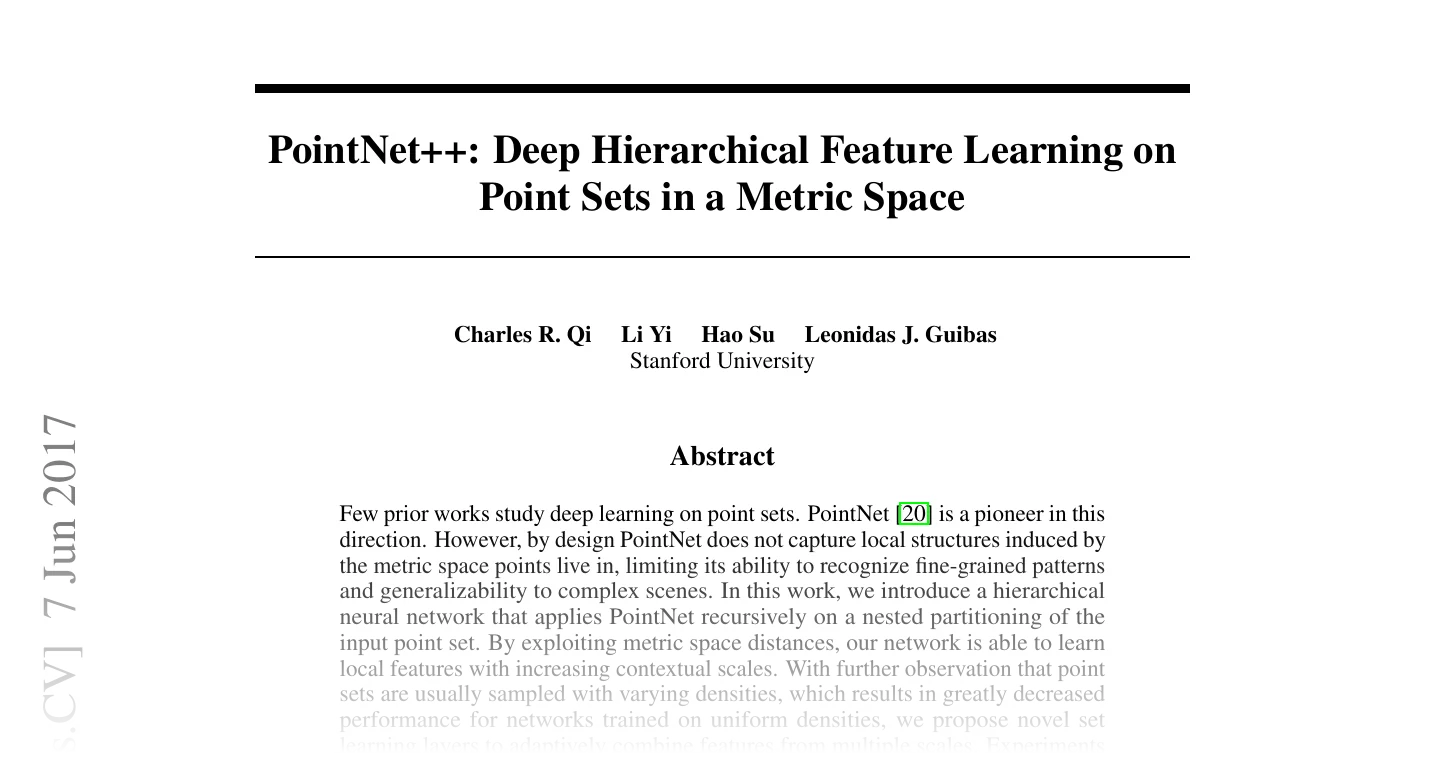
PointNet++ encoder from the paper PointNet++: Deep Hierarchical Feature Learning on Point Sets in a Metric Space by Charles R. Qi, Li Yi, Hao Su, Leonidas J. Guibas.
Processes raw point clouds through an optional linear stem followed by multiple Set Abstraction (SA) blocks that progressively downsample the points while learning local features using radius-based grouping. Each SA block can optionally use Multi-Scale Grouping (MSG).
Parameters:
-
in_channels(int) –Number of input channels (features per point).
-
sa_channels(Sequence[Sequence[Union[int, Sequence[int]]]]) –List of channel configurations for Set Abstraction (SA) blocks. Each element defines the MLP channels for one SA block. For Multi-Scale Grouping (MSG), provide nested lists of channels.
-
ratios(Optional[Sequence[float]], default:None) –Sampling ratios for each SA block (between 0 and 1). Mutually exclusive with
num_points. -
num_points(Optional[Sequence[int]], default:None) –Absolute number of sampled centroids for each SA block (e.g. PointRCNN's fixed \(4096, 1024, \ldots\)). Exactly one of
ratios/num_pointsmust be given. -
radii(Sequence[Union[float, Sequence[float]]]) –Search radiuses for each SA block's neighborhood. For MSG, provide a list of radii per block.
-
num_neighbors(Sequence[Union[int, Sequence[int]]]) –Max number of neighbors for each SA block. For MSG, provide a list of neighbor counts per block.
-
stem_channels(Optional[int], default:None) –Optional number of channels for initial linear projection.
-
spatial_dim(int, default:3) –Spatial dimensionality of point coordinates (e.g. 3 for 3D, 2 for 2D).
-
act(Union[str, Callable, None], default:'relu') –Activation function type or callable.
-
act_kwargs(Optional[Dict[str, Any]], default:None) –Additional keyword arguments for the activation function.
-
act_first(bool, default:False) –If
True, activation is applied before normalization. -
norm(Union[str, Callable, None], default:'batch_norm') –Normalization layer type or callable.
-
norm_kwargs(Optional[Dict[str, Any]], default:None) –Additional keyword arguments for the normalization layer.
-
bias(bool, default:False) –Whether to use bias in linear layers.
-
use_pos(bool, default:True) –Whether to concatenate per-point relative positions to
x. -
pos_first(bool, default:False) –Concatenate the relative positions before the grouped features (see
SAModule). -
pool(PoolLike, default:'max') –Pooling operation for SA blocks.
Attributes:
-
out_channels(int) –Output channels of the last SA block.
-
skip_channels(List[int]) –Skip-connection channel sizes (stem output + each SA output except the last), ordered
PointNet2Decoder(
    in_channels: int,
    skip_channels: Sequence[int],
    fp_channels: Sequence[Sequence[int]],
    *,
    spatial_dim: int = 3,
    act: Union[str, Callable, None] = "relu",
    act_kwargs: Optional[Dict[str, Any]] = None,
    act_first: bool = False,
    norm: Union[str, Callable, None] = "batch_norm",
    norm_kwargs: Optional[Dict[str, Any]] = None,
    bias: bool = False,
    k: Optional[Union[int, Sequence[int]]] = None,
    weighting: Literal["squared", "inverse"] = "squared",
    eps: float = 1e-16,
)
Bases: Module
PointNet++ decoder (feature propagation) from the paper PointNet++: Deep Hierarchical Feature Learning on Point Sets in a Metric Space by Charles R. Qi, Li Yi, Hao Su, Leonidas J. Guibas.
Upsamples features from the encoder back to the original resolution using kNN interpolation and skip connections from encoder intermediates.
Parameters:
-
in_channels(int) –Number of input channels from the encoder (or aggregation) output.
-
skip_channels(Sequence[int]) –Channel sizes for skip connections at each level, ordered from coarsest to finest resolution.
-
fp_channels(Sequence[Sequence[int]]) –List of channel configurations for Feature Propagation (FP) blocks. Each element defines the MLP channels for one FP block.
-
spatial_dim(int, default:3) –Spatial dimensionality of point coordinates. Also used as the default number of neighbors
kfor kNN interpolation in all but the first FP block. -
act(Union[str, Callable, None], default:'relu') –Activation function type or callable.
-
act_kwargs(Optional[Dict[str, Any]], default:None) –Additional keyword arguments for the activation function.
-
act_first(bool, default:False) –If
True, activation is applied before normalization. -
norm(Union[str, Callable, None], default:'batch_norm') –Normalization layer type or callable.
-
norm_kwargs(Optional[Dict[str, Any]], default:None) –Additional keyword arguments for the normalization layer.
-
bias(bool, default:False) –Whether to use bias in linear layers.
-
k(Optional[Union[int, Sequence[int]]], default:None) –Number of neighbors for kNN interpolation, per FP block when a sequence. Defaults to
1for the first (deepest) block andspatial_dimfor the remaining blocks.
PointNet2Classification(
    in_channels: int,
    num_classes: int,
    *,
    stem_channels: Optional[int] = None,
    sa_channels: Sequence[
        Sequence[Union[int, Sequence[int]]]
    ],
    aggr_channels: Optional[
        Union[int, Sequence[int]]
    ] = None,
    aggr_use_pos: bool = False,
    head_channels: Optional[
        Union[int, Sequence[int]]
    ] = None,
    ratios: Sequence[float],
    radii: Sequence[Union[float, Sequence[float]]],
    num_neighbors: Sequence[Union[int, Sequence[int]]],
    spatial_dim: int = 3,
    act: Union[str, Callable, None] = "relu",
    act_kwargs: Optional[Dict[str, Any]] = None,
    act_first: bool = False,
    norm: Union[str, Callable, None] = "batch_norm",
    norm_kwargs: Optional[Dict[str, Any]] = None,
    bias: bool = False,
    use_pos: bool = True,
    normalize_pos: bool = True,
    pool: PoolLike = "max",
    dropout: Union[float, Sequence[float]] = 0.0,
    global_pool: PoolLike = "max",
)
Bases: ClassificationModel
PointNet++ classification model from the paper PointNet++: Deep Hierarchical Feature Learning on Point Sets in a Metric Space by Charles R. Qi, Li Yi, Hao Su, Leonidas J. Guibas.
This network is a hierarchical point cloud classification model. It processes raw point clouds through
a PointNet2Encoder (optional stem + SA blocks), an optional aggregation MLP, global pooling,
and a classification head.
Parameters:
-
in_channels(int) –Number of input channels (features per point).
-
num_classes(int) –Number of output classes.
-
stem_channels(Optional[int], default:None) –Optional number of channels for initial linear projection (inside the encoder).
-
sa_channels(Sequence[Sequence[Union[int, Sequence[int]]]]) –List of channel configurations for Set Abstraction (SA) blocks. Each element defines the MLP channels for one SA block. For Multi-Scale Grouping (MSG), provide nested lists of channels.
-
aggr_channels(Optional[Union[int, Sequence[int]]], default:None) –Channel sizes for the post-encoder aggregation MLP.
-
ratios(Sequence[float]) –Sampling ratios for each SA block (between 0 and 1).
-
radii(Sequence[Union[float, Sequence[float]]]) –Search radiuses for each SA block's neighborhood. For MSG, provide a list of radii per block.
-
num_neighbors(Sequence[Union[int, Sequence[int]]]) –Max number of neighbors for each SA block. For MSG, provide a list of neighbor counts per block.
-
spatial_dim(int, default:3) –Spatial dimensionality of point coordinates (e.g. 3 for 3D, 2 for 2D).
-
act(Union[str, Callable, None], default:'relu') –Activation function type or callable.
-
act_kwargs(Optional[Dict[str, Any]], default:None) –Additional keyword arguments for the activation function.
-
act_first(bool, default:False) –If
True, activation is applied before normalization. -
norm(Union[str, Callable, None], default:'batch_norm') –Normalization layer type or callable.
-
norm_kwargs(Optional[Dict[str, Any]], default:None) –Additional keyword arguments for the normalization layer.
-
bias(bool, default:False) –Whether to use bias in linear layers.
-
use_pos(bool, default:True) –Whether to concatenate per-point relative positions to
x. -
pool(PoolLike, default:'max') –Pooling operation for SA blocks.
-
dropout(Union[float, Sequence[float]], default:0.0) –Dropout for the classification head: a single rate shared by every hidden layer, or one rate per hidden layer.
-
global_pool(PoolLike, default:'max') –Global pooling operation.
Methods:
-
configure_encoder–Build the
PointNet2Encoderbackbone. -
configure_aggr–Build the aggregation MLP applied to the encoder output, or
Nonewhenaggr_channelsis unset.
Attributes:
-
num_features(int) –Feature dimension \(C\) of the encoder output, after the optional aggregation MLP.
PointNet2Segmentation(
    in_channels: int,
    num_classes: int,
    *,
    stem_channels: Optional[int] = None,
    sa_channels: Sequence[
        Sequence[Union[int, Sequence[int]]]
    ],
    aggr_channels: Optional[
        Union[int, Sequence[int]]
    ] = None,
    fp_channels: Sequence[Sequence[int]],
    head_channels: Optional[
        Union[int, Sequence[int]]
    ] = None,
    ratios: Sequence[float],
    radii: Sequence[Union[float, Sequence[float]]],
    num_neighbors: Sequence[Union[int, Sequence[int]]],
    spatial_dim: int = 3,
    act: Union[str, Callable, None] = "relu",
    act_kwargs: Optional[Dict[str, Any]] = None,
    act_first: bool = False,
    norm: Union[str, Callable, None] = "batch_norm",
    norm_kwargs: Optional[Dict[str, Any]] = None,
    bias: bool = False,
    use_pos: bool = True,
    normalize_pos: bool = True,
    pool: PoolLike = "max",
    dropout: float = 0.0,
    skip_input: bool = True,
    fp_k: Optional[Union[int, Sequence[int]]] = None,
)
Bases: SegmentationModel
PointNet++ segmentation model from the paper PointNet++: Deep Hierarchical Feature Learning on Point Sets in a Metric Space by Charles R. Qi, Li Yi, Hao Su, Leonidas J. Guibas.
This network is a hierarchical point cloud segmentation model built from a
PointNet2Encoder (optional stem + SA blocks), an optional aggregation MLP,
a PointNet2Decoder (FP blocks with skip connections), and a per-point
classification head.
Parameters:
-
in_channels(int) –Number of input channels (features per point).
-
num_classes(int) –Number of output classes.
-
stem_channels(Optional[int], default:None) –Optional number of channels for initial linear projection (inside the encoder).
-
sa_channels(Sequence[Sequence[Union[int, Sequence[int]]]]) –List of channel configurations for Set Abstraction (SA) blocks. Each element defines the MLP channels for one SA block. For Multi-Scale Grouping (MSG), provide nested lists of channels.
-
aggr_channels(Optional[Union[int, Sequence[int]]], default:None) –Channel sizes for the post-encoder aggregation MLP.
-
fp_channels(Sequence[Sequence[int]]) –List of channel configurations for Feature Propagation (FP) blocks. Each element defines the MLP channels for one FP block.
-
ratios(Sequence[float]) –Sampling ratios for each SA block (between 0 and 1).
-
radii(Sequence[Union[float, Sequence[float]]]) –Search radiuses for each SA block's neighborhood. For MSG, provide a list of radii per block.
-
num_neighbors(Sequence[Union[int, Sequence[int]]]) –Max number of neighbors for each SA block. For MSG, provide a list of neighbor counts per block.
-
spatial_dim(int, default:3) –Spatial dimensionality of point coordinates (e.g. 3 for 3D, 2 for 2D).
-
act(Union[str, Callable, None], default:'relu') –Activation function type or callable.
-
act_kwargs(Optional[Dict[str, Any]], default:None) –Additional keyword arguments for the activation function.
-
act_first(bool, default:False) –If
True, activation is applied before normalization. -
norm(Union[str, Callable, None], default:'batch_norm') –Normalization layer type or callable.
-
norm_kwargs(Optional[Dict[str, Any]], default:None) –Additional keyword arguments for the normalization layer.
-
bias(bool, default:False) –Whether to use bias in linear layers.
-
use_pos(bool, default:True) –Whether to concatenate per-point relative positions to
x. -
pool(PoolLike, default:'max') –Pooling operation for SA blocks.
-
dropout(float, default:0.0) –Dropout rate for classification head.
Methods:
-
configure_encoder–Build the
PointNet2Encoderbackbone. -
configure_aggr–Build the aggregation MLP applied to the encoder output, or
Nonewhenaggr_channelsis unset. -
configure_decoder–Build the
PointNet2Decoderupsampling the coarsest features back through the encoder skips.
Attributes:
-
num_features(int) –Feature dimension \(C\) of the decoder output.
Build the aggregation MLP applied to the encoder output, or None when aggr_channels is unset.
configure_decoder() -> PointNet2Decoder
Build the PointNet2Decoder upsampling the coarsest features back through the encoder skips.