Point-Mamba
Point-Mamba classification and masked autoencoder pretraining models.
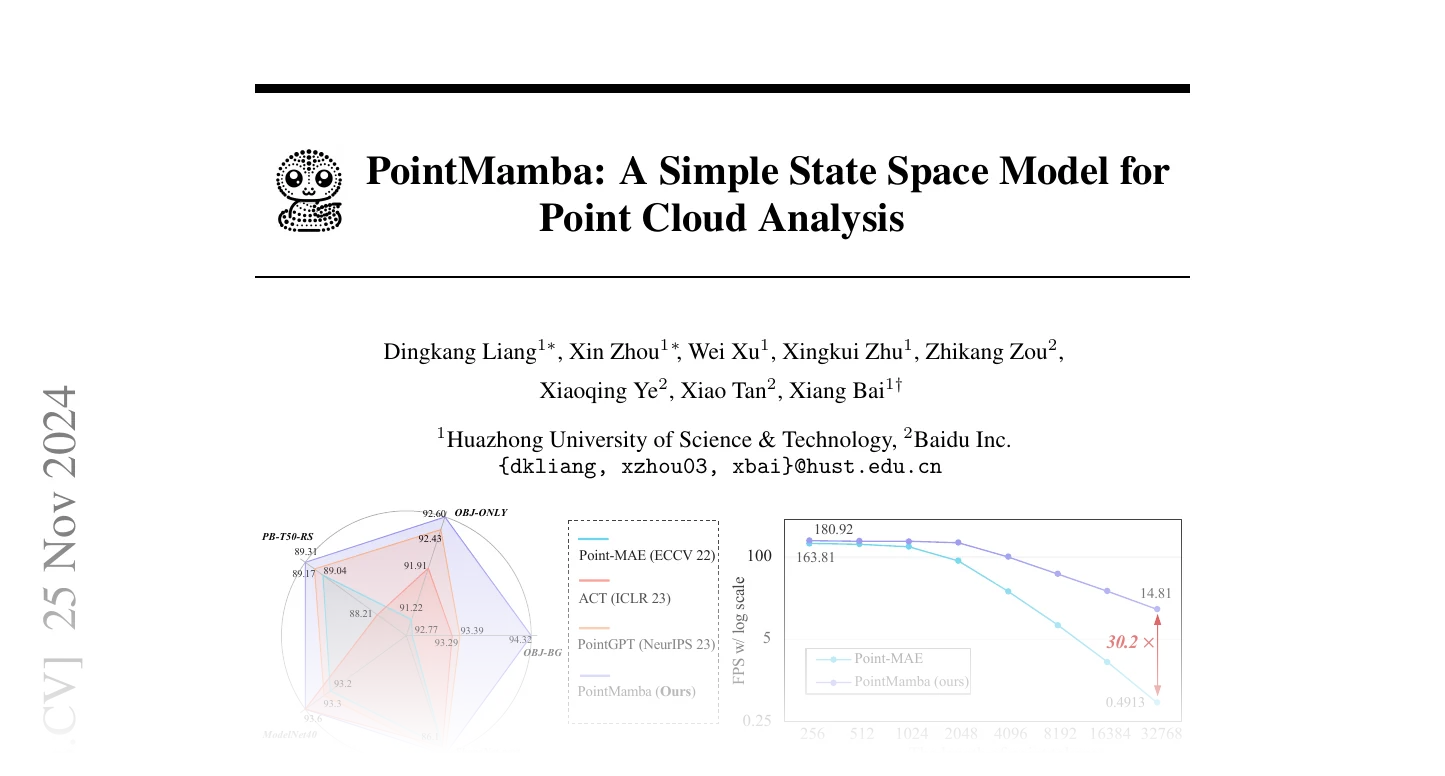
Classes:
-
PointMambaEncoderMAE–PointMamba encoder for masked-autoencoder pre-training.
-
PointMambaDecoderMAE–PointMamba decoder for masked-autoencoder pre-training.
-
PointMambaClassification– -
PointMambaMAE–PointMamba masked-autoencoder pre-training model, as described in the paper PointMamba: A Simple State Space Model for Point Cloud Analysis.
Functions:
-
order_sort–Sort points along a space-filling curve, so a state space model scans spatially close points in sequence.
PointMambaEncoderMAE(
    in_channels: int,
    embed_dim: int,
    depth: int,
    num_group: int,
    group_size: int,
    mask_ratio: float,
    drop_path: float = 0.0,
    spatial_dim: int = 3,
    patch_local_channels: Sequence[int] = (128, 256),
    patch_global_channels: Sequence[int] = (512,),
    pos_embed_channels: Sequence[int] = (128,),
    act: Union[str, Callable, None] = "relu",
    act_kwargs: Optional[Dict[str, Any]] = None,
    act_first: bool = False,
    norm: Union[str, Callable, None] = "batch_norm",
    norm_kwargs: Optional[Dict[str, Any]] = None,
    bias: Union[bool, List[bool]] = True,
)
Bases: Module
PointMamba encoder for masked-autoencoder pre-training.
Embeds patches, serializes them along a randomly chosen Hilbert or Trans-Hilbert curve, masks a fraction of the patch tokens, and processes only the visible tokens with the Mamba blocks. The forward pass returns a dict with the visible-token features, the densified patch positions and reconstruction targets, and the visible / masked token indices.
Parameters:
-
in_channels(int) –The number of input channels.
-
embed_dim(int) –The number of token channels.
-
depth(int) –The number of Mamba blocks.
-
num_group(int) –The number of patches to sample.
-
group_size(int) –The number of neighbors to consider for each patch.
-
mask_ratio(float) –The fraction of patch tokens to mask.
-
drop_path(float, default:0.0) –The maximum stochastic-depth rate, linearly scaled across the Mamba blocks.
-
spatial_dim(int, default:3) –The dimension of the spatial features.
-
patch_local_channels(Sequence[int], default:(128, 256)) –Hidden widths of the patch embedder's per-point MLP.
-
patch_global_channels(Sequence[int], default:(512,)) –Hidden widths of the patch embedder's per-patch MLP.
-
pos_embed_channels(Sequence[int], default:(128,)) –Hidden widths of the positional-embedding MLP.
-
act(Union[str, Callable, None], default:'relu') –The activation function to use.
-
act_kwargs(Optional[Dict[str, Any]], default:None) –The keyword arguments to pass to the activation function.
-
act_first(bool, default:False) –Whether to apply the activation function before the normalization.
-
norm(Union[str, Callable, None], default:'batch_norm') –The normalization function to use.
-
norm_kwargs(Optional[Dict[str, Any]], default:None) –The keyword arguments to pass to the normalization function.
-
bias(Union[bool, List[bool]], default:True) –Whether to use bias in the MLPs.
Shape
- Input: \((N, C_\text{in})\) features (or
None), \((N, 3)\) coordinates, and a \((N,)\) batch index. - Output: a dict with
x_vis\((B, V, C)\),pos_dense\((B, P, 3)\),target_pos_dense\((B, P, M, 3)\),mask_idx\((B, P - V)\),vis_idx\((B, V)\), and the number of patches \(P\).
PointMambaDecoderMAE(
    embed_dim: int,
    depth: int,
    drop_path: float,
    spatial_dim: int = 3,
    pos_embed_channels: Sequence[int] = (128,),
    bias: Union[bool, List[bool]] = True,
)
Bases: Module
PointMamba decoder for masked-autoencoder pre-training.
Scatters the visible-token features into a full-length sequence of learnable mask tokens, adds the positional embedding of every patch center, and refines the sequence with a stack of Mamba blocks.
Parameters:
-
embed_dim(int) –The number of token channels.
-
depth(int) –The number of Mamba blocks.
-
drop_path(float) –The maximum stochastic-depth rate, linearly scaled across the Mamba blocks.
-
spatial_dim(int, default:3) –The dimension of the spatial features.
-
pos_embed_channels(Sequence[int], default:(128,)) –Hidden widths of the positional-embedding MLP.
-
bias(Union[bool, List[bool]], default:True) –Whether to use bias in the MLPs.
Shape
- Input:
x_vis\((B, V, C)\),pos_dense\((B, P, 3)\), andids_keep\((B, V)\). - Output: \((B, P, C)\).
PointMambaClassification(
    in_channels: int,
    num_classes: int,
    *,
    embed_dim: int = 384,
    depth: int = 12,
    num_group: int = 64,
    group_size: int = 32,
    drop_path: float = 0.1,
    use_cls_token: bool = False,
    spatial_dim: int = 3,
    patch_local_channels: Sequence[int] = (128, 256),
    patch_global_channels: Sequence[int] = (512,),
    pos_embed_channels: Sequence[int] = (128,),
    act: Union[str, Callable, None] = "relu",
    act_kwargs: Optional[Dict[str, Any]] = None,
    act_first: bool = False,
    norm: Union[str, Callable, None] = "batch_norm",
    norm_kwargs: Optional[Dict[str, Any]] = None,
    bias: Union[bool, List[bool]] = True,
    dropout: float = 0.5,
    global_pool: AdaptivePoolLike = "mean",
    head_channels: Optional[
        Union[int, Sequence[int]]
    ] = None,
)
Bases: ClassificationModel
Methods:
-
configure_encoder–Build the
PointMambaEncoderbackbone.
Attributes:
-
num_features(int) –Channel count \(C\) of the pooled features entering the head.
PointMambaMAE(
    in_channels: int,
    *,
    embed_dim: int = 384,
    encoder_depth: int = 12,
    decoder_depth: int = 4,
    num_group: int = 64,
    group_size: int = 32,
    mask_ratio: float = 0.6,
    drop_path: float = 0.1,
    spatial_dim: int = 3,
    patch_local_channels: Sequence[int] = (128, 256),
    patch_global_channels: Sequence[int] = (512,),
    pos_embed_channels: Sequence[int] = (128,),
    act: Union[str, Callable, None] = "relu",
    act_kwargs: Optional[Dict[str, Any]] = None,
    act_first: bool = False,
    norm: Union[str, Callable, None] = "batch_norm",
    norm_kwargs: Optional[Dict[str, Any]] = None,
    bias: Union[bool, List[bool]] = True,
)
Bases: BaseModel
PointMamba masked-autoencoder pre-training model, as described in the paper PointMamba: A Simple State Space Model for Point Cloud Analysis. This implementation is adapted from the official repository LMD0311/PointMamba.
Masks a fraction of the serialized patch tokens, encodes the visible tokens with Mamba blocks,
reconstructs the masked patches' relative coordinates with a Mamba decoder and a linear head, and
returns the predicted and target patch coordinates for a set-to-set reconstruction objective such
as chamfer_distance from torch_pointcloud.losses.
Parameters:
-
in_channels(int) –The number of input channels.
-
embed_dim(int, default:384) –The number of token channels.
-
encoder_depth(int, default:12) –The number of encoder Mamba blocks.
-
decoder_depth(int, default:4) –The number of decoder Mamba blocks.
-
num_group(int, default:64) –The number of patches to sample.
-
group_size(int, default:32) –The number of neighbors to consider for each patch.
-
mask_ratio(float, default:0.6) –The fraction of patch tokens to mask.
-
drop_path(float, default:0.1) –The maximum stochastic-depth rate, linearly scaled across the Mamba blocks.
-
spatial_dim(int, default:3) –The dimension of the spatial features.
-
patch_local_channels(Sequence[int], default:(128, 256)) –Hidden widths of the patch embedder's per-point MLP.
-
patch_global_channels(Sequence[int], default:(512,)) –Hidden widths of the patch embedder's per-patch MLP.
-
pos_embed_channels(Sequence[int], default:(128,)) –Hidden widths of the positional-embedding MLPs.
-
act(Union[str, Callable, None], default:'relu') –The activation function to use.
-
act_kwargs(Optional[Dict[str, Any]], default:None) –The keyword arguments to pass to the activation function.
-
act_first(bool, default:False) –Whether to apply the activation function before the normalization.
-
norm(Union[str, Callable, None], default:'batch_norm') –The normalization function to use.
-
norm_kwargs(Optional[Dict[str, Any]], default:None) –The keyword arguments to pass to the normalization function.
-
bias(Union[bool, List[bool]], default:True) –Whether to use bias in the MLPs.
Shape
- Input: \((N, C_\text{in})\) features (or
None), \((N, 3)\) coordinates, and a \((N,)\) batch index. - Output: predicted and target patches, each of shape \((B \cdot M_\text{mask}, \text{group\_size}, 3)\).
Methods:
-
configure_encoder–Build the
PointMambaEncoderMAEbackbone, which encodes only the visible patches. -
configure_decoder–Build the
PointMambaDecoderMAEthat reconstructs the masked patches.
configure_encoder() -> PointMambaEncoderMAE
Build the PointMambaEncoderMAE backbone, which encodes only the visible patches.
configure_decoder() -> PointMambaDecoderMAE
Build the PointMambaDecoderMAE that reconstructs the masked patches.
Sort points along a space-filling curve, so a state space model scans spatially close points in sequence.
Parameters:
-
pos_grid(Tensor) –Non-negative integer grid coordinates of shape \((N, 3)\).
-
batch(Tensor) –Per-point batch index of shape \((N,)\).
-
order(SerializationOrder) –Space-filling curve to encode the coordinates along.
Returns:
-
Tensor–The permutation of shape \((N,)\) that sorts the points by their serialization code.
Raises:
-
ValueError–If
pos_gridholds a negative coordinate, which would silently wrap around to a valid code.