Object Detection
Open in Colab · Download notebook
Object detection predicts one oriented 3D box per object: a center, an extent and a heading, plus a class and a score. Boxes are packed like points, \((K, 7)\) rows of \((c_x, c_y, c_z, d_x, d_y, d_z, \theta)\) with a batch index naming the scene each box belongs to. \(\theta\) is counter-clockwise about \(+z\) from \(+x\), and axis-aligned detectors leave it at zero.
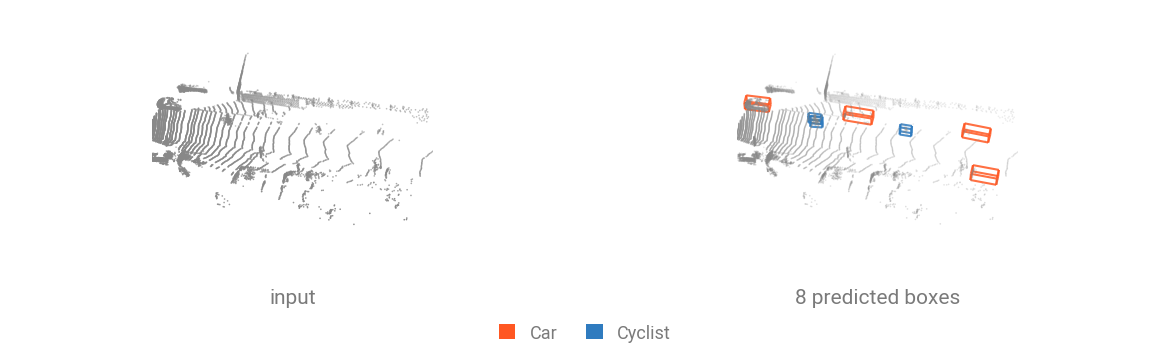
Run a pretrained checkpoint
Download the sample_driving.ply (264 kB) to get started. This is a KITTI lidar frame with reflectance.
curl -LO https://github.com/arthurdjn/pytorch-pointcloud/raw/main/docs/assets/data/sample_driving.ply
The registered transform associated with the checkpoint (with return_info=True) provides the preprocessing used for evaluation and benchmarking on the associated dataset. The forward method returns raw proposals and decode turns them into boxes. NMS and score thresholding are done in the evaluation protocol such that you can customize it.
import numpy as np
import torch
from plyfile import PlyData

import torch_pointcloud as tp
from torch_pointcloud.utils.box3d import nms3d
from torch_pointcloud.utils.data import DataKeys, collate

# Load the pretrained model
model, info = tp.create_model(
    "pointpillars.kitti.openpcdet",
    task="detection",
    pretrained=True,
    return_info=True,
)
model = model.cuda().eval()

# Get associated transform
transform = info["transform"]

# Load the sample frame
ply = PlyData.read("sample_driving.ply")["vertex"]
pos = np.stack([ply["x"], ply["y"], ply["z"]], 1).astype("float32")
intensity = np.asarray(ply["intensity"]).astype("float32")[:, None]

sample = {"pos": torch.from_numpy(pos), "intensity": torch.from_numpy(intensity)}
sample = transform(sample)

# Collate the sample into a batch, keeping the pillars packed
data = collate([sample], cat_keys=[DataKeys.POS_VOXEL])
print(f"Data keys: {data.keys()}")

# Inference pass
with torch.no_grad():
    out = model(
        data["voxel"].cuda(),
        data["pos_voxel"].cuda(),
        data["voxel_num_points"].cuda(),
        data["batch_pos_voxel"].cuda(),
    )

# Decode the raw proposals into boxes
det = model.decode(out)
boxes, scores, labels, index = det["boxes"], det["scores"], det["labels"], det["batch"]
print(f"Boxes shape: {tuple(boxes.shape)}")

# Cut the low scores, then deduplicate what is left
keep = (scores > 0.1).nonzero().squeeze(-1)
keep = keep[nms3d(boxes[keep], scores[keep], 0.01, batch=index[keep], rotated=True)]
print(f"Kept boxes: {len(keep)}")

# Report the confident ones
classes = info["weights"]["classes"]
for i in keep[scores[keep] > 0.5]:
    box = boxes[i]
    print(f"{classes[int(labels[i])]:>12}  {scores[i]:.2f}  center=({box[0]:.2f}, {box[1]:.2f}, {box[2]:.2f})  yaw={box[6]:.2f}")

# Data keys: dict_keys(['pos', 'intensity', 'x', 'voxel', 'pos_voxel', 'voxel_num_points', 'batch', 'batch_pos_voxel'])
# Boxes shape: (321408, 7)
# Kept boxes: 17
#          Car  0.94  center=(8.30, 5.00, -0.87)  yaw=3.16
#          Car  0.93  center=(24.25, 5.41, -0.83)  yaw=3.11
#          Car  0.89  center=(45.08, -2.77, -0.62)  yaw=6.23
#      Cyclist  0.84  center=(32.00, 3.62, -0.62)  yaw=3.11
#          Car  0.80  center=(42.77, 5.07, -0.73)  yaw=3.07
#      Cyclist  0.77  center=(18.10, 2.97, -0.74)  yaw=3.23
#          Car  0.76  center=(4.41, -2.60, -0.94)  yaw=6.29
#      Cyclist  0.74  center=(17.73, 3.61, -0.81)  yaw=3.14
An anchor-based head scores every anchor of its grid, so decode returns 321 408 boxes: the score cut leaves 218, rotated NMS at IoU 0.01 collapses those to 17, and the eight most confident are the ones the figure draws. The yaw values are non-zero, since KITTI annotates oriented boxes.
Inputs and outputs
Voxel-based detectors read the pillar / voxel layout their registered transform produces, one argument per tensor it writes.
| Argument | Shape | Description |
|---|---|---|
voxel |
\((V, P, C)\) | Points gathered per voxel, zero-padded to \(P\) slots |
pos_voxel |
\((V, 3)\) | Integer voxel-grid coordinates |
voxel_num_points |
\((V,)\) | How many of the \(P\) slots each voxel actually fills |
batch |
\((V,)\) | Index tensor associating each voxel to its scene |
| returns | dict of tensors | The raw head outputs, which model.decode(...) turns into boxes |
decode returns a packed dict: boxes \((K, 7)\), scores \((K,)\), labels \((K,)\) and a batch index \((K,)\) naming the scene each box came from.
Indoor detectors read points instead, which changes the call but not the output.
| Family | Checkpoints | Call |
|---|---|---|
| Point-based (indoor) | votenet.*, 3detr*, pointrcnn.* |
model(x, pos, batch) |
| Voxel-based (driving) | pointpillars.*, second.*, voxelnext.*, lion-* |
model(voxel, pos_voxel, voxel_num_points, batch_voxel) |
Collating a batch
cat_keys keeps a ragged per-scene key packed and emits a matching batch_<key> index. Voxel counts vary per scene, so pos_voxel collates that way and arrives with batch_pos_voxel; ground-truth boxes vary too, so box arrives with batch_box.
from pathlib import Path

import torch_pointcloud as tp
import torch_pointcloud.transforms as T
from torch_pointcloud.config import DATA_DIR
from torch_pointcloud.datasets import KITTI
from torch_pointcloud.datasets.kitti import KITTI_CLASSES
from torch_pointcloud.utils.data import DataKeys, PointCloudDataLoader

model, info = tp.create_model(
    "pointpillars.kitti.openpcdet",
    task="detection",
    pretrained=True,
    return_info=True,
)
model = model.cuda().eval()

# The dataset annotates every KITTI class, the checkpoint predicts three of them
classes = info["weights"]["classes"]
relabel = T.RelabelBoxes(
    keys=["box", "label"],
    mapping={KITTI_CLASSES.index(name): i for i, name in enumerate(classes)},
)

dataset = KITTI(
    root=DATA_DIR,
    train=True,
    split_file=Path(DATA_DIR, "KITTI", "raw", "ImageSets", "val.txt"),
    transform=T.Compose([relabel, info["transform"]]),
)
dataloader = PointCloudDataLoader(
    dataset,
    batch_size=4,
    num_workers=4,
    cat_keys=[DataKeys.BOX, DataKeys.POS_VOXEL],
)

data = next(iter(dataloader))
print(f"Box shape: {tuple(data['box'].shape)}")
print(f"Batch box shape: {tuple(data['batch_box'].shape)}")
print(f"Voxel shape: {tuple(data['voxel'].shape)}")
Evaluate on a dataset
You will find several utilities in torch_pointcloud.utils.metrics to score the predictions. mean_average_precision3d scores every class at one IoU, and average_precision3d gives each class its own threshold, as KITTI requires: Car at 0.7, Pedestrian and Cyclist at 0.5, over the 11-point recall grid.
import torch
from tqdm.auto import tqdm

from torch_pointcloud.utils.box3d import nms3d
from torch_pointcloud.utils.metrics import average_precision3d

preds, targets = [], []
with torch.no_grad():
    for data in tqdm(dataloader, desc="Evaluating"):
        out = model(
            data["voxel"].cuda(),
            data["pos_voxel"].cuda(),
            data["voxel_num_points"].cuda(),
            data["batch_pos_voxel"].cuda(),
        )
        det = model.decode(out)
        boxes, scores = det["boxes"], det["scores"]
        labels, index = det["labels"], det["batch"]

        keep = (scores > 0.1).nonzero().squeeze(-1)
        keep = keep[nms3d(boxes[keep], scores[keep], 0.01, batch=index[keep], rotated=True)]
        preds.append({
            "boxes": boxes[keep].cpu(),
            "scores": scores[keep].cpu(),
            "labels": labels[keep].cpu(),
            "batch": index[keep].cpu(),
        })
        targets.append({
            "boxes": data["box"],
            "labels": data["label"],
            "batch": data["batch_box"],
        })

metrics = average_precision3d(
    preds,
    targets,
    iou_per_class={0: 0.7, 1: 0.5, 2: 0.5},
    class_names=classes,
    interpolation="r11",
)
print({name: round(value * 100, 2) for name, value in metrics.items()})

# {'AP/Car': 66.82, 'AP/Pedestrian': 46.7, 'AP/Cyclist': 55.6, 'mAP': 56.37}
The published number needs the difficulty rules too
KITTI scores its moderate split only: RelabelBoxes turns Van and Person_sitting into ignore regions and downgrades boxes past the occlusion, truncation and 2D-height limits, and predictions projecting to under 25 px are dropped. examples/pointpillars_benchmark_detection.py is this loop with those rules in place.
Train from scratch
While provides various models and utils, you still own the whole training loop. Detection targets come from transforms, and the loss rebuilds the anchor grid from the same geometry the head uses.
import copy

import torch
from tqdm.auto import tqdm

import torch_pointcloud as tp
import torch_pointcloud.transforms as T
from torch_pointcloud.datasets.kitti import KITTI_CLASSES
from torch_pointcloud.losses import AnchorLoss
from torch_pointcloud.utils.data import DataKeys, PointCloudDataLoader

device = "cuda"
voxel_size = (0.16, 0.16, 4.0)
point_cloud_range = (0.0, -39.68, -3.0, 69.12, 39.68, 1.0)

# Constructing a KITTI pays for validating the whole frame cache, so share the one built
# above and give the copy its own relabel. The rest of the pipeline is the checkpoint's.
train_dataset = copy.copy(dataset)
train_dataset.transform = T.Compose([
    T.RelabelBoxes(
        keys=["box", "label", "truncation", "occlusion", "bbox_height"],
        mapping={KITTI_CLASSES.index(name): i for i, name in enumerate(classes)},
        ignore_fields={"occlusion": (None, 1), "truncation": (None, 0.3), "bbox_height": (25, None)},
    ),
    info["transform"],
])
train_dataloader = PointCloudDataLoader(
    train_dataset,
    batch_size=4,
    shuffle=True,
    num_workers=8,
    cat_keys=[DataKeys.BOX, DataKeys.POS_VOXEL],
)

# Create the desired model, criterion and optimizer
model = tp.create_model("pointpillars.kitti.openpcdet", task="detection").to(device)
criterion = AnchorLoss(
    num_classes=3,
    voxel_size=voxel_size,
    point_cloud_range=point_cloud_range,
    anchor_sizes=[[3.9, 1.6, 1.56], [0.8, 0.6, 1.73], [1.76, 0.6, 1.73]],
    anchor_bottom_heights=[-1.78, -0.6, -0.6],
    feature_map_stride=2,
    matched_thresholds=[0.6, 0.5, 0.5],
    unmatched_thresholds=[0.45, 0.35, 0.35],
).to(device)
optimizer = torch.optim.AdamW(
    model.parameters(),
    lr=3e-3,
    weight_decay=0.01,
)

# Training loop
num_epochs = 1  # a demo pass, raise it to actually train

model.train()
for epoch in range(num_epochs):
    total_loss = 0.0
    pbar = tqdm(enumerate(train_dataloader), total=len(train_dataloader), desc=f"Epoch {epoch}")
    for i, data in pbar:
        data = {k: v.to(device) if torch.is_tensor(v) else v for k, v in data.items()}

        optimizer.zero_grad()
        out = model(data["voxel"], data["pos_voxel"], data["voxel_num_points"], data["batch_pos_voxel"])
        loss = criterion(out, data)["loss"]

        loss.backward()
        optimizer.step()
        total_loss += loss.item()
        if (i + 1) % 10 == 0:
            pbar.set_postfix({"train/loss_step": f"{loss.item():.3f}"})

    loss_epoch = total_loss / len(train_dataloader)
    print(f"Loss epoch {epoch}: {loss_epoch:.3f}")
Train and evaluation relabel differently
The training transform maps Car, Pedestrian and Cyclist to \(0, 1, 2\) and stops there. Evaluation adds ignore_mapping={1: 0, 4: 1} so Van and Person_sitting become ignore regions; at training those rows would enter the anchor targets as real Car and Pedestrian ground truth.