Skip to content

ModelsΒΆ

pytorch-pointcloud-mini - torch-pointcloud Project mark of torch-pointcloud. Arthur Dujardin Copyright (c) 2024-2026 Arthur Dujardin https://github.com/arthurdjn/pytorch-pointcloud torch-pointcloud ships architectures for point cloud classification, semantic and part segmentation, object detection and self-supervised pretraining, behind one timm-style factory:

import torch_pointcloud as tp

model = tp.create_model("pointnext-sm.scanobjectnn-hardest.openpoints", pretrained=True)
tp.list_models(task="classification", pretrained=True)  # or "semantic-segmentation", "detection", ...

Weights are downloaded from the Hugging Face Hub on first use and cached under ~/.cache/torch-pointcloud/models (TORCH_POINTCLOUD_CACHE_DIR moves the cache). Each checkpoint keeps the license of its source, listed on the task pages, and a few are restricted to non-commercial use: see THIRD_PARTY_NOTICES.md.
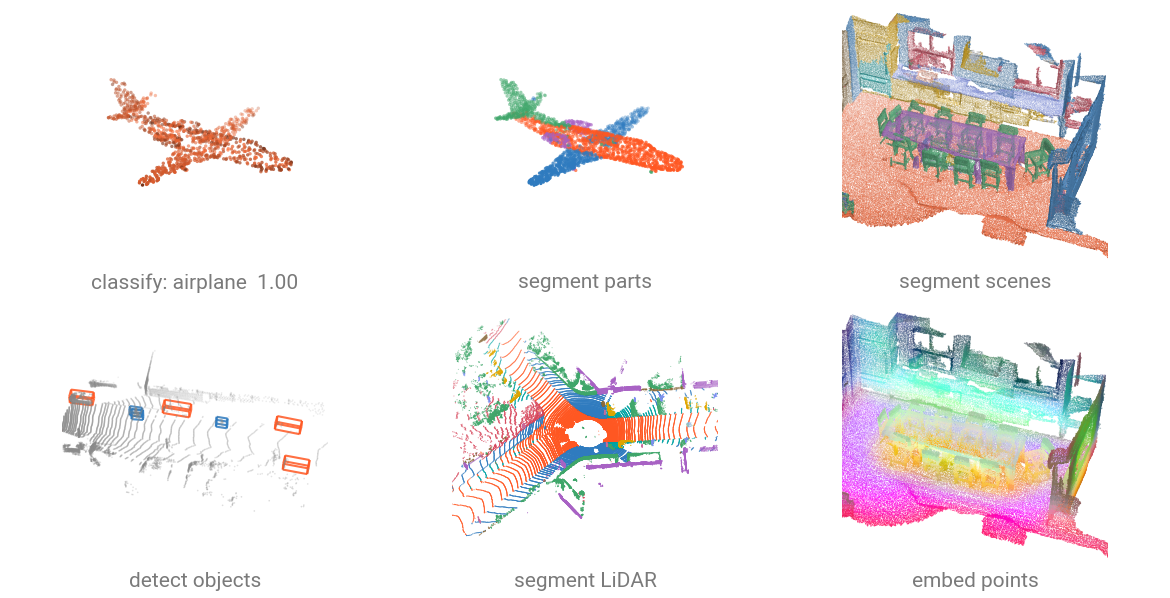
Five pretrained checkpoints on two committed sample clouds: object classification, part segmentation, scene segmentation, 3D detection, and LiDAR segmentation

TasksΒΆ

  • Classification

    One label per cloud: run, evaluate and fine-tune a classifier.

  • Semantic segmentation

    One label per point: voxelization, full-resolution predictions, mIoU.

  • Part segmentation

    Category-conditioned part labels and the ShapeNetPart protocol.

  • Object detection

    Oriented boxes: decode, filter with NMS, score with mAP.

  • Feature maps

    The representation under the head: embeddings, retrieval, PCA.

ScoresΒΆ

Every pretrained checkpoint is evaluated with the protocol of its reference implementation. The plot compares the measured score with the published one, and each task page lists the numbers.

3030404050506060707080809090100100Β±1 pointReference scoreMeasured score

ArchitecturesΒΆ

ClassificationΒΆ

Best for shape classification (ModelNet40, ScanObjectNN, ShapeNet objects). Inputs are single object scans, outputs are scene-level class predictions.

SegmentationΒΆ

Best for dense per-point labeling (S3DIS, ScanNet, SemanticKITTI). Inputs are large scenes, outputs are per-point class predictions.

Model Year Checkpoints
PointNet
PointNet: Deep Learning on Point Sets for 3D Classification and Segmentation
2016 –
PointNet++
PointNet++: Deep Hierarchical Feature Learning on Point Sets in a Metric Space
2017 7
DGCNN
Dynamic Graph CNN for Learning on Point Clouds
2018 7
PointCNN
PointCNN: Convolution On \(\mathcal{X}\)-Transformed Points
2018 –
KPConv
KPConv: Flexible and Deformable Convolution for Point Clouds
2019 8
PVCNN
Point-Voxel CNN for Efficient 3D Deep Learning
2019 3
PVCNN++
Point-Voxel CNN for Efficient 3D Deep Learning
2019 2
RandLA-Net
RandLA-Net: Efficient Semantic Segmentation of Large-Scale Point Clouds
2019 6
SpUNet
4D Spatio-Temporal ConvNets: Minkowski Convolutional Neural Networks
2019 1
Point Transformer V1
Point Transformer
2020 1
SPVCNN
Searching Efficient 3D Architectures with Sparse Point-Voxel Convolution
2020 3
Point Transformer V2
Point Transformer V2: Grouped Vector Attention and Partition-based Pooling
2022 –
PointMLP
Rethinking Network Design and Local Geometry in Point Cloud: A Simple Residual MLP Framework
2022 –
PointNeXt
PointNeXt: Revisiting PointNet++ with Improved Training and Scaling Strategies
2022 23
SPFormer-UNet
Superpoint Transformer for 3D Scene Instance Segmentation
2022 1
OctFormer
OctFormer: Octree-based Transformers for 3D Point Clouds
2023 2
Point Transformer V3
Point Transformer V3: Simpler, Faster, Stronger
2023 4
SphereFormer
Spherical Transformer for LiDAR-based 3D Recognition
2023 –
Concerto
Concerto: Joint 2D-3D Self-Supervised Learning Emerges Spatial Representations
2025 1
Sonata
Sonata: Self-Supervised Learning of Reliable Point Representations
2025 1
Utonia
Utonia: Toward One Encoder for All Point Clouds
2026 1

Part segmentationΒΆ

Best for object parts (ShapeNetPart). Inputs are single objects and their category, outputs are per-point part labels.

DetectionΒΆ

Predict 3D bounding boxes for indoor scenes (ScanNet, SUN RGB-D) or driving scenes (KITTI, nuScenes, Waymo).

Self-supervised pretrainingΒΆ

Backbones pretrained without labels, registered with task="pretraining"; the fine-tuned classification / segmentation heads are registered under their downstream task.