Train a model
Open in Colab · Download notebook
This notebook will guide you on how to train a model using torch-pointcloud and raw PyTorch, and at the end how to wrap it in PyTorch Lightning.
Models from torch-pointcloud are plain nn.Modules that take packed tensors, so there is no framework to learn: a standard PyTorch training loop works as-is.
Setup
# On Colab:
# !pip install "torch-pointcloud"
# !pip install pyg-lib -f https://data.pyg.org/whl/torch-2.10.0+cu128.html
import torch

import torch_pointcloud as tp
import torch_pointcloud.transforms as T
from torch_pointcloud.utils.data import PointCloudDataLoader

DEVICE = "cuda" if torch.cuda.is_available() else "cpu"
NUM_POINTS = 1024
BATCH_SIZE = 32
EPOCHS = 5

torch.manual_seed(0)
DEVICE
Data
ModelNet40 ships CAD meshes, so the transform samples points on the faces and normalizes the result. The train transform adds augmentation on top, while the validation transform stays deterministic so validation numbers are comparable across epochs.
from torch_pointcloud.datasets import ModelNet40

val_transform = T.Compose([
    T.Rescale(keys="pos", method="centroid"),
    T.RandomSampleFaceVertices(keys="pos", face_key="face", num_samples=NUM_POINTS),
    T.KeepItems(keys=["pos", "normal", "label"]),
])
train_transform = T.Compose([
    val_transform,
    T.RandomScale(keys="pos", scale_range=(0.8, 1.2)),
    T.RandomJitter(keys="pos", sigma=0.01, clip=0.05),
])

train_dataset = ModelNet40(root="data", train=True, transform=train_transform, download=True)
val_dataset = ModelNet40(root="data", train=False, transform=val_transform, download=True)
print(f"Train dataset: {len(train_dataset):,} | Val dataset: {len(val_dataset):,}")
Packed batches
Point clouds have different point counts, so batches are packed: every cloud is concatenated along axis 0 and a batch index tags each point with the cloud it came from. Here we use the torch_pointcloud.utils.data.PointCloudDataLoader dataloader, which is a DataLoader with a custom collate function used to pack input data.
train_dataloader = PointCloudDataLoader(train_dataset, batch_size=BATCH_SIZE, shuffle=True, drop_last=True)
val_dataloader = PointCloudDataLoader(val_dataset, batch_size=BATCH_SIZE, shuffle=False)

data = next(iter(train_dataloader))
{k: tuple(v.shape) for k, v in data.items() if torch.is_tensor(v)}
# {'pos': (32768, 3), 'normal': (32768, 3), 'label': (32,), 'batch': (32768,)}
pos is \((N, 3)\) with \(N = 32 \times 1024\) points from 32 clouds, batch is \((N,)\), and label is \((B,)\): one class per cloud.
Model
Next we use create_model to instantiate a model with a registered architecture. pretrained=False (the default) gives random weights. You can of course instantiate the model from the class itself: it is a standard nn.Module, and is recommended for training from scratch because it makes the instantiation explicit (no **kwargs forwarded).
from torch_pointcloud.models import PointNet2Classification


model = PointNet2Classification(
        in_channels=0,
        num_classes=40,
        sa_channels=[[64, 64, 128], [128, 128, 256]],
        aggr_channels=[256, 512, 1024],
        aggr_use_pos=True,
        head_channels=[512, 256],
        ratios=[0.5, 0.25],
        radii=[0.2, 0.4],
        num_neighbors=[32, 64],
        use_pos=True,
        normalize_pos=False,
        bias=True,
        dropout=0.4,
).to(DEVICE)
print(f"{sum(p.numel() for p in model.parameters()) / 1e6:.2f}M parameters")
print("signature: model(x, pos, batch)")
print("in_channels:", model.in_channels, "| num_classes:", model.num_classes)
Classification models take (x, pos, batch) and return \((B, C)\) logits. This configuration has in_channels = 0, meaning it learns from geometry alone, so x is None. A model configured with in_channels = 6 would instead receive 6 input channels, for example x = torch.cat([pos, normal], dim=1).
Optimizer, scheduler, loss
torch_pointcloud.optim adds what torch.optim does not ship: generate_param_groups splits the parameters into optimizer groups, here with no weight decay on the biases and normalization weights, and CosineWarmupLR is a cosine decay with a linear warm-up. The schedule is stepped once per iteration, so its length is counted in batches.
from torch_pointcloud.optim import CosineWarmupLR, generate_param_groups

optimizer = torch.optim.AdamW(generate_param_groups(model, weight_decay=1e-4, no_decay=True), lr=1e-3)
scheduler = CosineWarmupLR(
    optimizer,
    total_steps=EPOCHS * len(train_dataloader),
    warmup_steps=len(train_dataloader),
)
criterion = torch.nn.CrossEntropyLoss()
The training loop
The training loop is plain PyTorch:
from tqdm.auto import tqdm


def train_one_epoch(model, dataloader, optimizer, scheduler, criterion, device):
    model.train()
    total_loss, total_correct, total_seen = 0.0, 0, 0

    for data in tqdm(dataloader, desc="Training"):
        pos = data["pos"].to(device)
        batch = data["batch"].to(device)
        target = data["label"].to(device)

        optimizer.zero_grad()
        logits = model(None, pos, batch)
        loss = criterion(logits, target)
        loss.backward()
        optimizer.step()
        scheduler.step()

        total_loss += loss.item() * target.numel()
        total_correct += int(logits.argmax(dim=1).eq(target).sum())
        total_seen += target.numel()

    return {"loss": total_loss / total_seen, "acc": total_correct / total_seen}
@torch.no_grad()
def evaluate(model, dataloader, criterion, device):
    model.eval()
    total_loss, total_correct, total_seen = 0.0, 0, 0

    for data in tqdm(dataloader, desc="Evaluating"):
        pos = data["pos"].to(device)
        batch = data["batch"].to(device)
        target = data["label"].to(device)

        logits = model(None, pos, batch)
        total_loss += criterion(logits, target).item() * target.numel()
        total_correct += int(logits.argmax(dim=1).eq(target).sum())
        total_seen += target.numel()

    return {"loss": total_loss / total_seen, "acc": total_correct / total_seen}
history = []

for epoch in range(EPOCHS):
    train_metrics = train_one_epoch(model, train_dataloader, optimizer, scheduler, criterion, DEVICE)
    val_metrics = evaluate(model, val_dataloader, criterion, DEVICE)
    history.append({"epoch": epoch + 1, "train": train_metrics, "val": val_metrics})
    print(
        f"epoch {epoch + 1}/{EPOCHS}"
        f" | train loss {train_metrics['loss']:.3f} acc {train_metrics['acc']:.3f}"
        f" | val loss {val_metrics['loss']:.3f} acc {val_metrics['acc']:.3f}"
    )
import matplotlib.pyplot as plt

epochs = [entry["epoch"] for entry in history]

_, axes = plt.subplots(1, 2, figsize=(10.0, 4.0))
for ax, key, name in zip(axes, ("loss", "acc"), ("loss", "accuracy")):
    ax.plot(epochs, [entry["train"][key] for entry in history], marker="o", label="train")
    ax.plot(epochs, [entry["val"][key] for entry in history], marker="o", label="val")
    ax.set(xlabel="epoch", ylabel=name)
    ax.set_xticks(epochs)
    ax.legend(frameon=False, fontsize=9)
    ax.spines["top"].set_visible(False)
    ax.spines["right"].set_visible(False)
plt.show()
Where the errors are
Overall accuracy says nothing about which of the 40 classes go wrong. A confusion matrix does: replay the validation split through the trained model and count how often each true class lands on each predicted one.
confusion_matrix from torch_pointcloud.metrics scores one batch; the matrices add up, so summing them over the loader scores the whole split, and accuracy reads the total.
import matplotlib.pyplot as plt

from torch_pointcloud.metrics import confusion_matrix

cm = torch.zeros(40, 40, dtype=torch.long)

model.eval()
with torch.no_grad():
    for data in tqdm(val_dataloader, desc="Confusion matrix"):
        logits = model(None, data["pos"].to(DEVICE), data["batch"].to(DEVICE))
        cm += confusion_matrix(logits.argmax(dim=1).cpu(), data["label"], num_classes=40)

rows = cm / cm.sum(dim=1, keepdim=True).clamp(min=1)

_, ax = plt.subplots(figsize=(11.0, 10.0))
image = ax.imshow(rows, cmap="Oranges", vmin=0.0, vmax=1.0)
ax.set_xticks(range(40), val_dataset.classes, rotation=90, fontsize=8)
ax.set_yticks(range(40), val_dataset.classes, fontsize=8)
ax.set(xlabel="predicted", ylabel="true")
plt.colorbar(image, ax=ax, label="fraction of a true class")
plt.show()
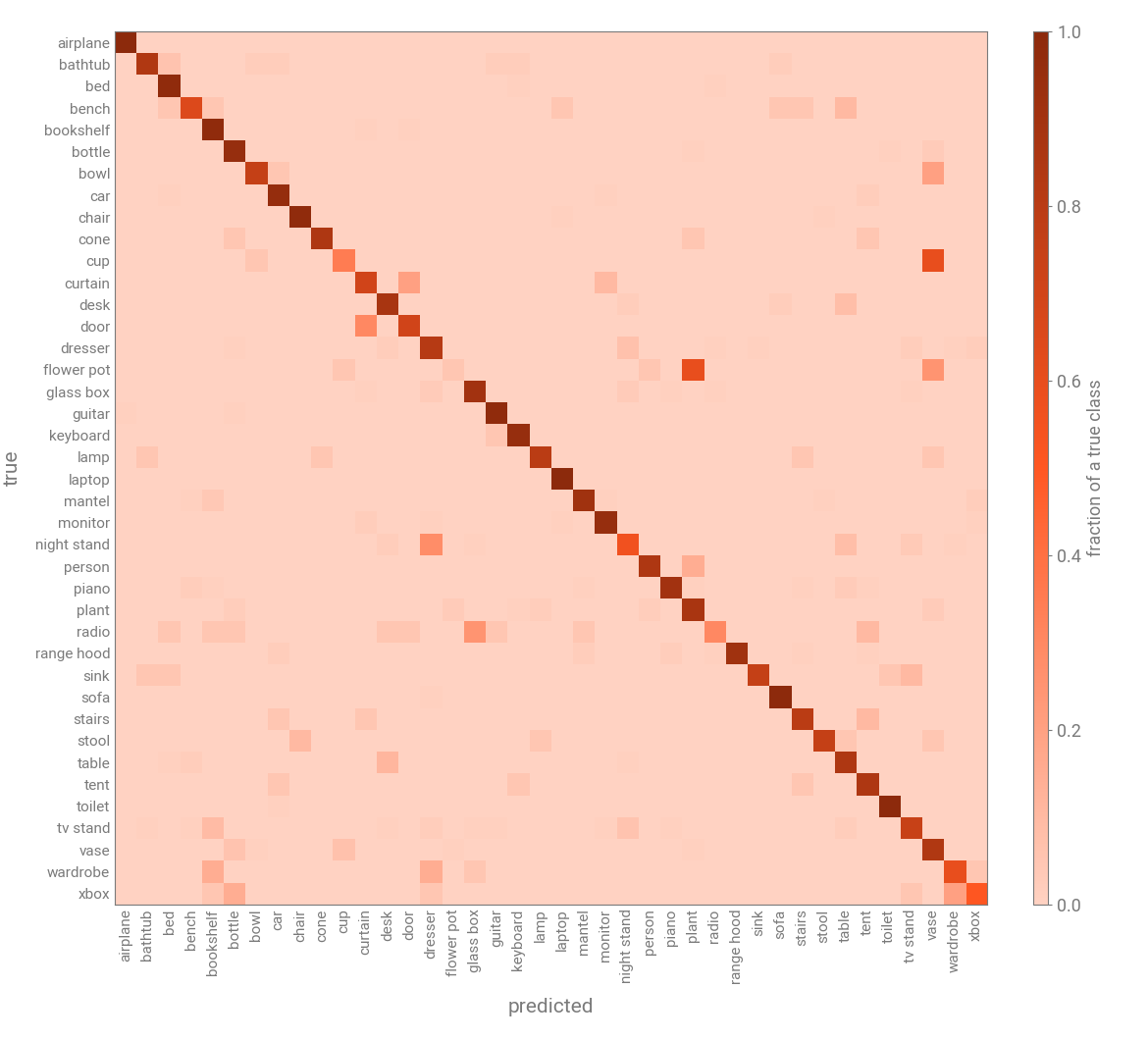
Every row is one true class and sums to 1, so the diagonal is that class's recall and the bright cells beside it are where its meshes went instead. The bright off-diagonal cells fall on the near-duplicate categories: ModelNet40 keeps plant and flower_pot, desk and table, dresser and night_stand as separate classes, and 1024 sampled points do not always tell them apart.
from torch_pointcloud.metrics import accuracy

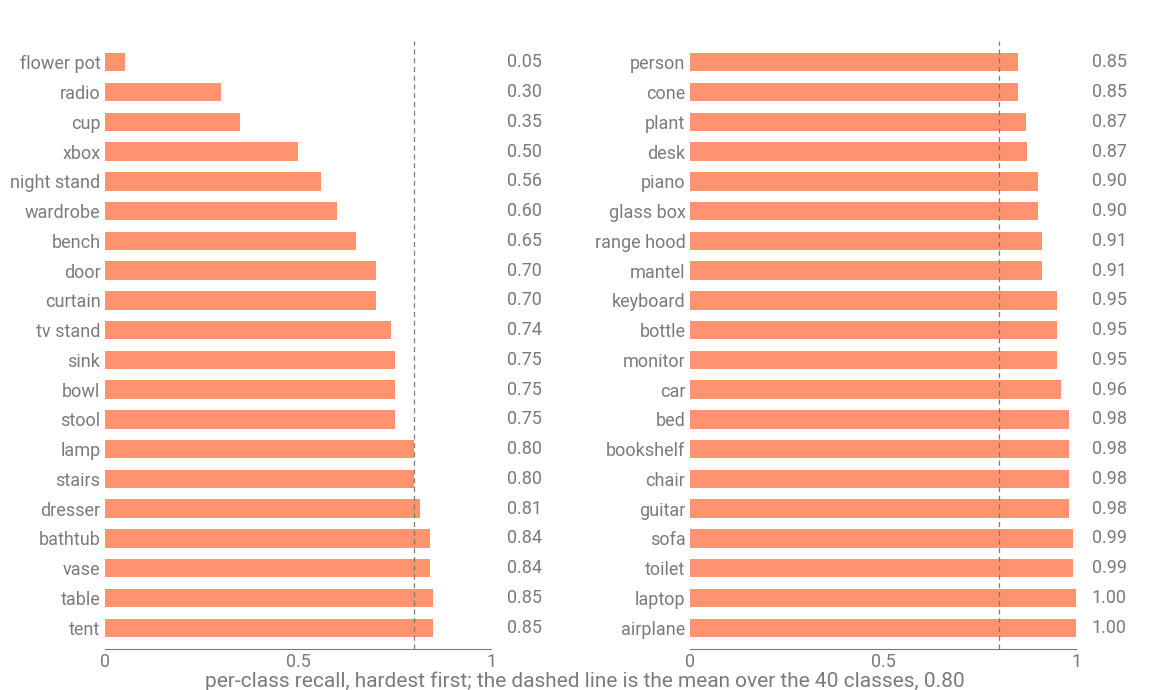
# Per class, the accuracy is the recall: the correct points of a class over all the points that truly belong to it.
class_acc = accuracy(cm, average="none", class_names=val_dataset.classes)
ranked = sorted(class_acc.items(), key=lambda entry: entry[1])
mean_class_acc = accuracy(cm, average="macro")

print(f"overall {accuracy(cm):.3f} | mean per class {mean_class_acc:.3f}")
for name, value in ranked[:5]:
    print(f"{name:<12} {value:.2f}")

_, ax = plt.subplots(figsize=(7.0, 9.0))
ax.barh([name for name, _ in ranked], [value for _, value in ranked], height=0.7)
ax.axvline(mean_class_acc, linewidth=0.9, linestyle="--")
ax.invert_yaxis()
ax.set(xlabel="recall", xlim=(0, 1))
plt.show()
Save and reload
Weights are a plain state_dict. Reload them into a fresh architecture built by the same create_model call.
torch.save(model.state_dict(), "pointnet2_modelnet40.pt")

reloaded = tp.create_model("pointnet2-ssg.modelnet40.xu-yan", task="classification")
reloaded.load_state_dict(torch.load("pointnet2_modelnet40.pt", weights_only=True))
reloaded.eval();
The same run with Lightning
Everything above is the loop Lightning would otherwise write for you. The lightning extra (pip install "torch-pointcloud[lightning]") provides two wrappers:
PointCloudDataModulebuilds the packed loaders from the datasets.LitClassificationModeltakes the same model namecreate_modeldoes, and owns the loop, the logging and the checkpointing. The optimizer and the scheduler are passed as factories; the scheduler is stepped once per epoch, soCosineWarmupLRcounts epochs here.
from functools import partial

import lightning.pytorch as L
from torchmetrics.classification import MulticlassAccuracy

from torch_pointcloud.lightning import LitClassificationModel, MetricCallback, PointCloudDataModule
from torch_pointcloud.optim import CosineWarmupLR

datamodule = PointCloudDataModule(
    train_dataset=train_dataset,
    val_dataset=val_dataset,
    batch_size=BATCH_SIZE,
    num_workers=0,
)
lit = LitClassificationModel(
    "pointnet2-ssg.modelnet40.xu-yan",
    optimizer=partial(torch.optim.AdamW, lr=1e-3, weight_decay=1e-4),
    scheduler=partial(CosineWarmupLR, total_steps=EPOCHS, warmup_steps=1),
    target_key="label",
)

trainer = L.Trainer(
    max_epochs=EPOCHS,
    accelerator="auto",
    logger=False,
    enable_checkpointing=False,
    callbacks=[MetricCallback(MulticlassAccuracy(num_classes=40), name="acc")],
)
trainer.fit(lit, datamodule=datamodule)
trainer.validate replays the validation loop on its own, printing the same val/loss and val/acc the plain loop computed by hand.