utils
Transforms that rename, copy, convert or combine the entries of a sample dict, and element-wise arithmetic.
Classes:
-
SetValue–Set values for keys in the dictionary, creating or overwriting them.
-
ToFloat–Cast dictionary tensor entries to float32.
-
ToDevice–Convert dictionary tensor entries to the given device.
-
Relabel–Remap integer labels in dictionary entries via a lookup table.
-
RenameItems–Rename keys in the dictionary.
-
CopyItems–Copy values from source keys to new destination keys.
-
ToTensor–Convert dictionary entries to tensors.
-
OnesLike–Adds a tensor of ones shaped like existing dictionary entries.
-
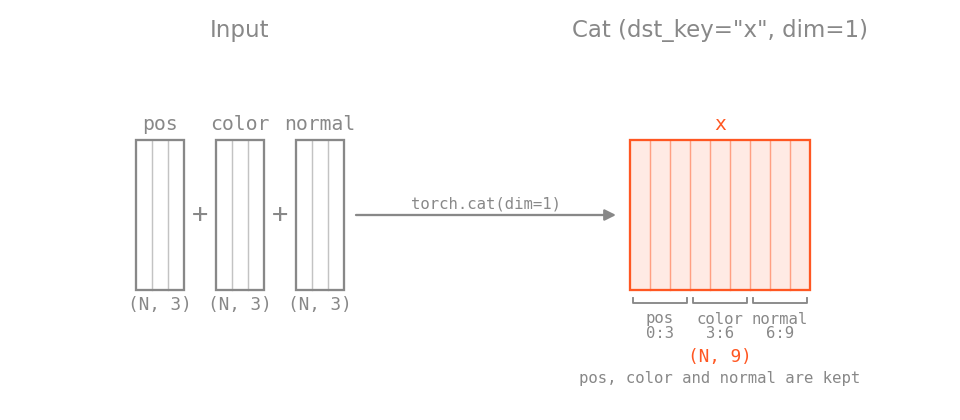
Cat–Concatenates tensors from multiple keys into a single feature tensor.
-
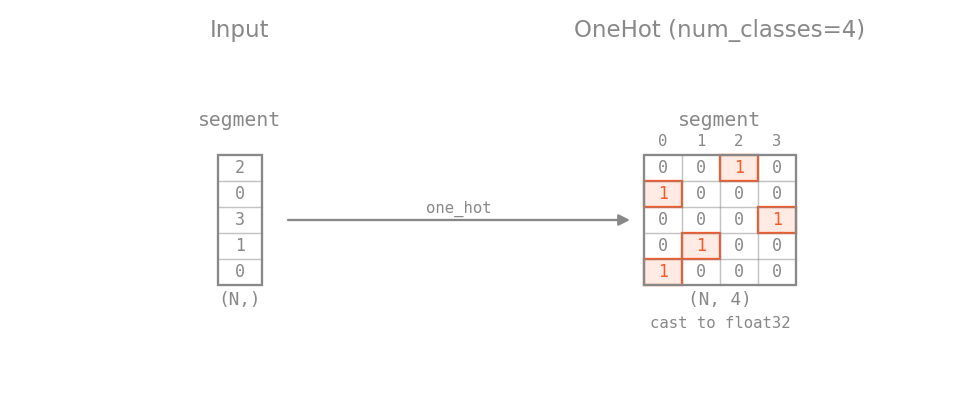
OneHot–One-hot encode integer-class tensors.
-
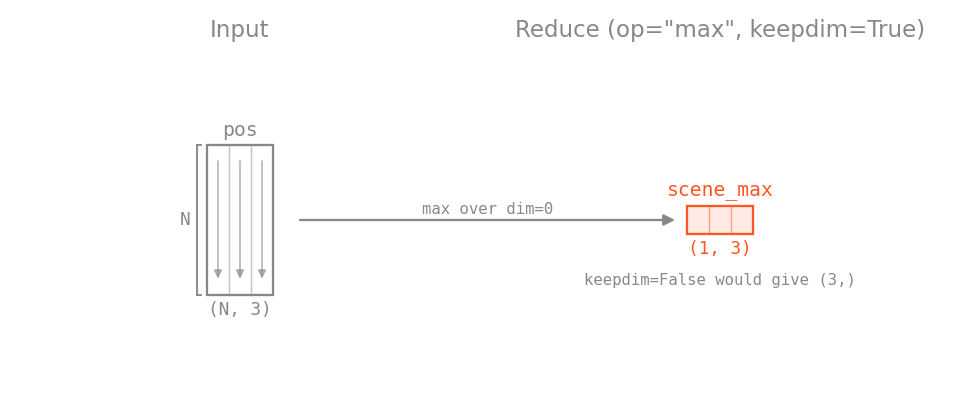
Reduce–Reduce a tensor along a dimension and store the scalar/vector result.
-
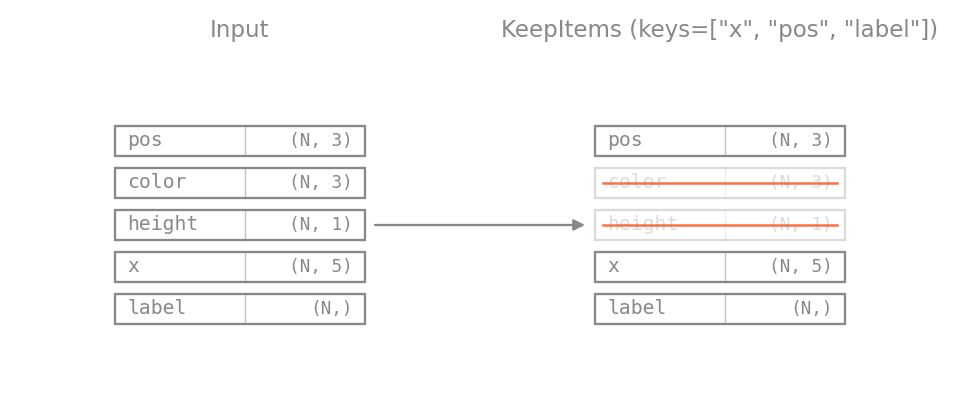
KeepItems–Keep only items in the data dictionary that are in the keys list.
-
Scale–Multiply dictionary tensor entries by a scale factor.
-
Divide–Divide dictionary tensor entries by a divisor.
-
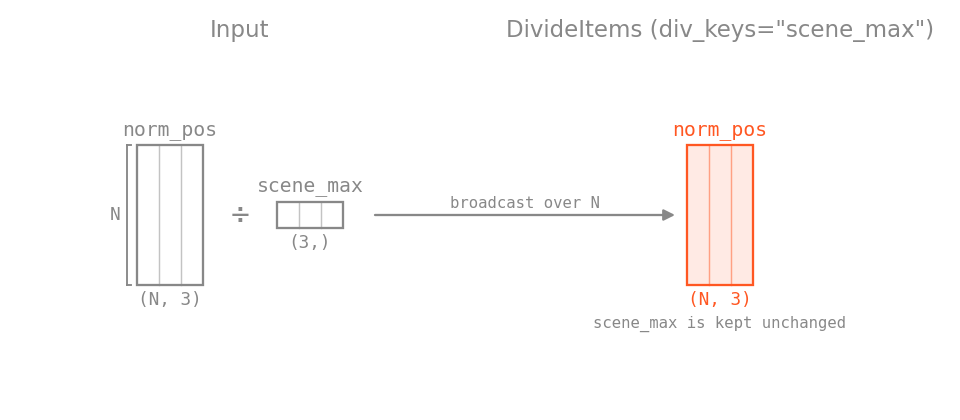
DivideItems–Divide target keys by the value of a reference key element-wise.
-
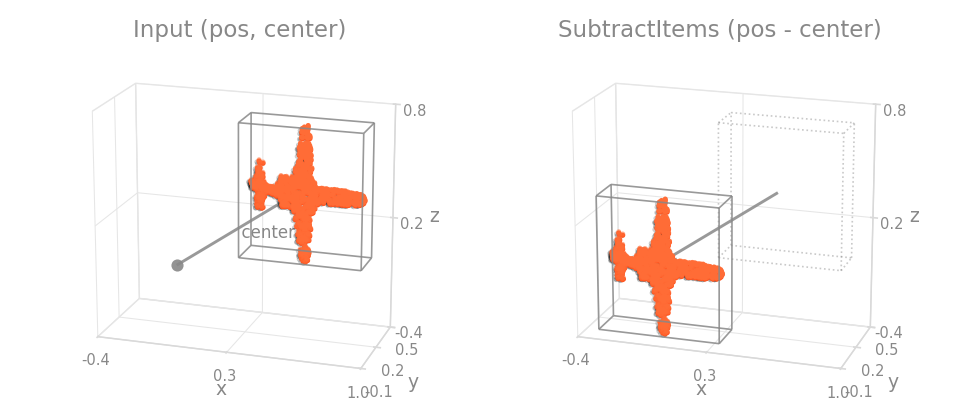
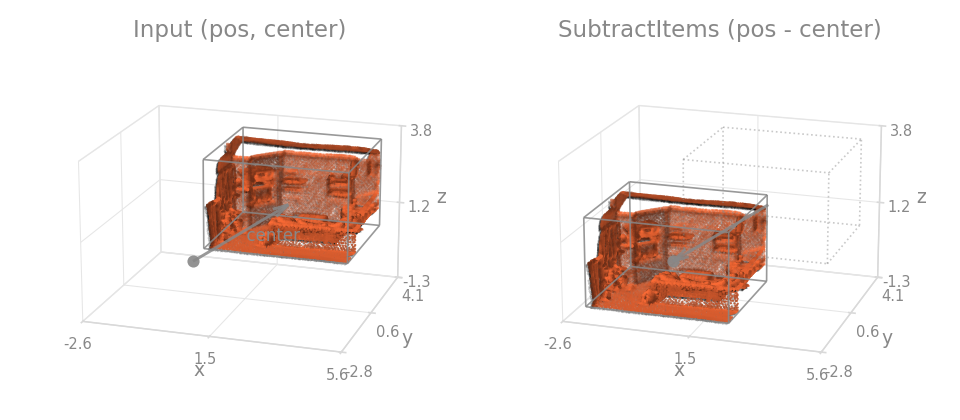
SubtractItems–Subtract the value of a reference key from target keys element-wise.
-
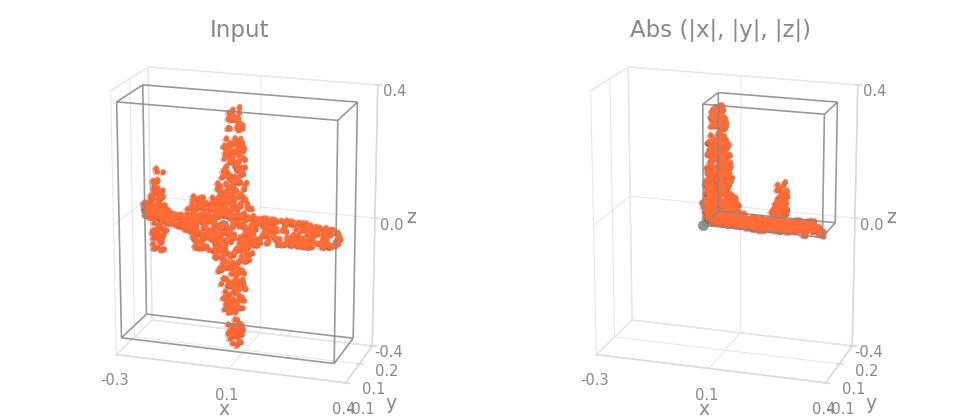
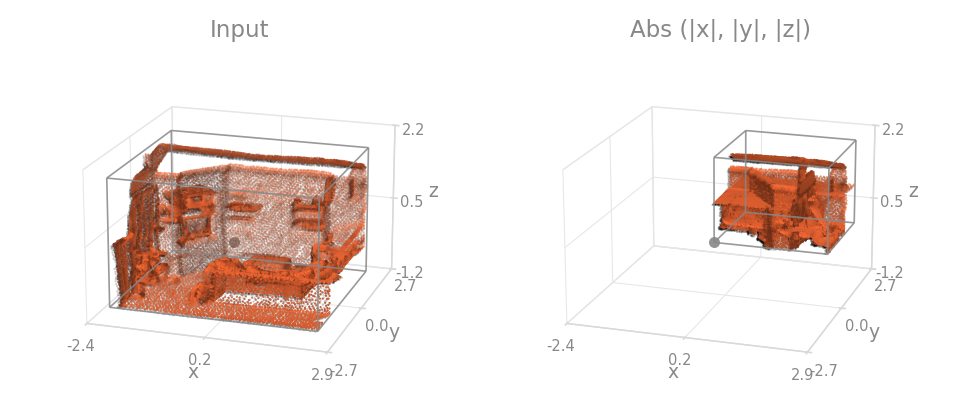
Abs–Make dictionary tensor entries absolute.
-
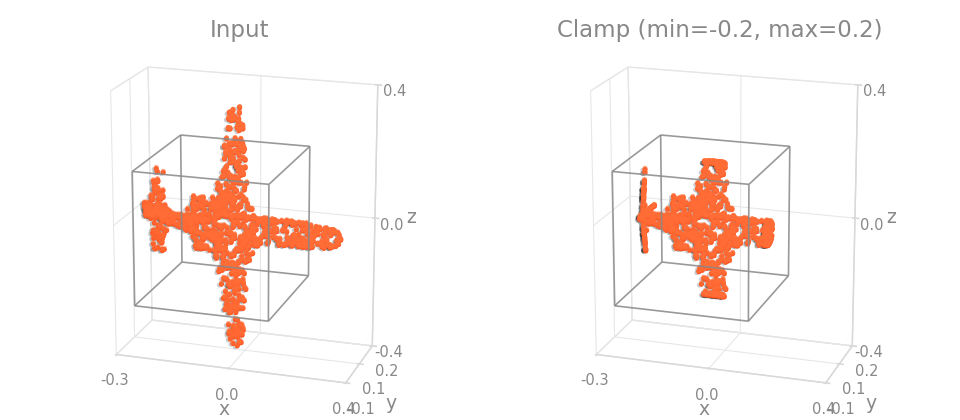
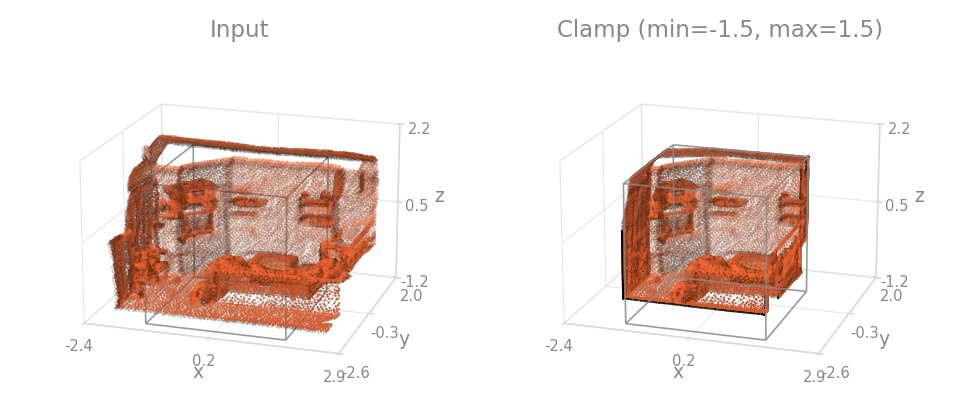
Clamp–Clamp tensor entries to a range (a thin wrapper over
torch.clamp).
module-attribute 
Allowed values for Reduce.op (per-key reduction operator).
Bases: DictTransform
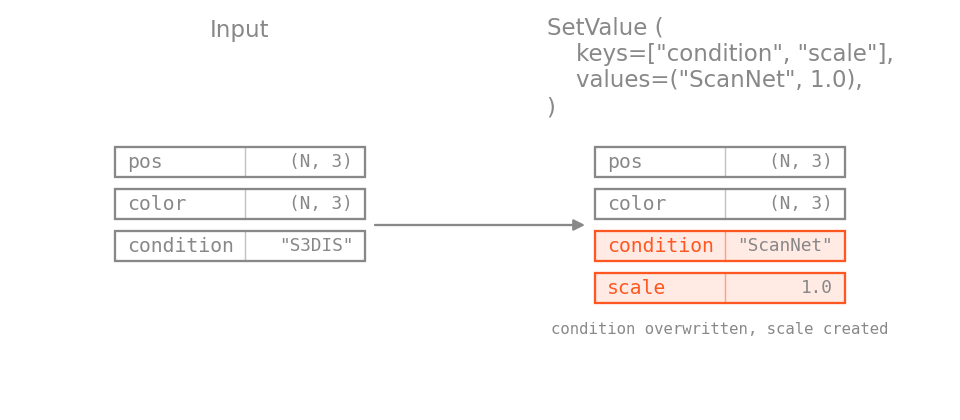
Set values for keys in the dictionary, creating or overwriting them.
Unlike most DictTransform subclasses, SetValue does not read existing values, so allow_missing_keys has no meaning and is not accepted.
Parameters:
-
keys(KeyCollection) –The keys to set.
-
values(Any) –The values to set. Either a single value broadcast to every key, or a sequence of values the same length as
keys.
Bases: DictTransform
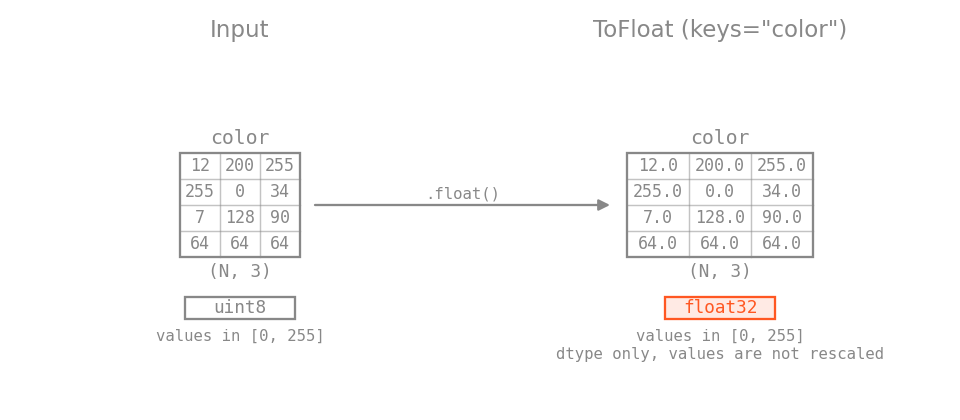
Cast dictionary tensor entries to float32.
Useful when tensors are stored in integer formats (e.g. uint8 for colors) and need to be promoted to floating point before arithmetic transforms like Divide or Normalize.
Parameters:
-
keys(KeyCollection) –The keys to cast.
-
allow_missing_keys(bool, default:False) –If
True, missing keys are silently ignored.
ToDevice(
    keys: KeyCollection,
    device: ValueCollection[str | device],
    non_blocking: ValueCollection[bool] = False,
    copy: ValueCollection[bool] = True,
    memory_format: ValueCollection[
        memory_format | None
    ] = None,
    dst_keys: Optional[KeyCollection] = None,
    allow_missing_keys: bool = False,
)
Bases: DictTransform
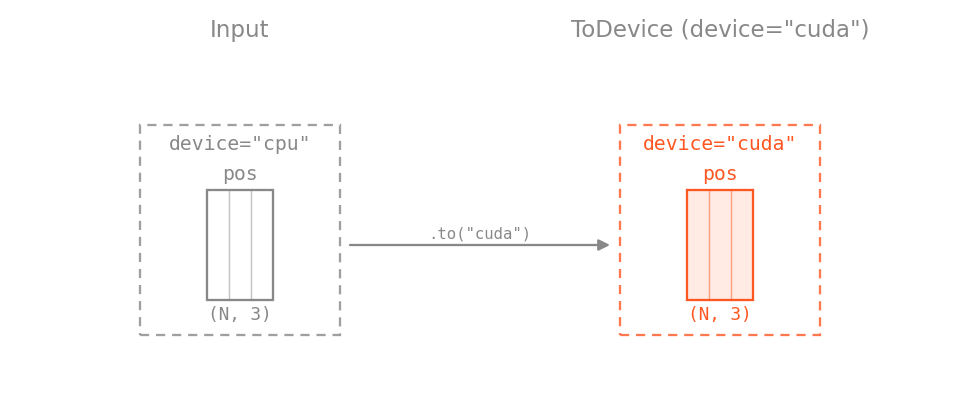
Convert dictionary tensor entries to the given device.
Parameters:
-
keys(KeyCollection) –The keys to convert the tensors to the given device.
-
device(ValueCollection[str | device]) –The device to convert the tensors to.
-
non_blocking(ValueCollection[bool], default:False) –If
True, the transfer will be done asynchronously. -
copy(ValueCollection[bool], default:True) –If
True, the tensor will be copied to the new device. -
memory_format(ValueCollection[memory_format | None], default:None) –The memory format to use for the tensor.
-
dst_keys(Optional[KeyCollection], default:None) –The keys to store the converted tensors in.
-
allow_missing_keys(bool, default:False) –If
True, the transform will not raise an error if the keys are not present in the data.
Relabel(
    keys: KeyCollection,
    labels: Sequence[int] | Dict[int, int],
    default: int = 0,
    allow_missing_keys: bool = False,
)
Bases: DictTransform
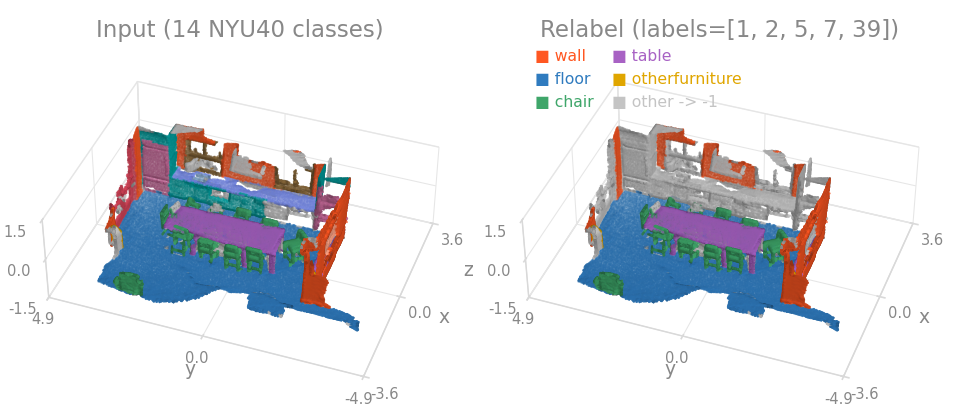
Remap integer labels in dictionary entries via a lookup table.
labels can be either:
- a sequence of source values (1:1) - each value at index
iis mapped toi; - a
dict[int, int](general source → target) - supports N-to-1 merges (e.g. SemanticKITTI'smoving-carandcarboth → 0).
Source values not listed in labels are set to default.
Parameters:
-
keys(KeyCollection) –Keys holding label tensors to remap.
-
labels(Sequence[int] | Dict[int, int]) –Source-value listing (1:1) or explicit
{source: target}dict (N:1). -
default(int, default:0) –Value assigned to source values not listed in
labels. -
allow_missing_keys(bool, default:False) –If
True, skip missing keys instead of raising.
Example
import torch
import torch_pointcloud.transforms as T

# 1:1 - keep raw NYU40 ids 1, 2, 3, 4, 5 and remap them to 0..4
relabel = T.Relabel(keys="segment", labels=[1, 2, 3, 4, 5], default=255)
relabel({"segment": torch.tensor([1, 3, 5, 7])})["segment"]  # tensor([0, 2, 4, 255])

# N:1 - SemanticKITTI 19-class benchmark (merges moving-* into static)
relabel = T.Relabel(
    keys="segment",
    labels={
        10: 0, 252: 0,    # car        (+ moving-car)
        11: 1,             # bicycle
        15: 2,             # motorcycle
        18: 3, 258: 3,    # truck      (+ moving-truck)
        # ...
    },
    default=255,
)
relabel({"segment": torch.tensor([10, 252, 11, 99])})["segment"]  # tensor([0, 0, 1, 255])
Bases: DictTransform
Rename keys in the dictionary.
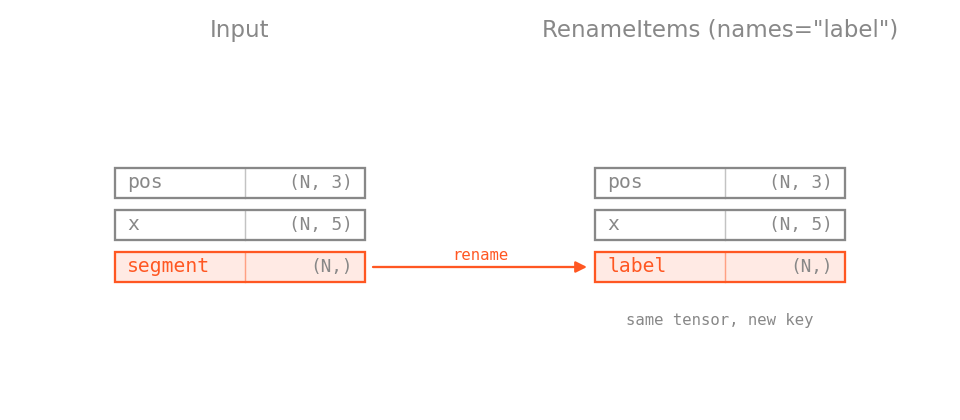
Parameters:
-
keys(KeyCollection) –Source keys to rename.
-
dst_keys(KeyCollection) –New key names (same length as
keys). -
allow_missing_keys(bool, default:False) –If
True, silently skip absent source keys.
Bases: DictTransform
Copy values from source keys to new destination keys.
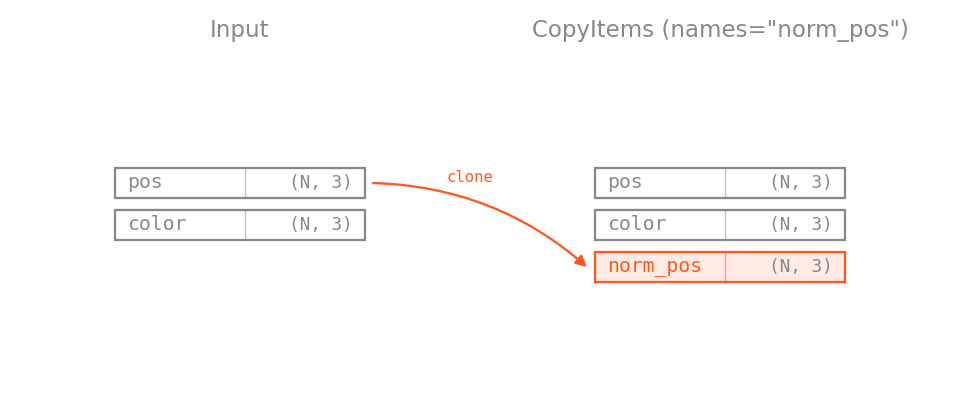
Parameters:
-
keys(KeyCollection) –Source keys to copy from.
-
dst_keys(KeyCollection) –Destination keys to copy to (same length as
keys). -
allow_missing_keys(bool, default:False) –If
True, silently skip absent source keys.
ToTensor(
    keys: KeyCollection,
    dtype: ValueCollection[str | dtype] | None = None,
    device: ValueCollection[str | device] | None = None,
    allow_missing_keys: bool = False,
)
Bases: DictTransform
Convert dictionary entries to tensors.
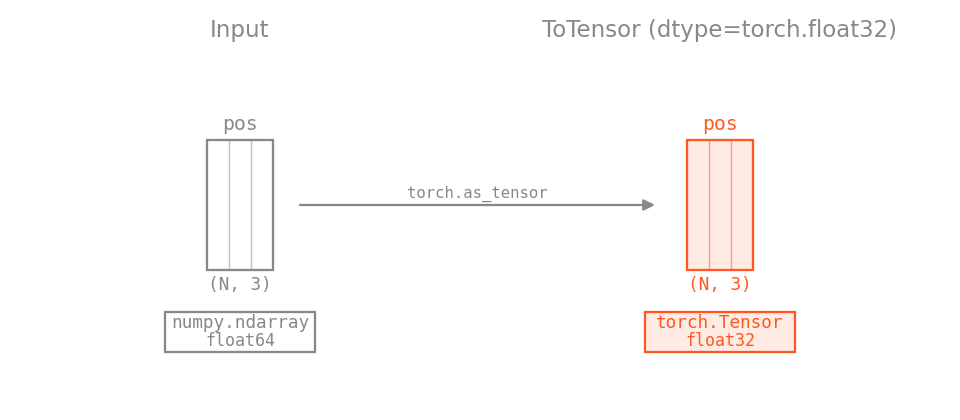
Parameters:
-
keys(KeyCollection) –The keys to convert.
-
dtype(ValueCollection[str | dtype] | None, default:None) –Target dtype(s).
-
device(ValueCollection[str | device] | None, default:None) –Target device(s).
-
allow_missing_keys(bool, default:False) –If
True, the transform will not raise an error if the keys are not present in the data.
OnesLike(
    keys: KeyCollection,
    memory_format: ValueCollection[memory_format]
    | None = None,
    dtype: ValueCollection[dtype] | None = None,
    layout: ValueCollection[layout] | None = None,
    device: ValueCollection[device] | None = None,
    pin_memory: ValueCollection[bool] | None = False,
    requires_grad: ValueCollection[bool] | None = False,
    dst_keys: KeyCollection | None = None,
    allow_missing_keys: bool = False,
)
Bases: DictTransform
Adds a tensor of ones shaped like existing dictionary entries.
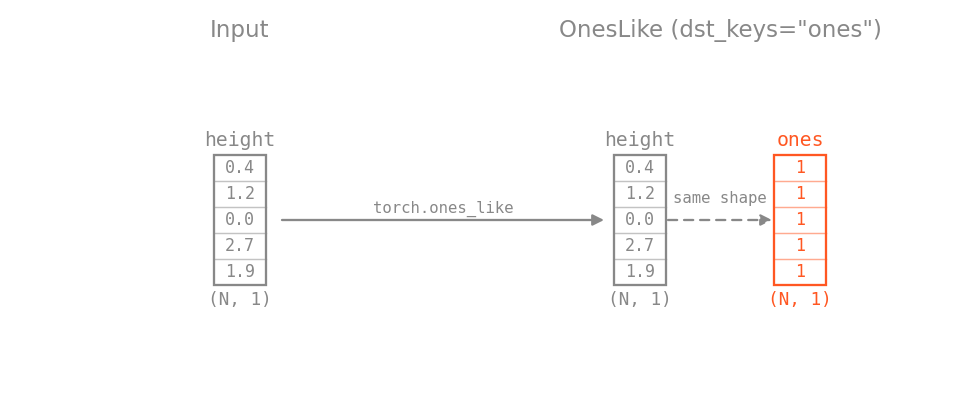
Parameters:
-
keys(KeyCollection) –Reference keys used to determine tensor shape.
-
dst_keys(KeyCollection | None, default:None) –Keys under which the ones tensors are stored.
Bases: DictTransform
Concatenates tensors from multiple keys into a single feature tensor.
Note
This transform is mostly used to concatenate multiple features into a single tensor to feed into your model.
Integer inputs are cast to float32; floating inputs keep their dtype. When the inputs mix floating dtypes, the result uses the widest one (so float64 is preserved, never downcast).
Parameters:
-
keys(KeyCollection) –Keys whose tensors are concatenated (in order).
-
dst_key(str) –Key under which the result is stored.
-
dim(int, default:-1) –Dimension along which to concatenate.
-
allow_missing_keys(bool, default:False) –If
True, silently skip absent keys.
Example
If you have a point cloud data containing position, color and normal and want to concatenate them into a single feature tensor (to feed into your model), you can do the following:
import torch

from torch_pointcloud.transforms import Cat

data = {
    "pos": torch.randn(10, 3),
    "color": torch.randn(10, 3),
    "normal": torch.randn(10, 3),
}
transform = Cat(keys=["pos", "color", "normal"], dst_key="x", dim=1)
data = transform(data)
Now, the data dictionary will contain the key x with the shape \((10, 9)\).
OneHot(
    keys: KeyCollection,
    num_classes: ValueCollection[int],
    dst_keys: Optional[KeyCollection] = None,
    allow_missing_keys: bool = False,
)
Bases: DictTransform
One-hot encode integer-class tensors.
Wraps torch.nn.functional.one_hot and casts the result to float so the output is ready to feed into a model.
Parameters:
-
keys(KeyCollection) –Keys holding integer (long) class indices.
-
num_classes(ValueCollection[int]) –Number of classes \(C\) in the one-hot encoding.
-
dst_keys(Optional[KeyCollection], default:None) –Where to store the one-hot tensors. Defaults to
keys. -
allow_missing_keys(bool, default:False) –If
True, silently skip absent keys.
Shape
Input class tensor of shape \((N,)\) becomes \((N, C)\). A scalar input becomes shape \((C,)\), which after batched collate stacks to \((B, C)\).
Reduce(
    keys: KeyCollection,
    op: ValueCollection[ReduceOp],
    dim: ValueCollection[int] = 0,
    keepdim: bool = False,
    dst_keys: Optional[KeyCollection] = None,
    allow_missing_keys: bool = False,
)
Bases: DictTransform
Reduce a tensor along a dimension and store the scalar/vector result.
Useful for capturing per-sample statistics (e.g. axis-wise scene maxima or centroids) as standalone keys that downstream transforms can reference.
Parameters:
-
keys(KeyCollection) –Keys to reduce.
-
op(ValueCollection[ReduceOp]) –Reduction operator:
"min","max","mean", or"sum"(matches the vocabulary used byVoxelize)."mean"keeps the input's floating dtype (float64included); integer inputs are cast tofloat32. -
dim(ValueCollection[int], default:0) –Dimension to reduce. Defaults to
0. -
keepdim(bool, default:False) –Pass
keepdim=Trueto keep the reduced axis as size \(1\). This is helpful when the result is meant to broadcast against a \((N, D)\) tensor (e.g. per-sample bbox stats) and to survive the packed-batch collate - a \((1, D)\) tensor collates to \((B, D)\) viatorch.cat, whereas a \((D,)\) tensor would concatenate to \((B \cdot D,)\). -
dst_keys(Optional[KeyCollection], default:None) –Output keys. Defaults to
keys(in-place overwrite). -
allow_missing_keys(bool, default:False) –If
True, silently skip absent keys.
Bases: DictTransform
Keep only items in the data dictionary that are in the keys list.
Note
This transform is useful if during augmentation process you constructed multiple tensors and want to drop intermediate tensors for memory efficiency.
Parameters:
-
keys(KeyCollection) –The keys to keep in the data dictionary.
-
allow_missing_keys(bool, default:False) –If
True, the transform will not raise an error if the keys are not present in the data.
Example
If you have a data dictionary containing position, color and normal and want to keep only the position and color, you can do the following:
import torch

from torch_pointcloud.transforms import KeepItems

data = {
    "pos": torch.randn(10, 3),
    "color": torch.randn(10, 3),
    "normal": torch.randn(10, 3),
}
transform = KeepItems(keys=["pos", "color"])
data = transform(data)
Now, the data dictionary will contain only the keys pos and color. The key normal will be removed.
Bases: DictTransform
Multiply dictionary tensor entries by a scale factor.
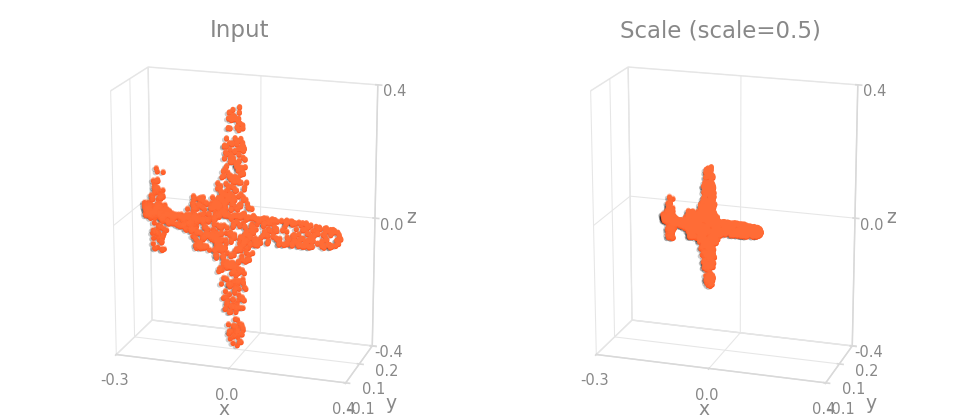
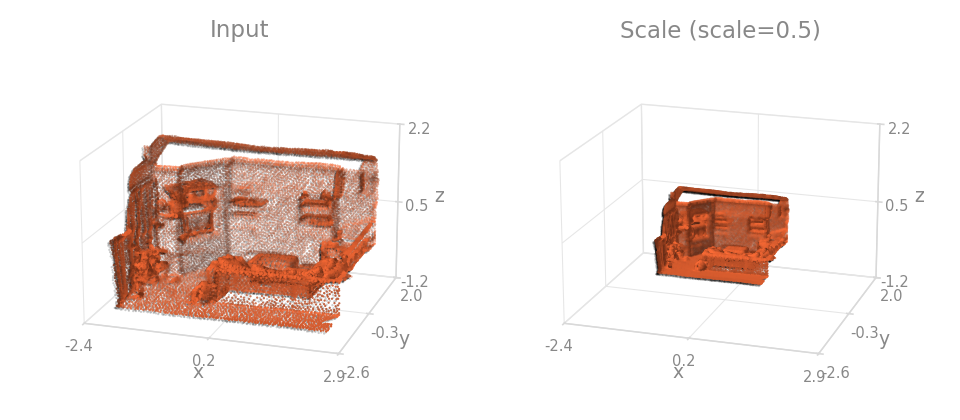
Parameters:
-
keys(KeyCollection) –The keys to scale.
-
scale(float | Sequence[float]) –The scale factor(s).
-
allow_missing_keys(bool, default:False) –If
True, the transform will not raise an error if the keys are not present in the data.
Bases: DictTransform
Divide dictionary tensor entries by a divisor.
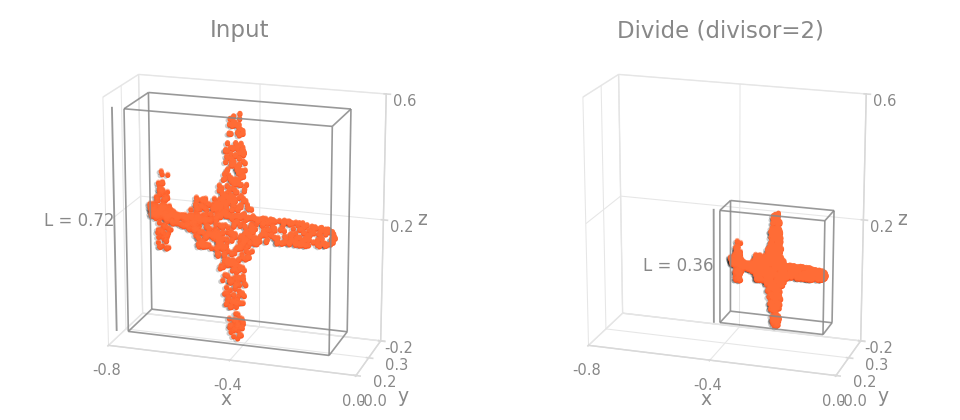
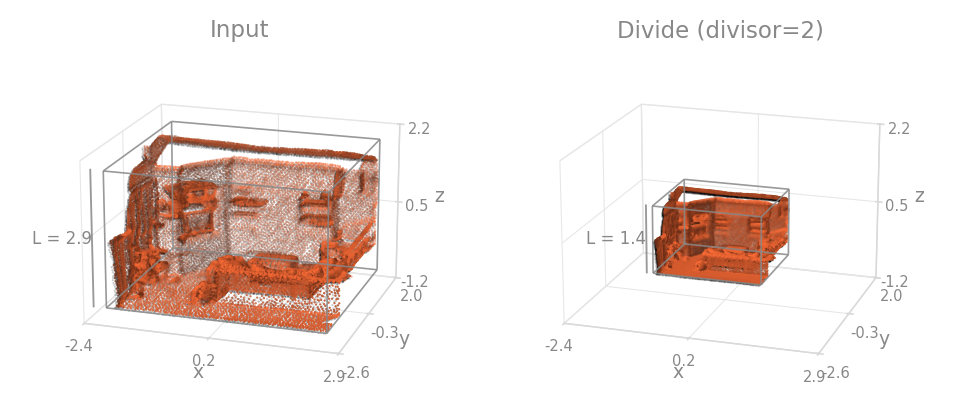
Parameters:
-
keys(KeyCollection) –The keys to divide.
-
divisor(float | Sequence[float]) –The divisor(s).
-
allow_missing_keys(bool, default:False) –If
True, the transform will not raise an error if the keys are not present in the data.
DivideItems(
    keys: KeyCollection,
    div_keys: KeyCollection,
    dst_keys: Optional[KeyCollection] = None,
    allow_missing_keys: bool = False,
)
Bases: DictTransform
Divide target keys by the value of a reference key element-wise.
Computes data[key] = data[key] / data[div_key] for each key.
Parameters:
-
keys(KeyCollection) –Keys whose tensors are divided.
-
div_keys(KeyCollection) –Keys whose values are used as the divisors.
-
dst_keys(Optional[KeyCollection], default:None) –Where to store results. Defaults to
keys. -
allow_missing_keys(bool, default:False) –If
True, silently skip absent target keys.
SubtractItems(
    keys: KeyCollection,
    sub_keys: KeyCollection,
    dst_keys: Optional[KeyCollection] = None,
    axes: Optional[Sequence[int]] = None,
    allow_missing_keys: bool = False,
)
Bases: DictTransform
Subtract the value of a reference key from target keys element-wise.
Computes data[key] = data[key] - data[sub_key] for each key. With axes set, only the listed last-dim indices are subtracted; the other components pass through unchanged (useful to shift only XY while keeping Z absolute).
Parameters:
-
keys(KeyCollection) –Keys whose tensors are modified (subtracted from).
-
sub_keys(KeyCollection) –Keys whose values are subtracted from each target key.
-
dst_keys(Optional[KeyCollection], default:None) –Where to store results. Defaults to
keys. -
axes(Optional[Sequence[int]], default:None) –Optional indices into the last dim restricting which components are subtracted.
None(default) subtracts every component. -
allow_missing_keys(bool, default:False) –If
True, silently skip absent target keys.
Bases: DictTransform
Make dictionary tensor entries absolute.
See Also
torch_pointcloud.transforms.functional.absolute
Parameters:
-
keys(KeyCollection) –The keys to make absolute.
-
allow_missing_keys(bool, default:False) –If
True, the transform will not raise an error if the keys are not present in the data.
Clamp(
    keys: KeyCollection,
    min: Union[float, Sequence[float], None] = None,
    max: Union[float, Sequence[float], None] = None,
    dst_keys: Optional[KeyCollection] = None,
    allow_missing_keys: bool = False,
)
Bases: DictTransform
Clamp tensor entries to a range (a thin wrapper over torch.clamp).
Parameters:
-
keys(KeyCollection) –Keys to clamp.
-
min(Union[float, Sequence[float], None], default:None) –Lower bound, one value or one per channel of the last dim.
Nonedisables the lower clamp. -
max(Union[float, Sequence[float], None], default:None) –Upper bound, one value or one per channel of the last dim.
Nonedisables the upper clamp. -
dst_keys(Optional[KeyCollection], default:None) –Where to store the result. Defaults to
keys(in-place overwrite). -
allow_missing_keys(bool, default:False) –If
True, silently skip absent keys.
relabel(
    labels: Tensor,
    mapping: Union[Sequence[int], Dict[int, int]],
    default: int = 0,
) -> Tensor
Remap integer labels via a lookup table.
mapping can be either:
- a sequence of source values (1:1): each value at index \(i\) is mapped to \(i\);
- a
dict[int, int](general source → target): supports N-to-1 merges (e.g. SemanticKITTI'smoving-carandcarboth → 0).
Source values not listed in mapping are set to default.
Parameters:
-
labels(Tensor) –Integer label tensor (any integer dtype). Output preserves dtype.
-
mapping(Union[Sequence[int], Dict[int, int]]) –Source-value listing (1:1) or explicit
{source: target}dict (N:1). -
default(int, default:0) –Value assigned to source values not listed in
mapping.
Returns:
-
Tensor–Remapped tensor with the same shape and dtype as
labels.
Raises:
-
ValueError–If
mappingis empty.