sampling
Transforms that select a subset of the points.
Classes:
-
RandomSample–Randomly sample a fixed number of points from dict entries.
-
RandomSampleFaceVertices–Randomly sample a fixed number of vertices from a 3D mesh stored in a dictionary.
-
FarthestPointSample–Farthest-point sampling (FPS) of a dictionary entry.
-
RandomDropout–Randomly drop a fraction of points across all listed keys.
-
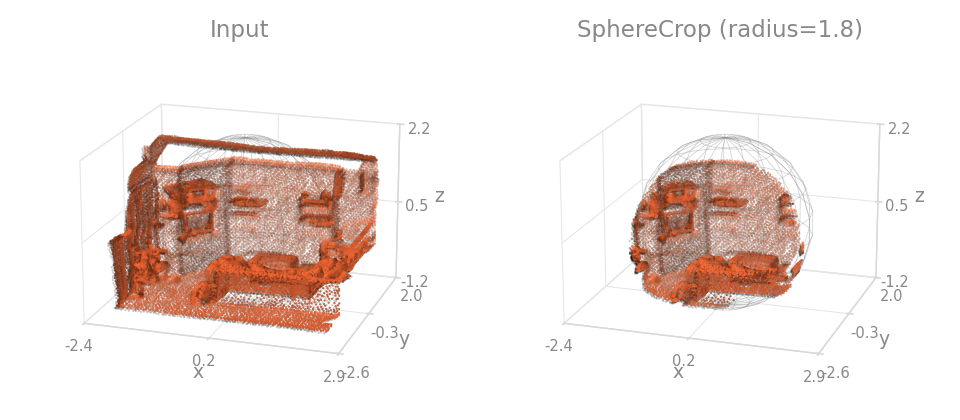
SphereCrop–Keep only points inside an L2 sphere of given radius.
-
RandomBlockCrop–Keep the points of a random vertical block: a square window of the ground plane, full height.
-
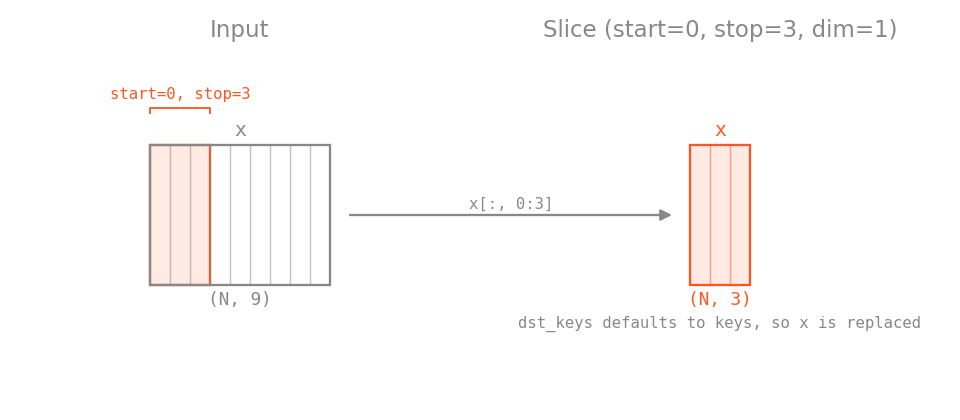
Slice–Slice each listed tensor along a chosen dimension via standard Python slicing.
-
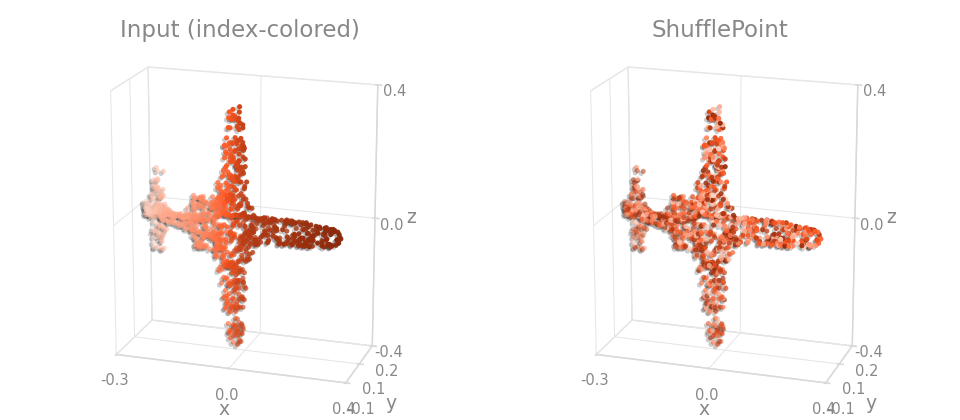
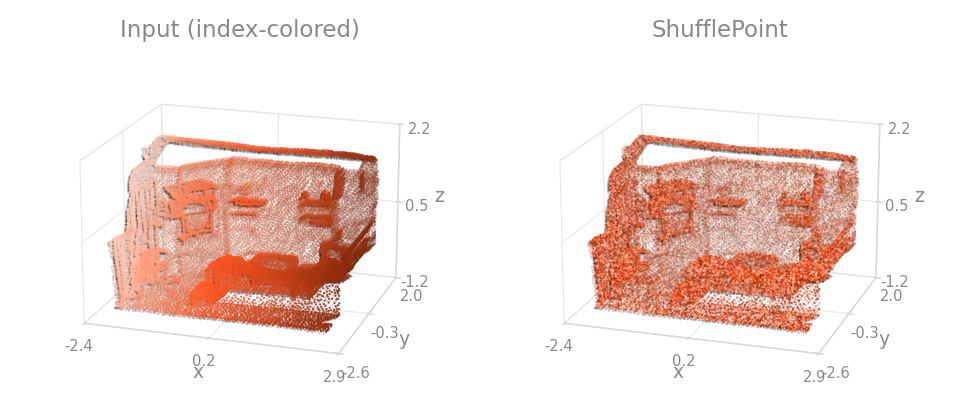
ShufflePoint–Randomly permute the order of points across listed keys.
RandomSample(
    keys: KeyCollection,
    num_samples: int,
    replace: bool = False,
    seed: Optional[int] = None,
    dst_index_key: Optional[str] = None,
    allow_missing_keys: bool = False,
    allow_fewer: bool = False,
)
Bases: DictTransform, Randomizable
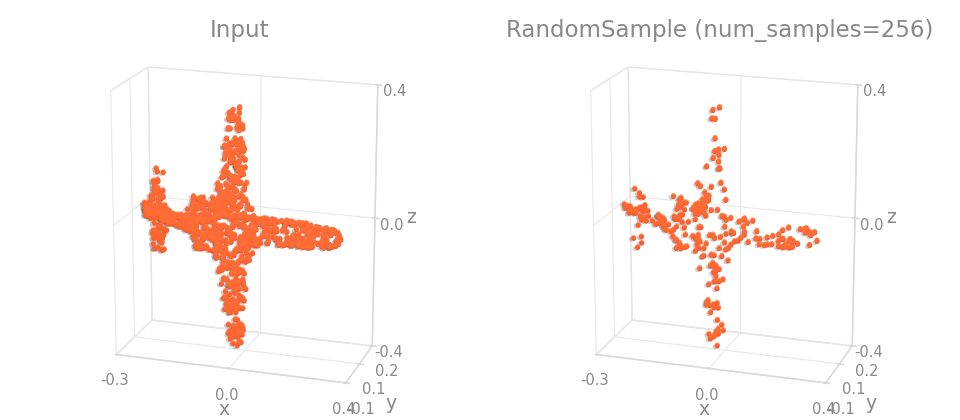
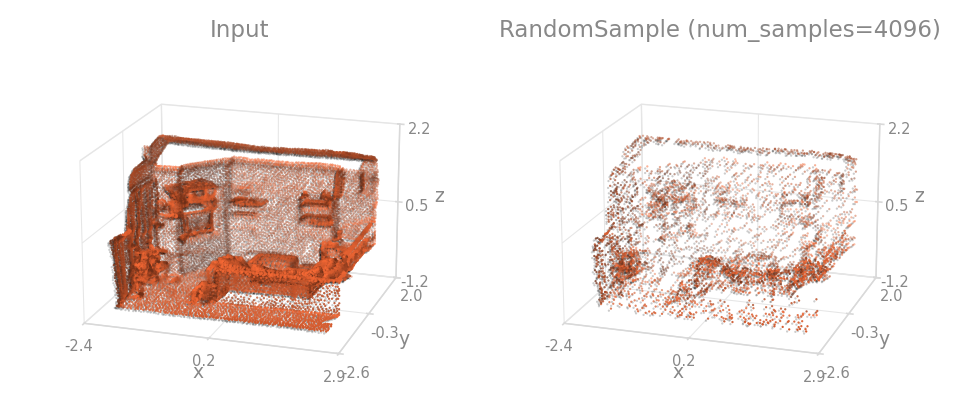
Randomly sample a fixed number of points from dict entries.
If multiple keys are provided, the same indices are used for all keys, ensuring correspondence between the sampled values.
See Also
torch_pointcloud.transforms.functional.random_sample
Parameters:
-
keys(KeyCollection) –The keys to sample from.
-
num_samples(int) –The number of values to sample.
-
replace(bool, default:False) –If
True, sample with replacement (duplicates allowed). IfFalse(default), sample without replacement when the first sampled key has at leastnum_samplespoints; whennum_samplesexceeds that count the draw falls back to replacement so the output always hasnum_samplesrows. -
seed(Optional[int], default:None) –Seed of the transform's own random stream;
Nonedraws from the global generator (seeRandomizable). -
dst_index_key(Optional[str], default:None) –Key for the output-to-input row map (see the module docs on sampling keys);
None(the default) disables it. -
allow_missing_keys(bool, default:False) –If
True, the transform will not raise an error if the keys are not present in the data. -
allow_fewer(bool, default:False) –If
True, a cloud with at mostnum_samplespoints passes through unchanged instead of being completed by draws with replacement.
Raises:
-
ValueError–If the first sampled tensor is empty and
num_samples > 0.
RandomSampleFaceVertices(
    *,
    keys: KeyCollection,
    face_key: KeyCollection,
    dst_normal_key: Optional[KeyCollection] = "normal",
    num_samples: int,
    seed: Optional[int] = None,
    allow_missing_keys: bool = False,
)
Bases: DictTransform, Randomizable
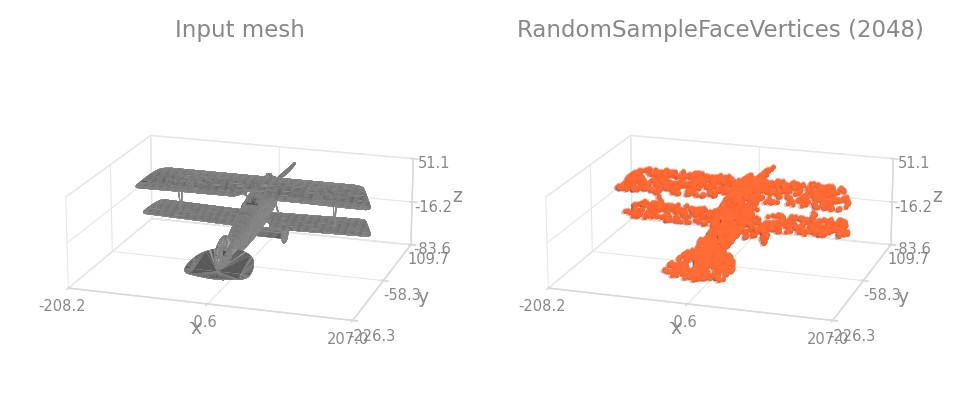
Randomly sample a fixed number of vertices from a 3D mesh stored in a dictionary.
See Also
torch_pointcloud.transforms.functional.random_sample_face_vertices
Parameters:
-
keys(KeyCollection) –The keys holding vertex positions.
-
face_key(KeyCollection) –The keys holding the face indices.
-
dst_normal_key(Optional[KeyCollection], default:'normal') –The key to store the computed normals in.
-
num_samples(int) –The number of vertices to sample.
-
seed(Optional[int], default:None) –Seed of the transform's own random stream;
Nonedraws from the global generator (seeRandomizable). -
allow_missing_keys(bool, default:False) –If
True, the transform will not raise an error if the keys are not present in the data.
FarthestPointSample(
    pos_key: str,
    keys: Optional[KeyCollection] = None,
    num_samples: Optional[int] = None,
    ratio: Optional[float] = None,
    random_start: bool = False,
    dst_index_key: Optional[str] = None,
    allow_missing_keys: bool = False,
)
Bases: DictTransform
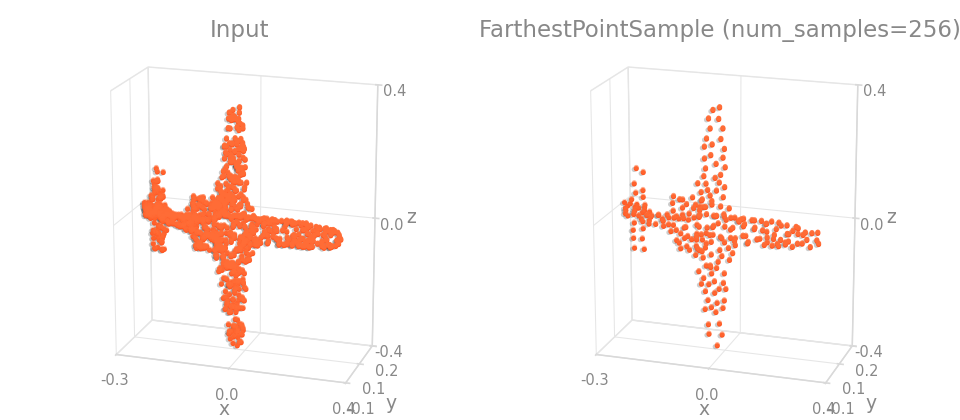
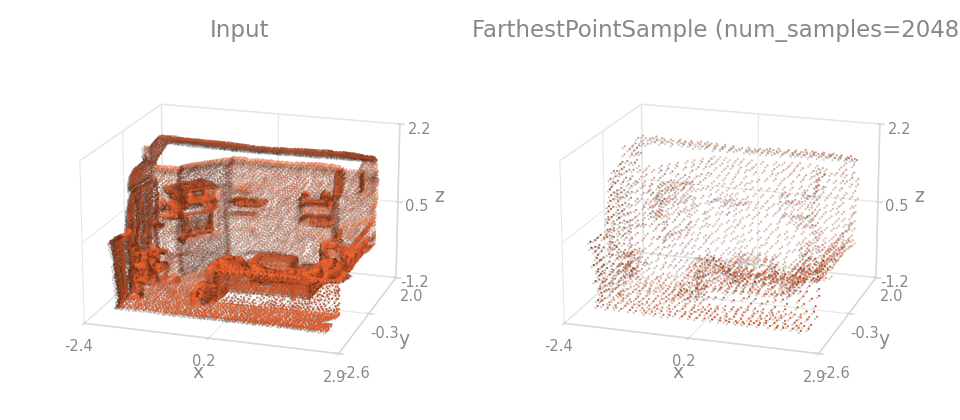
Farthest-point sampling (FPS) of a dictionary entry.
Iteratively picks the point that maximizes the minimum distance to the already-selected set, producing a well-distributed subset. Matches the FPS convention used by PointNet++, PointNeXt, KPConv, and others.
See Also
torch_pointcloud.transforms.functional.farthest_point_sample
Note
The underlying fps does not accept a torch.Generator. To make random_start=True reproducible, seed PyTorch globally via torch.manual_seed(...) before applying this transform.
Parameters:
-
pos_key(str) –The key holding the positions used for FPS.
-
keys(Optional[KeyCollection], default:None) –Extra keys to subsample with the same indices.
-
num_samples(Optional[int], default:None) –The number of points to sample.
-
ratio(Optional[float], default:None) –The ratio of points to sample.
-
random_start(bool, default:False) –Whether to start the sampling from a random point.
-
dst_index_key(Optional[str], default:None) –Key for the output-to-input row map (see the module docs on sampling keys);
None(the default) disables it. -
allow_missing_keys(bool, default:False) –If
True, the transform will not raise an error if the keys are not present in the data.
RandomDropout(
    keys: KeyCollection,
    drop_ratio_range: Tuple[float, float] = (0.1, 0.1),
    p: float = 1.0,
    seed: Optional[int] = None,
    dst_index_key: Optional[str] = None,
    allow_missing_keys: bool = False,
)
Bases: DictTransform, Randomizable
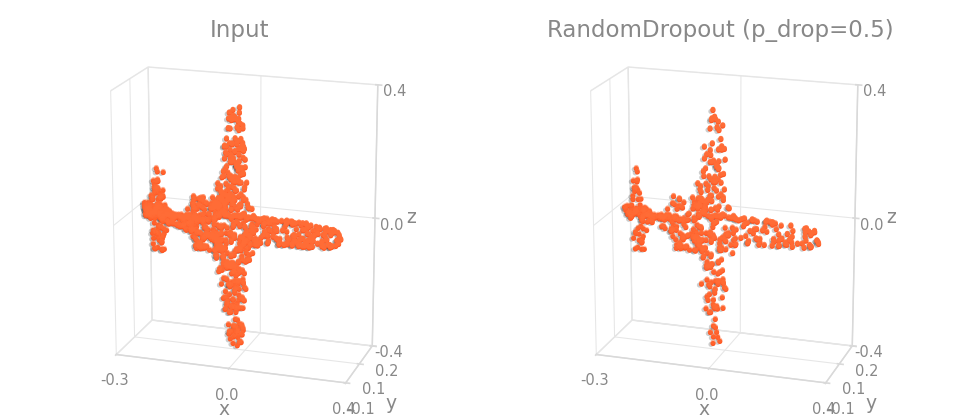
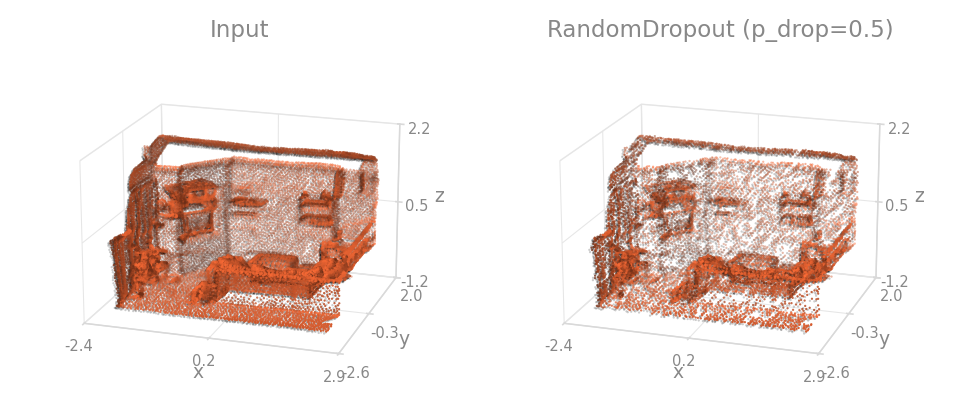
Randomly drop a fraction of points across all listed keys.
The same boolean keep-mask is applied to every key so per-point correspondence is preserved. Sampling is once per call, with a drop ratio drawn uniformly from drop_ratio_range.
See Also
torch_pointcloud.transforms.functional.random_dropout_mask
Parameters:
-
keys(KeyCollection) –Keys to subset. All must share the same leading dimension \(N\).
-
drop_ratio_range(Tuple[float, float], default:(0.1, 0.1)) –Min and max fraction of points to drop;
(r, r)drops a fixed fraction. Must lie in \([0, 1)\). -
p(float, default:1.0) –Probability of applying the transform.
-
seed(Optional[int], default:None) –Seed of the transform's own random stream;
Nonedraws from the global generator (seeRandomizable). -
dst_index_key(Optional[str], default:None) –Key for the output-to-input row map (see the module docs on sampling keys);
None(the default) disables it. -
allow_missing_keys(bool, default:False) –If
True, silently skip absent keys.
SphereCrop(
    pos_key: str,
    radius: float,
    max_nodes: Optional[int] = None,
    keys: Optional[KeyCollection] = None,
    center: Any = "centroid",
    p: float = 1.0,
    seed: Optional[int] = None,
    dst_index_key: Optional[str] = None,
    allow_missing_keys: bool = False,
    max_ratio: Optional[float] = None,
    dst_center_key: Optional[str] = None,
)
Bases: DictTransform, Randomizable
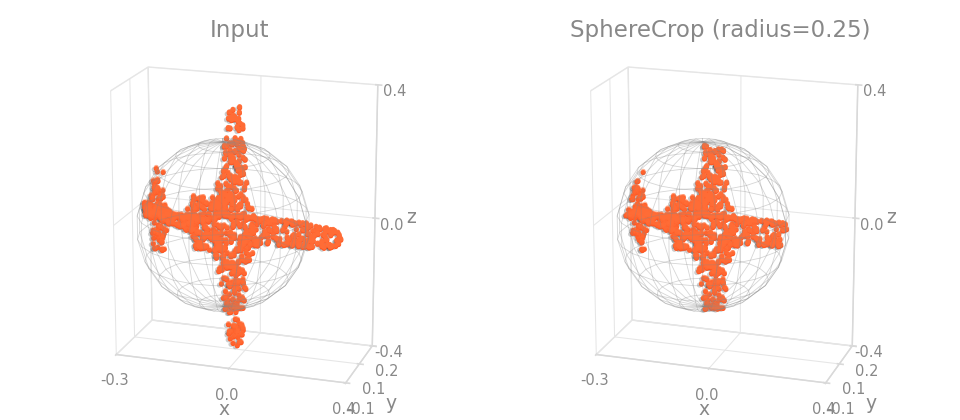
Keep only points inside an L2 sphere of given radius.
The mask is computed from pos_key and applied to every listed keys. Equivalent to Compose([SphereMask(...), ApplyMask(...)]), kept as a convenience preset (the dual of RemoveNearOrigin).
When max_nodes is set and the sphere holds more than max_nodes points, only the max_nodes nearest the center are kept, bounding memory on large scenes.
Parameters:
-
pos_key(str) –Key with positions used to compute the mask.
-
keys(Optional[KeyCollection], default:None) –Extra keys to filter with the same mask.
-
center(Any, default:'centroid') –Center of the sphere. If
"centroid", uses the per-cloud centroid; if"random_point", picks a random point as the center; otherwise treat as a 3-vector. -
radius(float) –Radius of the sphere (Euclidean).
-
max_nodes(Optional[int], default:None) –Optional cap on the number of kept points. If
None(default), no cap is applied; otherwise themax_nodespoints nearest the center are kept. -
max_ratio(Optional[float], default:None) –Optional cap as a fraction of the input point count (keeps that fraction of the points nearest the center); combined with
max_nodesby the minimum. -
dst_center_key(Optional[str], default:None) –Key receiving the center \((D,)\) the crop was taken around;
Nonedoes not store it. -
p(float, default:1.0) –Probability of applying the transform.
-
seed(Optional[int], default:None) –Seed for the random center (
center="random_point") and the probability draw;Nonedraws from the global generator (seeRandomizable). -
dst_index_key(Optional[str], default:None) –Key for the output-to-input row map (see the module docs on sampling keys);
None(the default) disables it. -
allow_missing_keys(bool, default:False) –If
True, silently skip absent keys.
RandomBlockCrop(
    pos_key: str,
    keys: Optional[KeyCollection] = None,
    block_size: float = 1.0,
    min_nodes: int = 1024,
    max_tries: int = 100,
    axes: Sequence[int] = (0, 1),
    dst_center_key: Optional[str] = None,
    seed: Optional[int] = None,
    dst_index_key: Optional[str] = None,
    allow_missing_keys: bool = False,
)
Bases: DictTransform, Randomizable
Keep the points of a random vertical block: a square window of the ground plane, full height.
A random point centers a block_size x block_size window over axes (the ground plane); the window is redrawn until it holds more than min_nodes points, up to max_tries draws, after which the largest draw is kept. The center is written under dst_center_key so SubtractItems(axes=...) can center the block on it.
Parameters:
-
pos_key(str) –Key holding the positions, \((N, D)\).
-
keys(Optional[KeyCollection], default:None) –Extra per-point keys to crop with the same mask.
-
block_size(float, default:1.0) –Side of the window, in the units of the positions.
-
min_nodes(int, default:1024) –A draw is accepted once the window holds more than this many points.
-
max_tries(int, default:100) –Number of draws before the largest window is kept.
-
axes(Sequence[int], default:(0, 1)) –Axes of the window (the other axes are unbounded).
-
dst_center_key(Optional[str], default:None) –Key receiving the window center, the drawn point \((D,)\);
Nonedoes not store it. -
seed(Optional[int], default:None) –Seed of the transform's own random stream;
Nonedraws from the global generator (seeRandomizable). -
dst_index_key(Optional[str], default:None) –Key for the output-to-input row map (see the module docs on sampling keys);
None(the default) does not record it. -
allow_missing_keys(bool, default:False) –If
True, silently skip absent keys.
Example
import torch
from torch_pointcloud.transforms import RandomBlockCrop
crop = RandomBlockCrop(pos_key="pos", keys="segment", block_size=1.0, min_nodes=10, seed=0)
data = {"pos": torch.rand(500, 3) * 4, "segment": torch.zeros(500, dtype=torch.long)}
out = crop(data)
bool((out["pos"].max(0).values - out["pos"].min(0).values)[:2].max() <= 1.0)  # True
Slice(
    keys: KeyCollection,
    start: Optional[int] = None,
    stop: Optional[int] = None,
    step: Optional[int] = None,
    dim: int = 0,
    dst_keys: Optional[KeyCollection] = None,
    dst_index_key: Optional[str] = None,
    allow_missing_keys: bool = False,
)
Bases: DictTransform
Slice each listed tensor along a chosen dimension via standard Python slicing.
Useful for taking the first \(N\) rows (e.g. on FPS-sorted point clouds), or extracting a single column of pos into a separate key (set dim=1 with start=axis, stop=axis+1).
Parameters:
-
keys(KeyCollection) –Keys to slice.
-
start(Optional[int], default:None) –Start index (inclusive).
Noneis equivalent to0. -
stop(Optional[int], default:None) –Stop index (exclusive).
Nonemeans "to the end". -
step(Optional[int], default:None) –Stride between selected positions.
Noneis equivalent to1. -
dim(int, default:0) –Dimension along which to slice. Defaults to
0(the row axis). -
dst_keys(Optional[KeyCollection], default:None) –Where to store results. Defaults to
keys. -
dst_index_key(Optional[str], default:None) –Key for the output-to-input row map (see the module docs on sampling keys), written only when
dim == 0;None(the default) disables it. Leave it unset whendst_keysdiffer fromkeys, since the map would describe thedst_keysrows. -
allow_missing_keys(bool, default:False) –If
True, silently skip absent keys.
Example
ShufflePoint(
    keys: KeyCollection,
    p: float = 1.0,
    seed: Optional[int] = None,
    dst_index_key: Optional[str] = None,
    allow_missing_keys: bool = False,
)
Bases: DictTransform, Randomizable
Randomly permute the order of points across listed keys.
The same permutation is applied to every key so per-point correspondence is preserved. Useful before RandomSample when you want to break any structural ordering in the input.
See Also
torch_pointcloud.transforms.functional.shuffle_indices
Parameters:
-
keys(KeyCollection) –Keys to permute. All must share the same leading dimension \(N\).
-
p(float, default:1.0) –Probability of applying the transform.
-
seed(Optional[int], default:None) –Seed of the transform's own random stream;
Nonedraws from the global generator (seeRandomizable). -
dst_index_key(Optional[str], default:None) –Key for the output-to-input row map (see the module docs on sampling keys);
None(the default) disables it. -
allow_missing_keys(bool, default:False) –If
True, silently skip absent keys.
random_sample(
    tensor: Tensor,
    num_samples: int,
    return_indices: bool = False,
    replace: bool = False,
    generator: Optional[Generator] = None,
) -> Union[Tensor, Tuple[Tensor, Tensor]]
Randomly sample a fixed number of values from a tensor.
Note
The data is sampled uniformly along dim=0.
Parameters:
-
tensor(Tensor) –The input tensor of shape \((N, \ldots)\).
-
num_samples(int) –The number of values to sample.
-
return_indices(bool, default:False) –Whether to return the indices of the sampled values.
-
replace(bool, default:False) –If
True, sample with replacement (duplicates allowed). IfFalse, sample without replacement when \(N \geq \text{num\_samples}\); when \(\text{num\_samples} > N\) the draw falls back to replacement so the output always hasnum_samplesrows. -
generator(Optional[Generator], default:None) –The generator for the random number generator.
Returns:
-
Union[Tensor, Tuple[Tensor, Tensor]]–If
return_indicesisTrue, the function returns a tuple of the sampled values and their indices. -
Union[Tensor, Tuple[Tensor, Tensor]]–Otherwise, it returns the sampled values.
Raises:
-
ValueError–If
num_samples > 0and the input is empty.
random_sample_face_vertices(
    vertices: Tensor,
    face: Tensor,
    num_samples: int,
    return_normals: Literal[True],
    generator: Optional[Generator] = None,
) -> Tuple[Tensor, Tensor]
random_sample_face_vertices(
    vertices: Tensor,
    face: Tensor,
    num_samples: int,
    return_normals: bool = False,
    generator: Optional[Generator] = None,
) -> Union[Tensor, Tuple[Tensor, Tensor]]
Randomly sample a fixed number of vertices from a 3D mesh (vertices, face), using:
Note
The data is sampled uniformly from the mesh.
Parameters:
-
vertices(Tensor) –The input tensor.
-
face(Tensor) –The input tensor.
-
num_samples(int) –The number of vertices to sample.
-
return_normals(bool, default:False) –Whether to return the normal of the sampled vertices.
-
generator(Optional[Generator], default:None) –The generator for the random number generator.
Returns:
-
Union[Tensor, Tuple[Tensor, Tensor]]–If
return_normalsisTrue, the function returns a tuple of the sampled vertices and their normal. -
Union[Tensor, Tuple[Tensor, Tensor]]–Otherwise, it returns the sampled vertices.
farthest_point_sample(
    pos: Tensor,
    num_samples: Optional[int] = None,
    ratio: Optional[float] = None,
    random_start: bool = False,
) -> Tensor
Farthest-point sampling (FPS) from a tensor of positions.
Thin wrapper around torch_pointcloud.ops.cluster.fps, provided for convenience and naming symmetry with random_sample.
See Also
torch_pointcloud.ops.cluster.fps for more details and advanced usage.
Parameters:
-
pos(Tensor) –The input tensor of shape \((N, D)\).
-
num_samples(Optional[int], default:None) –The number of points to sample.
-
ratio(Optional[float], default:None) –The ratio of points to sample.
-
random_start(bool, default:False) –Whether to start the sampling from a random point.
Returns:
-
Tensor–The indices of the sampled points, always
num_samplesof them whennum_samplesis given. A cloud with at -
Tensor–most
num_samplespoints keeps its original order instead of being reordered by farthest-point rank, and a -
Tensor–smaller one is completed by cycling through its points, the repetition
fpsapplies too.ratio >= 1 -
Tensor–returns
torch.arange(N).
Examples:
random_dropout_mask(
    n: int,
    drop_ratio: float,
    device: Optional[device] = None,
    generator: Optional[Generator] = None,
) -> Tensor
Return a boolean keep-mask of length n where each entry is kept with probability 1 - drop_ratio.
Parameters:
-
n(int) –Number of points.
-
drop_ratio(float) –Probability of dropping a point. Must be in \([0, 1)\).
-
device(Optional[device], default:None) –Output device.
-
generator(Optional[Generator], default:None) –Random generator for reproducibility.
Returns:
-
Tensor–Boolean tensor of shape \((n,)\).
Raises:
-
ValueError–If
drop_ratiois not in[0, 1).
shuffle_indices(
    n: int,
    device: Optional[device] = None,
    generator: Optional[Generator] = None,
) -> Tensor
Return a random permutation of [0, n).
Parameters:
-
n(int) –Sequence length.
-
device(Optional[device], default:None) –Output device.
-
generator(Optional[Generator], default:None) –Random generator for reproducibility.
Returns:
-
Tensor–Long tensor of shape \((n,)\).