augmentation
Random geometric and color augmentations.
Classes:
-
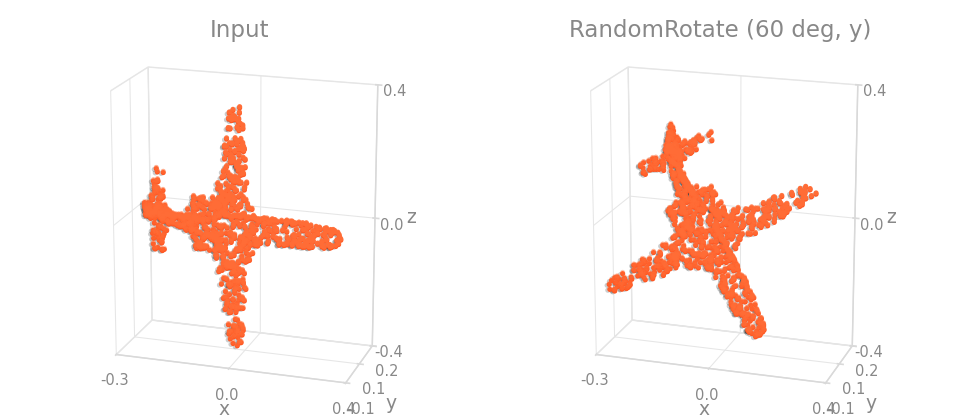
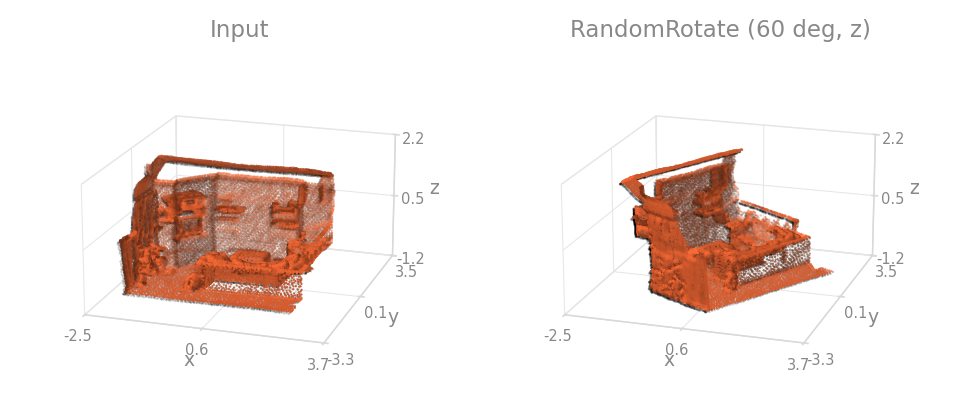
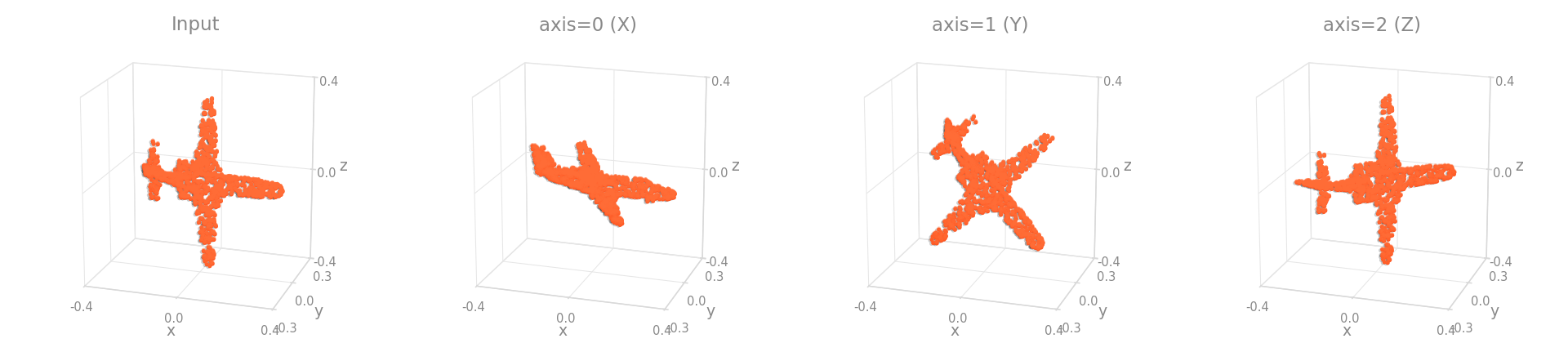
RandomRotate–Rotate one or more keys (and optionally oriented boxes) by a uniformly random angle around an axis.
-
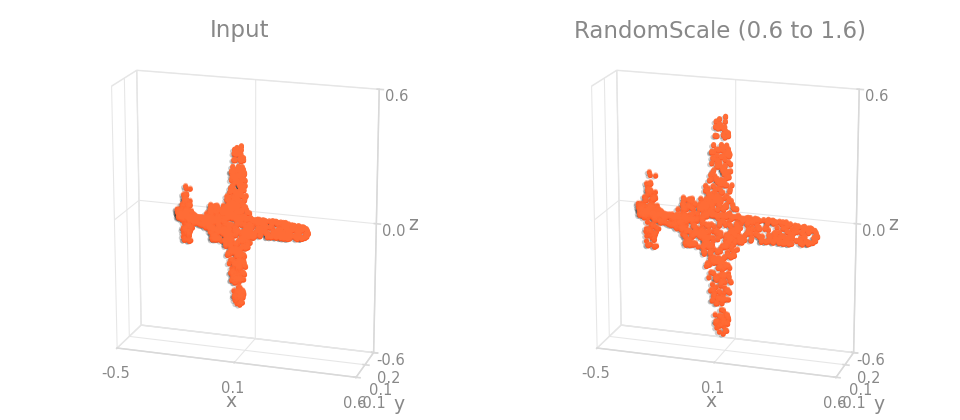
RandomScale–Scale one or more keys (and optionally oriented boxes) by a uniformly random factor.
-
RandomFlip–Flip listed axes (and optionally oriented boxes) with probability
peach. -
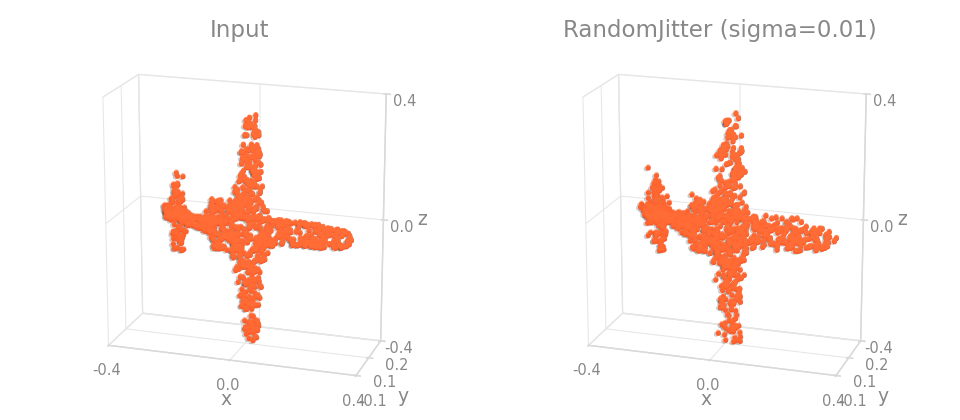
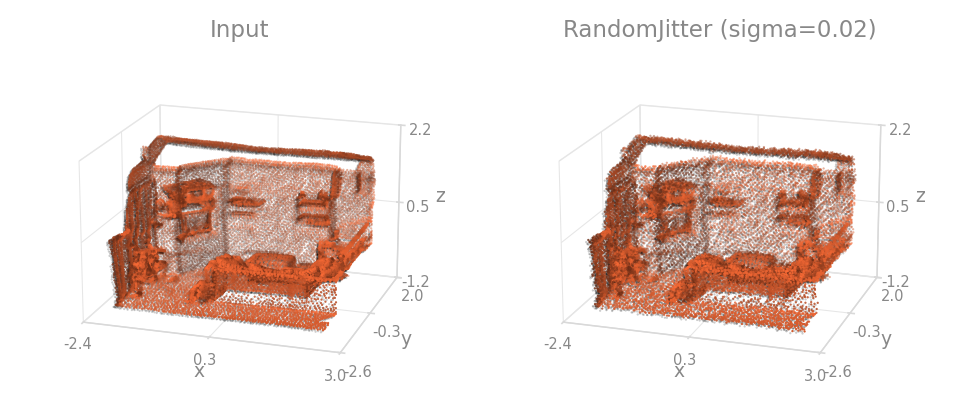
RandomJitter–Add Gaussian noise to listed keys, optionally clipped.
-
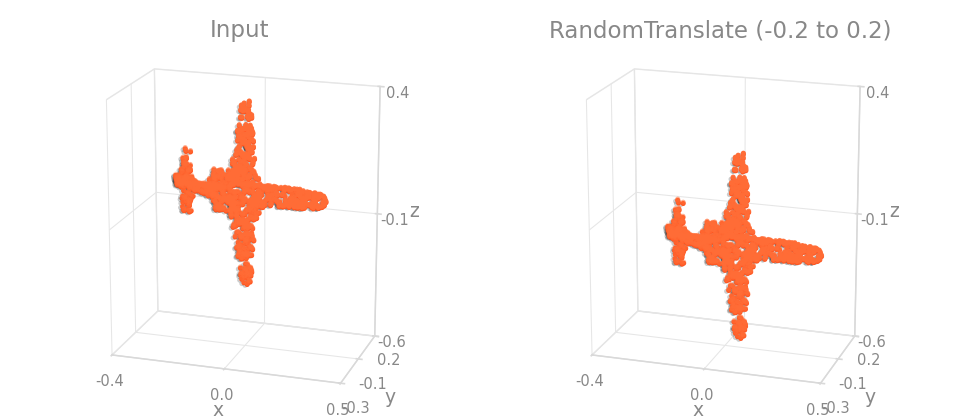
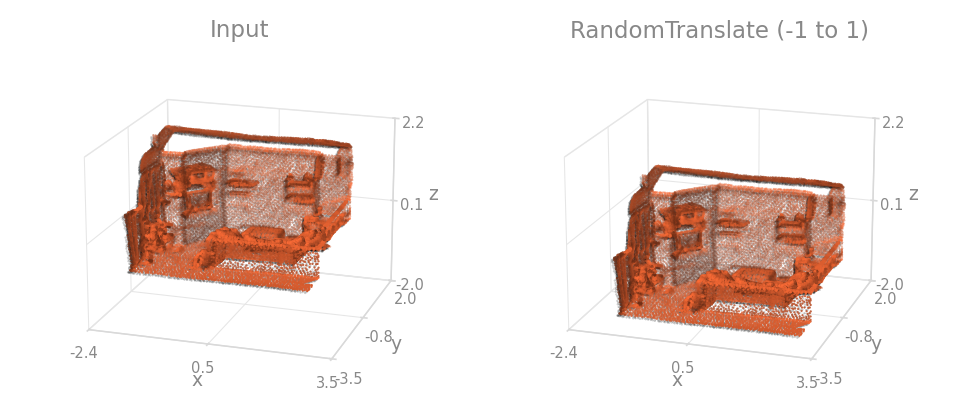
RandomTranslate–Translate listed keys (and optionally oriented boxes) by a uniformly random vector.
-
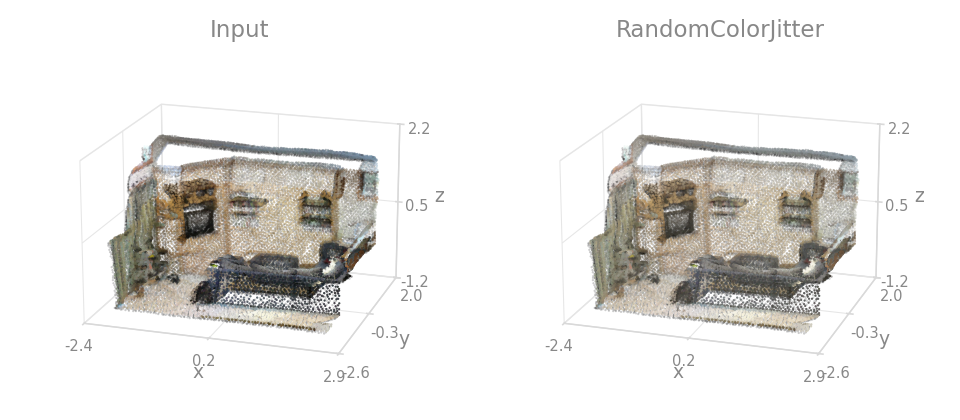
RandomColorJitter–Jitter colors by brightness, contrast, and saturation strengths.
-
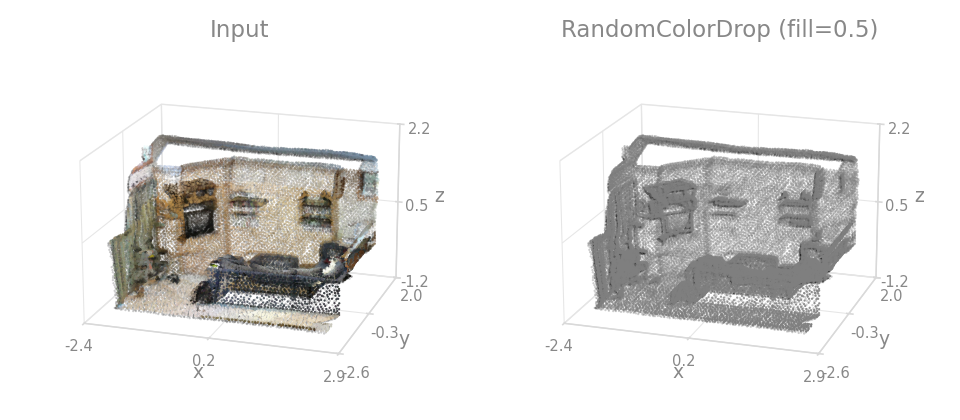
RandomColorDrop–Replace colors with a constant gray value with probability
p. -
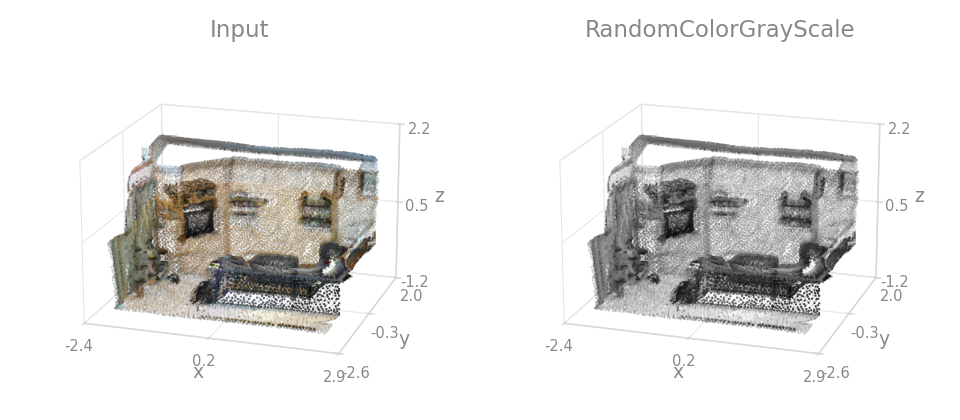
RandomColorGrayScale–Convert listed color keys to grayscale (BT.601 luminance) with probability
p. -
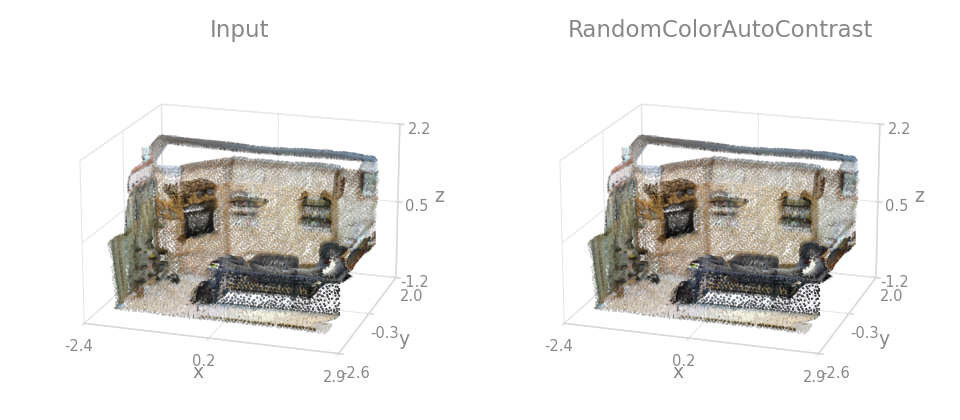
RandomColorAutoContrast–Stretch per-cloud color range to the full extent, then blend back, with probability
p. -
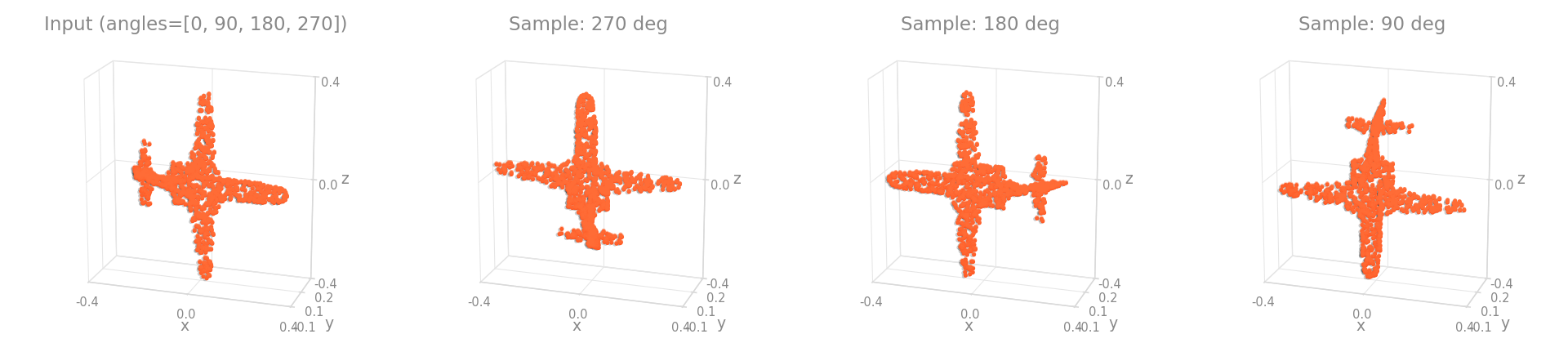
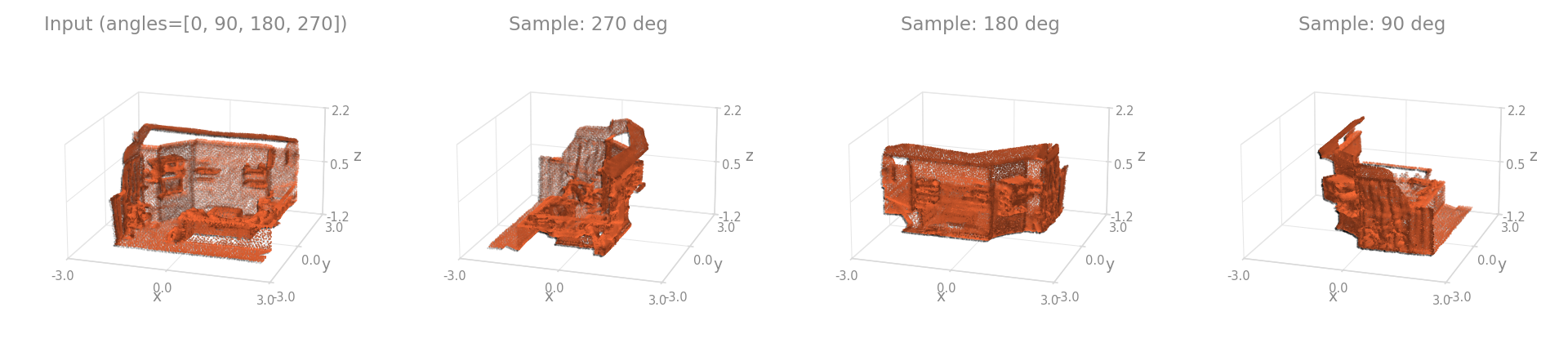
RandomRotateChoice–Rotate one or more keys by an angle chosen uniformly from a discrete list.
-
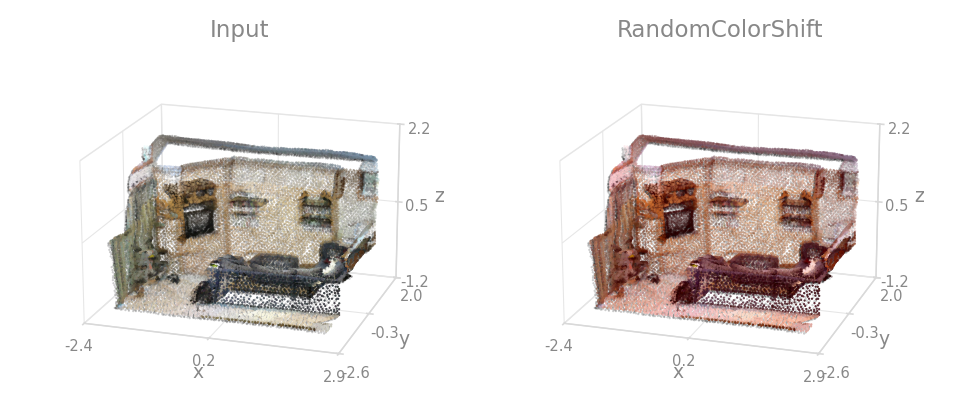
RandomColorShift–Additive per-channel color shift sampled uniformly per channel.
-
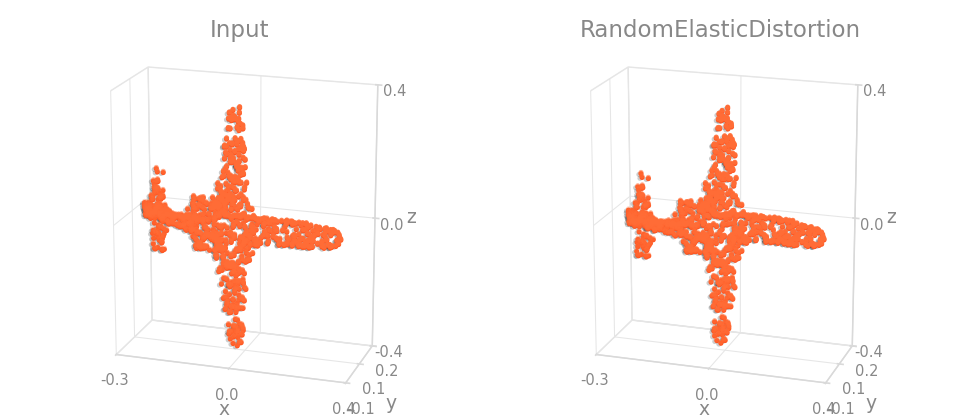
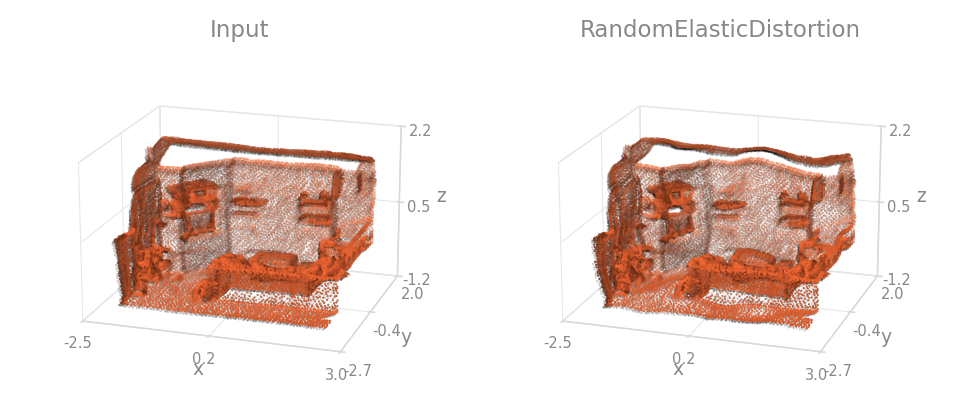
RandomElasticDistortion–Apply a smooth random displacement field (elastic distortion).
RandomRotate(
    keys: KeyCollection,
    angle_range: Tuple[float, float] = (-180.0, 180.0),
    axis: int = 2,
    p: float = 1.0,
    box_key: Optional[str] = None,
    center: Union[str, Sequence[float]] = "origin",
    vector_keys: Optional[KeyCollection] = None,
    dst_keys: Optional[KeyCollection] = None,
    dst_box_key: Optional[str] = None,
    seed: Optional[int] = None,
    allow_missing_keys: bool = False,
)
Bases: DictTransform, Randomizable
Rotate one or more keys (and optionally oriented boxes) by a uniformly random angle around an axis.
Sampling is done once per call: every listed key and the optional box get the same rotation. Each key is a \((\ldots, 3)\) field or a packed \((N, 3G)\) field of tiled 3D offsets (e.g. vote offsets). Pair keys=("pos", "normal") to keep positions and normals consistent, or pass box_key to also rotate a \((K, 7)\) oriented-box tensor (centers rotated, heading incremented). Box headings are counterclockwise yaw about the up axis, so box_key requires axis=2.
See Also
torch_pointcloud.transforms.functional.rotate_vectors, torch_pointcloud.transforms.functional.rotate_boxes, torch_pointcloud.transforms.functional.rotation_matrix
Parameters:
-
keys(KeyCollection) –Keys to rotate. Each must be a \((\ldots, 3)\) or \((N, 3G)\) vector field.
-
angle_range(Tuple[float, float], default:(-180.0, 180.0)) –Min and max rotation angle, in degrees.
-
axis(int, default:2) –Axis index to rotate around (0=X, 1=Y, 2=Z).
-
p(float, default:1.0) –Probability of applying the transform.
-
box_key(Optional[str], default:None) –Optional key of a \((K, 7)\) oriented-box tensor to rotate jointly (requires
axis=2); a \((K, 9)\) tensor carries a planar velocity in its last two columns, rotated with the boxes. -
center(Union[str, Sequence[float]], default:'origin') –Point the rotation is about:
"origin","bbox"(the midrange of the first key),"centroid"(its mean) or an explicit \((x, y, z)\). -
vector_keys(Optional[KeyCollection], default:None) –Direction fields (normals) rotated without the recentering, whatever
centeris. -
dst_keys(Optional[KeyCollection], default:None) –Where to store the rotated tensors. Defaults to
keys(in-place). -
dst_box_key(Optional[str], default:None) –Where to store the rotated boxes. Defaults to
box_key(in-place). -
seed(Optional[int], default:None) –Seed of the transform's own random stream;
Nonedraws from the global generator (seeRandomizable). -
allow_missing_keys(bool, default:False) –If
True, silently skip absent keys.
RandomScale(
    keys: KeyCollection,
    scale_range: Tuple[float, float] = (0.8, 1.25),
    anisotropic: bool = False,
    axes: Optional[Sequence[int]] = None,
    p: float = 1.0,
    box_key: Optional[str] = None,
    dst_keys: Optional[KeyCollection] = None,
    dst_box_key: Optional[str] = None,
    seed: Optional[int] = None,
    allow_missing_keys: bool = False,
)
Bases: DictTransform, Randomizable
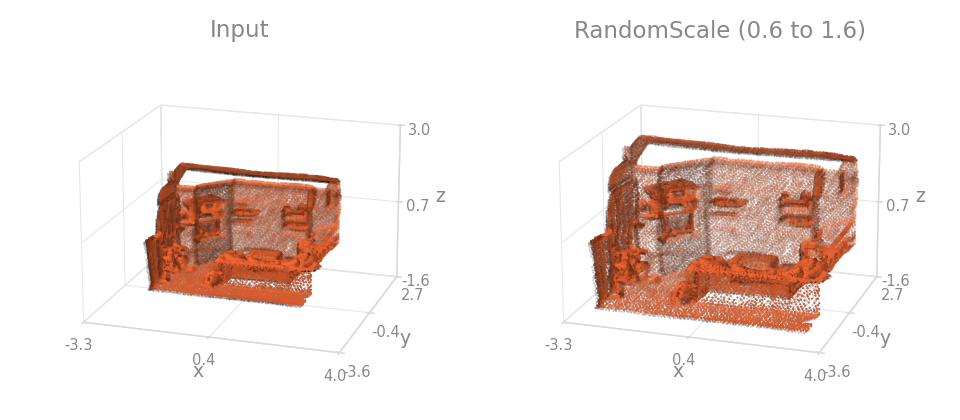
Scale one or more keys (and optionally oriented boxes) by a uniformly random factor.
Sampling is done once per call: every listed key and the optional box are scaled by the same factor (or per-axis factor vector when anisotropic=True). Pass box_key to also scale a \((K, 7)\) oriented-box tensor (centers and sizes). An oriented box has no per-axis scale, so box_key is incompatible with anisotropic=True.
List only point-like keys. Do not list direction vectors such as normal: a scaled normal is no longer unit length, while a true surface normal is unchanged by an isotropic scale (and an anisotropic scale would require the inverse-transpose rule). Simply omit normal keys.
See Also
torch_pointcloud.transforms.functional.scale_boxes
Parameters:
-
keys(KeyCollection) –Keys to scale. Point-like keys only; do not list direction vectors such as
normal. -
scale_range(Tuple[float, float], default:(0.8, 1.25)) –Min and max scaling factor.
-
anisotropic(bool, default:False) –If
True, sample a separate scale per axis of the last dim (incompatible withbox_key). -
axes(Optional[Sequence[int]], default:None) –Channels of the last dim that receive the factor, the others keep their values;
Nonescales them all (incompatible withanisotropicandbox_key). -
p(float, default:1.0) –Probability of applying the transform.
-
box_key(Optional[str], default:None) –Optional key of a \((K, 7)\) oriented-box tensor to scale jointly; a \((K, 9)\) tensor carries a planar velocity in its last two columns, scaled with the boxes.
-
dst_keys(Optional[KeyCollection], default:None) –Where to store the scaled tensors.
-
dst_box_key(Optional[str], default:None) –Where to store the scaled boxes. Defaults to
box_key(in-place). -
seed(Optional[int], default:None) –Seed of the transform's own random stream;
Nonedraws from the global generator (seeRandomizable). -
allow_missing_keys(bool, default:False) –If
True, silently skip absent keys.
RandomFlip(
    keys: KeyCollection,
    axes: Sequence[int] = (0, 1),
    p: float = 0.5,
    box_key: Optional[str] = None,
    dst_keys: Optional[KeyCollection] = None,
    dst_box_key: Optional[str] = None,
    seed: Optional[int] = None,
    allow_missing_keys: bool = False,
)
Bases: DictTransform, Randomizable
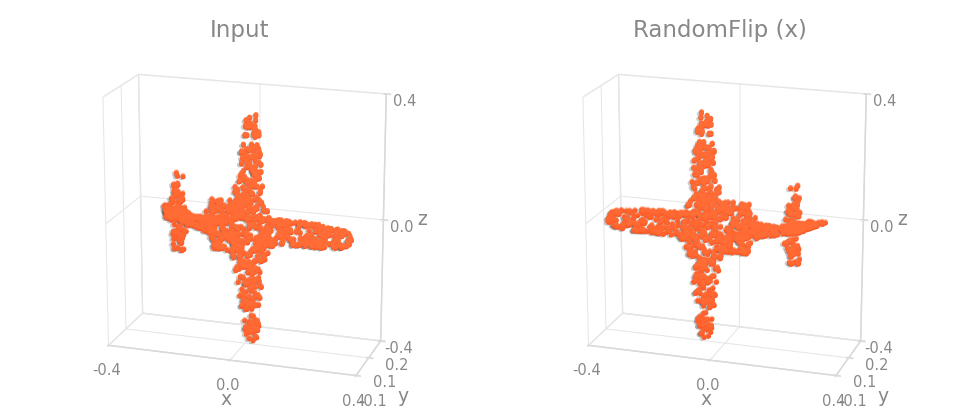
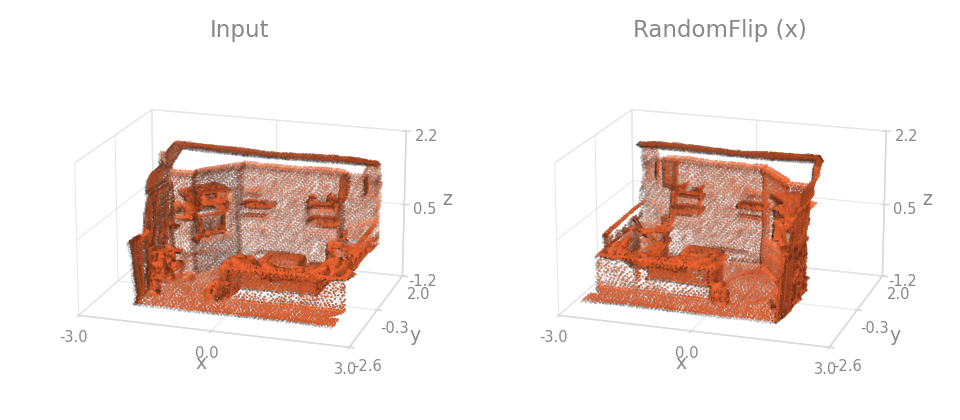
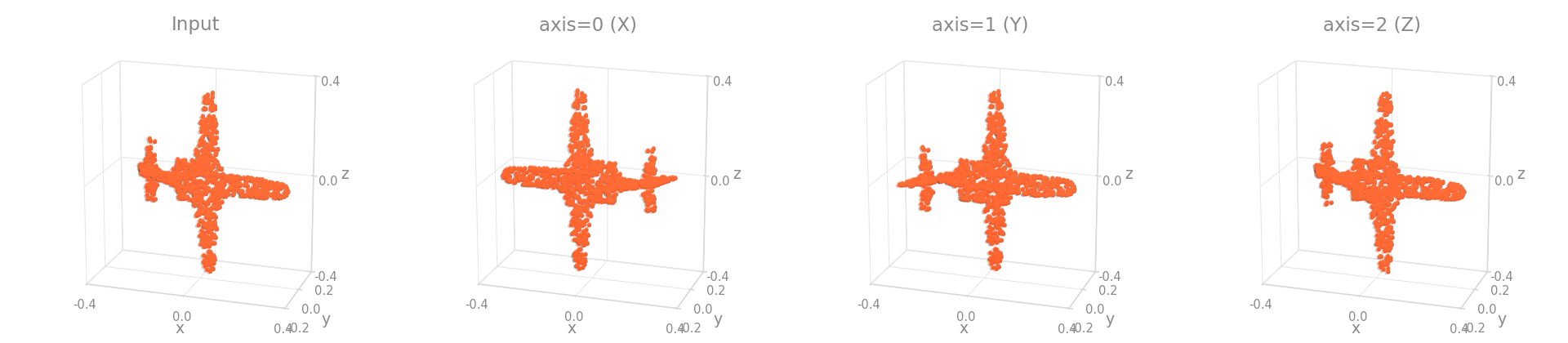
Flip listed axes (and optionally oriented boxes) with probability p each.
Sampling is done once per call: every listed key and the optional box are flipped on the same axes. Each key is a \((\ldots, 3)\) field or a packed \((N, 3G)\) field of tiled 3D offsets (e.g. vote offsets). Pass box_key to also flip a \((K, 7)\) oriented-box tensor (centers negated, heading remapped).
See Also
torch_pointcloud.transforms.functional.flip_vectors, torch_pointcloud.transforms.functional.flip_boxes
Parameters:
-
keys(KeyCollection) –Keys to flip. Each must be a \((\ldots, 3)\) or \((N, 3G)\) vector field.
-
axes(Sequence[int], default:(0, 1)) –Axis indices (into each 3D triple) to consider for flipping.
-
p(float, default:0.5) –Per-axis flip probability.
-
box_key(Optional[str], default:None) –Optional key of a \((K, 7)\) oriented-box tensor to flip jointly; a \((K, 9)\) tensor carries a planar velocity in its last two columns, flipped with the boxes.
-
dst_keys(Optional[KeyCollection], default:None) –Where to store the flipped tensors.
-
dst_box_key(Optional[str], default:None) –Where to store the flipped boxes. Defaults to
box_key(in-place). -
seed(Optional[int], default:None) –Seed of the transform's own random stream;
Nonedraws from the global generator (seeRandomizable). -
allow_missing_keys(bool, default:False) –If
True, silently skip absent keys.
RandomJitter(
    keys: KeyCollection,
    sigma: float = 0.01,
    clip: Optional[float] = 0.05,
    p: float = 1.0,
    dst_keys: Optional[KeyCollection] = None,
    seed: Optional[int] = None,
    allow_missing_keys: bool = False,
)
Bases: DictTransform, Randomizable
Add Gaussian noise to listed keys, optionally clipped.
Each key gets its own independent noise tensor (because the noise shape matches the key shape). Pair-rotation-style consistency does not apply here.
See Also
torch_pointcloud.transforms.functional.random_jitter
Parameters:
-
keys(KeyCollection) –Keys to jitter.
-
sigma(float, default:0.01) –Standard deviation of the Gaussian noise.
-
clip(Optional[float], default:0.05) –If not
None, clip the noise to[-clip, clip]. -
p(float, default:1.0) –Probability of applying the transform.
-
dst_keys(Optional[KeyCollection], default:None) –Where to store the jittered tensors.
-
seed(Optional[int], default:None) –Seed of the transform's own random stream;
Nonedraws from the global generator (seeRandomizable). -
allow_missing_keys(bool, default:False) –If
True, silently skip absent keys.
RandomTranslate(
    keys: KeyCollection,
    translation_range: Tuple[float, float] = (-0.2, 0.2),
    p: float = 1.0,
    box_key: Optional[str] = None,
    dst_keys: Optional[KeyCollection] = None,
    dst_box_key: Optional[str] = None,
    seed: Optional[int] = None,
    allow_missing_keys: bool = False,
)
Bases: DictTransform, Randomizable
Translate listed keys (and optionally oriented boxes) by a uniformly random vector.
Sampling is done once per call: all listed keys and the optional box are shifted by the same translation vector. Pass box_key to also translate a \((K, 7)\) oriented-box tensor (centers only; sizes and heading unchanged).
List only point-like keys. Do not list direction vectors such as normal: directions are translation-invariant, so a shifted normal is wrong. Simply omit normal keys.
See Also
torch_pointcloud.transforms.functional.translate_boxes
Parameters:
-
keys(KeyCollection) –Keys to translate. Point-like keys only; do not list direction vectors such as
normal. -
translation_range(Tuple[float, float], default:(-0.2, 0.2)) –Min and max per-axis translation.
-
p(float, default:1.0) –Probability of applying the transform.
-
box_key(Optional[str], default:None) –Optional key of a \((K, 7)\) oriented-box tensor to translate jointly.
-
dst_keys(Optional[KeyCollection], default:None) –Where to store the shifted tensors.
-
dst_box_key(Optional[str], default:None) –Where to store the shifted boxes. Defaults to
box_key(in-place). -
seed(Optional[int], default:None) –Seed of the transform's own random stream;
Nonedraws from the global generator (seeRandomizable). -
allow_missing_keys(bool, default:False) –If
True, silently skip absent keys.
RandomColorJitter(
    keys: KeyCollection,
    brightness: float = 0.4,
    contrast: float = 0.4,
    saturation: float = 0.2,
    int_color: bool = False,
    p: float = 1.0,
    dst_keys: Optional[KeyCollection] = None,
    seed: Optional[int] = None,
    allow_missing_keys: bool = False,
)
Bases: DictTransform, Randomizable
Jitter colors by brightness, contrast, and saturation strengths.
Each strength is a relative delta uniformly sampled from [-x, x]. Sampling is once per call, so the same factors are applied to every listed key.
See Also
torch_pointcloud.transforms.functional.color_jitter
Parameters:
-
keys(KeyCollection) –Color keys to jitter, shape \((N, 3)\).
-
brightness(float, default:0.4) –Max relative brightness change in \([0, 1]\).
-
contrast(float, default:0.4) –Max relative contrast change in \([0, 1]\).
-
saturation(float, default:0.2) –Max relative saturation change in \([0, 1]\).
-
int_color(bool, default:False) –If
True, treat float colors as[0, 255]values; otherwise[0, 1].uint8colors are always treated as[0, 255]regardless of the flag; float colors above 1 withint_color=Falseraise a ValueError. -
p(float, default:1.0) –Probability of applying the transform.
-
dst_keys(Optional[KeyCollection], default:None) –Where to store the jittered tensors.
-
seed(Optional[int], default:None) –Seed of the transform's own random stream;
Nonedraws from the global generator (seeRandomizable). -
allow_missing_keys(bool, default:False) –If
True, silently skip absent keys.
RandomColorDrop(
    keys: KeyCollection,
    fill: float = 0.5,
    int_color: bool = False,
    p: float = 0.2,
    dst_keys: Optional[KeyCollection] = None,
    seed: Optional[int] = None,
    allow_missing_keys: bool = False,
)
Bases: DictTransform, Randomizable
Replace colors with a constant gray value with probability p.
See Also
torch_pointcloud.transforms.functional.color_drop
Parameters:
-
keys(KeyCollection) –Color keys to drop.
-
fill(float, default:0.5) –Replacement value in the range implied by
int_color([0, 1]whenFalse,[0, 255]whenTrue); rescaled to the input's actual range when that differs, so the default0.5fills127onuint8colors. -
int_color(bool, default:False) –If
True, treat float colors as[0, 255]values; otherwise[0, 1].uint8colors are always treated as[0, 255]regardless of the flag; float colors above 1 withint_color=Falseraise a ValueError. -
p(float, default:0.2) –Probability of dropping colors.
-
dst_keys(Optional[KeyCollection], default:None) –Where to store the result.
-
seed(Optional[int], default:None) –Seed of the transform's own random stream;
Nonedraws from the global generator (seeRandomizable). -
allow_missing_keys(bool, default:False) –If
True, silently skip absent keys.
RandomColorGrayScale(
    keys: KeyCollection,
    int_color: bool = False,
    p: float = 0.2,
    dst_keys: Optional[KeyCollection] = None,
    seed: Optional[int] = None,
    allow_missing_keys: bool = False,
)
Bases: DictTransform, Randomizable
Convert listed color keys to grayscale (BT.601 luminance) with probability p.
See Also
torch_pointcloud.transforms.functional.color_grayscale
Parameters:
-
keys(KeyCollection) –Color keys, shape \((N, 3)\).
-
int_color(bool, default:False) –If
True, treat colors as[0, 255]ints; otherwise[0, 1]floats. -
p(float, default:0.2) –Probability of converting to grayscale.
-
dst_keys(Optional[KeyCollection], default:None) –Where to store the result.
-
seed(Optional[int], default:None) –Seed of the transform's own random stream;
Nonedraws from the global generator (seeRandomizable). -
allow_missing_keys(bool, default:False) –If
True, silently skip absent keys.
RandomColorAutoContrast(
    keys: KeyCollection,
    blend: Optional[float] = 0.5,
    int_color: bool = False,
    p: float = 0.2,
    dst_keys: Optional[KeyCollection] = None,
    seed: Optional[int] = None,
    allow_missing_keys: bool = False,
)
Bases: DictTransform, Randomizable
Stretch per-cloud color range to the full extent, then blend back, with probability p.
See Also
torch_pointcloud.transforms.functional.color_auto_contrast
Parameters:
-
keys(KeyCollection) –Color keys, shape \((N, 3)\).
-
blend(Optional[float], default:0.5) –Blend weight in
[0, 1].1.0is fully auto-contrasted;0.0is the input;Nonedraws a uniform weight on every application. -
int_color(bool, default:False) –If
True, treat float colors as[0, 255]values; otherwise[0, 1].uint8colors are always treated as[0, 255]regardless of the flag; float colors above 1 withint_color=Falseraise a ValueError. -
p(float, default:0.2) –Probability of applying the transform.
-
dst_keys(Optional[KeyCollection], default:None) –Where to store the result.
-
seed(Optional[int], default:None) –Seed of the transform's own random stream;
Nonedraws from the global generator (seeRandomizable). -
allow_missing_keys(bool, default:False) –If
True, silently skip absent keys.
RandomRotateChoice(
    keys: KeyCollection,
    angles: Sequence[float],
    axis: int = 2,
    p: float = 1.0,
    dst_keys: Optional[KeyCollection] = None,
    seed: Optional[int] = None,
    allow_missing_keys: bool = False,
)
Bases: DictTransform, Randomizable
Rotate one or more keys by an angle chosen uniformly from a discrete list.
Common use: ModelNet / ScanObjectNN augmentation with angles=[0, 90, 180, 270] around the z-axis. Sampling is done once per call: every listed key gets the same rotation matrix.
See Also
torch_pointcloud.transforms.functional.rotation_matrix, torch_pointcloud.transforms.functional.rotate_vectors
Parameters:
-
keys(KeyCollection) –Keys to rotate. Each must have shape
(..., 3). -
angles(Sequence[float]) –Candidate rotation angles, in degrees. Must be non-empty.
-
axis(int, default:2) –Axis index to rotate around (0=X, 1=Y, 2=Z).
-
p(float, default:1.0) –Probability of applying the transform.
-
dst_keys(Optional[KeyCollection], default:None) –Where to store the rotated tensors. Defaults to
keys(in-place). -
seed(Optional[int], default:None) –Seed of the transform's own random stream;
Nonedraws from the global generator (seeRandomizable). -
allow_missing_keys(bool, default:False) –If
True, silently skip absent keys.
RandomColorShift(
    keys: KeyCollection,
    shift_range: Tuple[float, float] = (-0.05, 0.05),
    int_color: bool = False,
    p: float = 1.0,
    dst_keys: Optional[KeyCollection] = None,
    seed: Optional[int] = None,
    allow_missing_keys: bool = False,
)
Bases: DictTransform, Randomizable
Additive per-channel color shift sampled uniformly per channel.
For each of the 3 channels, sample one offset uniformly from shift_range and add it to every point's value. Sampling is once per call (same shift across all listed keys). Result is clamped to the valid color range.
See Also
torch_pointcloud.transforms.functional.color_shift
Parameters:
-
keys(KeyCollection) –Color keys to shift, shape \((N, 3)\).
-
shift_range(Tuple[float, float], default:(-0.05, 0.05)) –Min and max per-channel offset (in the same range as the colors).
-
int_color(bool, default:False) –If
True, treat float colors as[0, 255]values; otherwise[0, 1].uint8colors are always treated as[0, 255]regardless of the flag; float colors above 1 withint_color=Falseraise a ValueError. -
p(float, default:1.0) –Probability of applying the transform.
-
dst_keys(Optional[KeyCollection], default:None) –Where to store the shifted tensors.
-
seed(Optional[int], default:None) –Seed of the transform's own random stream;
Nonedraws from the global generator (seeRandomizable). -
allow_missing_keys(bool, default:False) –If
True, silently skip absent keys.
RandomElasticDistortion(
    keys: KeyCollection,
    granularity: Union[float, Sequence[float]] = 0.2,
    magnitude: Union[float, Sequence[float]] = 0.4,
    p: float = 1.0,
    dst_keys: Optional[KeyCollection] = None,
    seed: Optional[int] = None,
    allow_missing_keys: bool = False,
)
Bases: DictTransform, Randomizable
Apply a smooth random displacement field (elastic distortion).
Used in sparse-voxel indoor segmentation recipes. Sampling is done once per call so multi-key consistency is preserved (the same displacement field is applied to every listed key).
For multi-scale distortion (the common default), compose two RandomElasticDistortion calls with different granularity / magnitude.
See Also
torch_pointcloud.transforms.functional.random_elastic_distortion
Parameters:
-
keys(KeyCollection) –Position keys to distort, shape \((N, 3)\). All listed keys must share the same leading dimension \(N\): the per-point displacement is computed once from the first present key and added to every key.
-
granularity(Union[float, Sequence[float]], default:0.2) –Size of the displacement-field grid cells. Smaller values give higher-frequency distortion. Several values (paired with
magnitude) run one pass each, under the same probability gate. -
magnitude(Union[float, Sequence[float]], default:0.4) –Standard deviation of the per-cell Gaussian noise. Larger values give stronger deformation.
-
p(float, default:1.0) –Probability of applying the transform.
-
dst_keys(Optional[KeyCollection], default:None) –Where to store the distorted tensors.
-
seed(Optional[int], default:None) –Seed of the transform's own random stream;
Nonedraws from the global generator (seeRandomizable). -
allow_missing_keys(bool, default:False) –If
True, silently skip absent keys.
Rotate oriented 3D boxes about the up axis.
Box centers are rotated by rotation (centers @ rotation.transpose(-1, -2)) and the heading is incremented by angle, so a counterclockwise rotation about \(+z\) keeps the counterclockwise heading aligned with the jointly rotated points. Sizes are unchanged. Boxes with a planar velocity \((v_x, v_y)\) in columns \(7{:}9\) have it rotated in the plane; further columns are kept as they are.
Parameters:
-
boxes(Tensor) –Box tensor of shape \((K, 7)\) as \([c_x, c_y, c_z, d_x, d_y, d_z, \theta]\), or \((K, 7 + C)\).
-
rotation(Tensor) –A \(3 \times 3\) rotation matrix rotating by
anglecounterclockwise about the \(z\) axis. -
angle(float) –Rotation angle in radians, added to the heading.
Returns:
-
Tensor–The rotated box tensor, same shape as
boxes.
Scale oriented 3D boxes by an isotropic factor.
Both centers and extents (columns \(0\) to \(6\)) are multiplied by scale, and so is a planar velocity \((v_x, v_y)\) in columns \(7{:}9\). Heading and further columns are unchanged.
Parameters:
-
boxes(Tensor) –Box tensor of shape \((K, 7)\) or \((K, 7 + C)\).
-
scale(Union[float, Tensor]) –Isotropic scalar factor applied to centers, sizes and velocity.
Returns:
-
Tensor–The scaled box tensor, same shape as
boxes.
Flip oriented 3D boxes along a spatial axis.
Boxes are stored as \((K, 7)\) rows \([c_x, c_y, c_z, d_x, d_y, d_z, \theta]\) with full extents and heading in radians counterclockwise about \(+z\) from \(+x\). A flip negates the center component along axis. A flip along axis \(0\) (the \(yz\) plane) maps the heading to \(\pi - \theta\); a flip along axis \(1\) (the \(xz\) plane) maps the heading to \(-\theta\). Sizes are unchanged. Boxes with a planar velocity \((v_x, v_y)\) in columns \(7{:}9\) have its axis component negated too; further columns are kept as they are.
Parameters:
-
boxes(Tensor) –Box tensor of shape \((K, 7)\) or \((K, 7 + C)\).
-
axis(int) –Center axis index to negate (0=X, 1=Y).
Returns:
-
Tensor–The flipped box tensor, same shape as
boxes.
Flip a packed field of 3D vectors along a spatial axis.
Negates component axis of every contiguous triple of the last dimension, so it handles both a plain \((N, 3)\) field (e.g. coordinates or normals) and a \((N, 3 G)\) field of \(G\) tiled offsets (e.g. vote offsets \((\text{center} - \text{point})\)) alike.
Parameters:
-
x(Tensor) –Vector field of shape \((N, 3)\) or \((N, 3 G)\).
-
axis(int) –Axis index within each triple to negate.
Returns:
-
Tensor–The flipped tensor with the same shape as
x.
random_jitter(
    x: Tensor,
    sigma: float = 0.01,
    clip: Optional[float] = 0.05,
    generator: Optional[Generator] = None,
) -> Tensor
Add Gaussian noise to x, optionally clipped.
Parameters:
-
x(Tensor) –Input tensor.
-
sigma(float, default:0.01) –Standard deviation of the Gaussian noise.
-
clip(Optional[float], default:0.05) –If not
None, clip the noise to[-clip, clip]. -
generator(Optional[Generator], default:None) –Random generator for reproducibility.
Returns:
-
Tensor–Jittered tensor with the same shape as
x.
Translate oriented 3D boxes by a fixed offset.
Centers (columns \(0\) to \(3\)) are offset by translation. Sizes, heading and any further column (such as a velocity) are unchanged.
Parameters:
-
boxes(Tensor) –Box tensor of shape \((K, 7)\) as \([c_x, c_y, c_z, d_x, d_y, d_z, \theta]\), or \((K, 7 + C)\).
-
translation(Tensor) –Translation vector of shape \((3,)\).
Returns:
-
Tensor–The shifted box tensor, same shape as
boxes.
color_jitter(
    color: Tensor,
    brightness: Optional[float] = None,
    contrast: Optional[float] = None,
    saturation: Optional[float] = None,
    int_color: bool = False,
) -> Tensor
Apply brightness, contrast, and saturation factors to colors, in that order.
Each factor multiplies its component directly (1.0 is identity); None skips the component entirely.
Parameters:
-
color(Tensor) –Color tensor of shape \((N, 3)\).
-
brightness(Optional[float], default:None) –Multiplicative brightness factor (e.g.
1.2brightens by 20%). -
contrast(Optional[float], default:None) –Contrast factor, scaling the deviation from the per-channel mean.
-
saturation(Optional[float], default:None) –Saturation factor, scaling the deviation from the per-point grayscale luminance.
-
int_color(bool, default:False) –If
True, treat float colors as[0, 255]values; otherwise[0, 1].uint8colors are always treated as[0, 255]regardless of the flag.
Returns:
-
Tensor–Jittered colors with the same shape and dtype as
color.
Raises:
-
ValueError–If
coloris a float tensor with values above 1 whileint_color=False.
random_color_jitter(
    color: Tensor,
    brightness: float = 0.0,
    contrast: float = 0.0,
    saturation: float = 0.0,
    int_color: bool = False,
    generator: Optional[Generator] = None,
) -> Tensor
Jitter colors by brightness, contrast, and saturation, in that order.
Each strength is a relative delta sampled uniformly from [-x, x] and applied multiplicatively (out = x * factor) via color_jitter.
Parameters:
-
color(Tensor) –Color tensor of shape \((N, 3)\).
-
brightness(float, default:0.0) –Max relative brightness change.
0.2means ±20%. -
contrast(float, default:0.0) –Max relative contrast change.
-
saturation(float, default:0.0) –Max relative saturation change. Saturation moves toward (or away from) the per-channel grayscale luminance.
-
int_color(bool, default:False) –If
True, treat float colors as[0, 255]values; otherwise[0, 1].uint8colors are always treated as[0, 255]regardless of the flag. -
generator(Optional[Generator], default:None) –Random generator for reproducibility.
Returns:
-
Tensor–Jittered colors with the same shape and dtype as
color.
Raises:
-
ValueError–If
coloris a float tensor with values above 1 whileint_color=False.
Replace colors with a constant gray value (drops chromatic information).
Parameters:
-
color(Tensor) –Color tensor of shape \((N, 3)\).
-
fill(float, default:0.5) –Replacement value, expressed in the range implied by
int_color([0, 1]whenFalse,[0, 255]whenTrue). It is rescaled to the input's actual range when that differs, so the default0.5fills127onuint8colors. -
int_color(bool, default:False) –If
True, treat float colors as[0, 255]values; otherwise[0, 1].uint8colors are always treated as[0, 255]regardless of the flag.
Returns:
-
Tensor–Tensor of the same shape and dtype as
color, filled with the rescaledfill.
Raises:
-
ValueError–If
coloris a float tensor with values above 1 whileint_color=False.
Convert RGB colors to grayscale using the BT.601 luminance weights.
Parameters:
-
color(Tensor) –Color tensor of shape \((N, 3)\).
-
int_color(bool, default:False) –If
True, treat colors as[0, 255]ints; otherwise[0, 1]floats.
Returns:
-
Tensor–Tensor with the same shape and dtype as
color, with R=G=B = luminance.
Stretch per-cloud color range to the full [0, max] interval, then blend.
For each channel, the min becomes 0 and the max becomes max_val. The output is then linearly blended with the original by blend (blend=1.0 is the fully stretched version, blend=0.0 is the input).
Parameters:
-
color(Tensor) –Color tensor of shape \((N, 3)\).
-
blend(float, default:0.5) –Blend weight in
[0, 1]. -
int_color(bool, default:False) –If
True, treat float colors as[0, 255]values; otherwise[0, 1].uint8colors are always treated as[0, 255]regardless of the flag.
Returns:
-
Tensor–Auto-contrast tensor with the same shape and dtype as
color.
Raises:
-
ValueError–If
coloris a float tensor with values above 1 whileint_color=False.
Add a per-channel offset to colors, clamped to the valid color range.
Parameters:
-
color(Tensor) –Color tensor of shape \((N, 3)\).
-
shift(Tensor) –Per-channel offset of shape \((3,)\), in the same range as the colors.
-
int_color(bool, default:False) –If
True, treat float colors as[0, 255]values; otherwise[0, 1].uint8colors are always treated as[0, 255]regardless of the flag.
Returns:
-
Tensor–Shifted colors with the same shape and dtype as
color.
Raises:
-
ValueError–If
coloris a float tensor with values above 1 whileint_color=False.
random_elastic_distortion(
    pos: Tensor,
    granularity: float = 0.2,
    magnitude: float = 0.4,
    generator: Optional[Generator] = None,
) -> Tensor
Apply a smooth random displacement field to pos.
Implements the elastic distortion recipe common in sparse-voxel indoor segmentation pipelines: sample Gaussian noise on a coarse 3D grid (cells of side granularity), smooth it with two passes of a \(3 \times 3 \times 3\) mean filter, trilinear-interpolate the smoothed displacement at each point, and add it to the position. Net effect is a locally-coherent, low-frequency deformation that preserves nearby-point relationships.
Parameters:
-
pos(Tensor) –Input positions of shape \((N, 3)\).
-
granularity(float, default:0.2) –Size of the noise grid cells (in the same units as
pos). Smaller values give higher-frequency distortion. -
magnitude(float, default:0.4) –Standard deviation of the per-cell Gaussian noise (in the same units as
pos). Larger values give stronger deformation. -
generator(Optional[Generator], default:None) –Random generator for reproducibility.
Returns:
-
Tensor–Distorted positions of shape \((N, 3)\).