pointrcnn
PointRCNN detection model.
Classes:
-
PointRCNNOutput–Inference-mode PointRCNN output: refined boxes with stage-2 confidences (packed layout).
-
PointRCNNTrainOutput–Training-mode PointRCNN output: stage-1 point predictions plus sampled-ROI stage-2 tensors.
-
PointHeadBox–Stage-1 per-point foreground head + bin-free box proposal generation (
PointHeadBox). -
PointRCNNRefinementHead–Stage-2 ROI refinement head (
PointRCNNHead): point ROI pooling + canonical transform + PointNet++. -
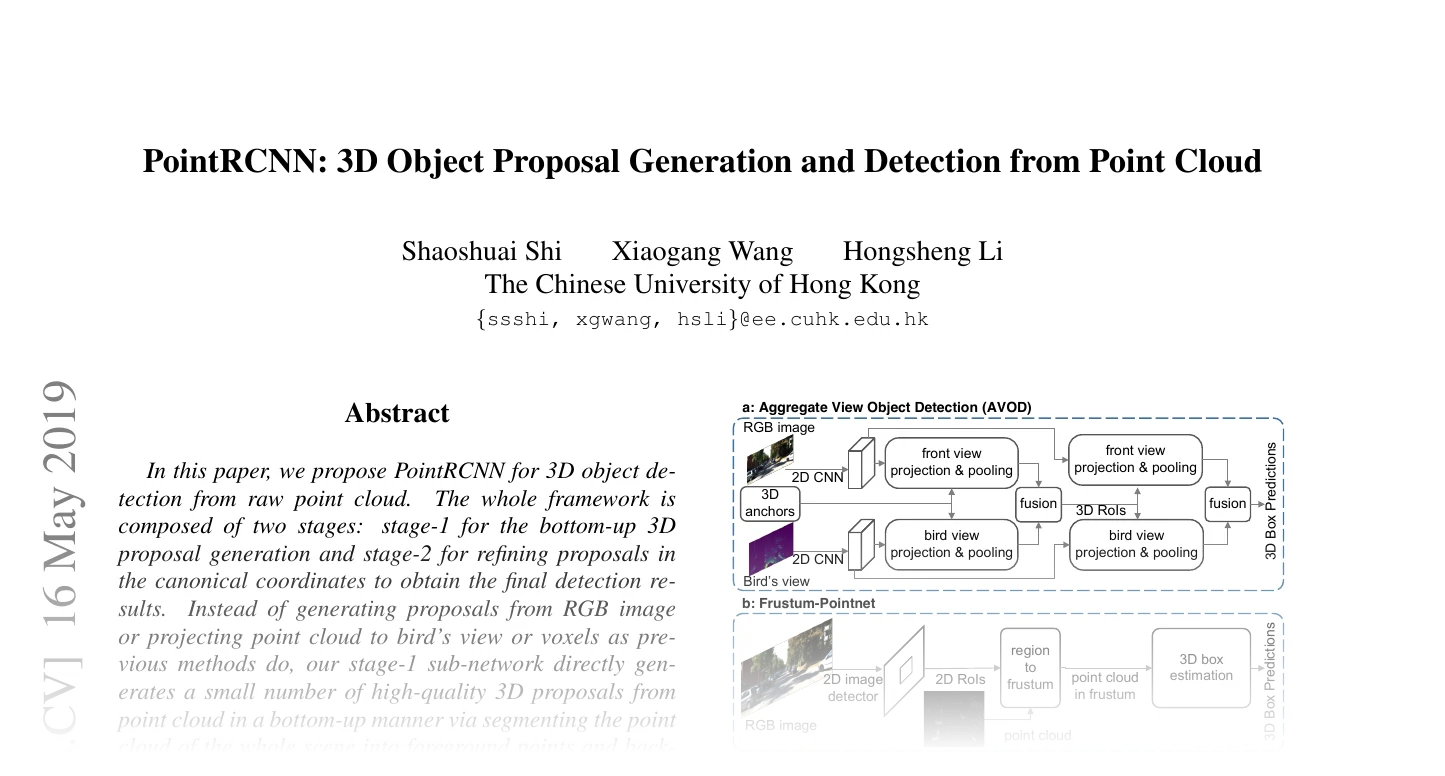
PointRCNNDetection–PointRCNN two-stage point-based 3D object detector (packed point format).
Functions:
-
rotate_points_along_z–Rotate point sets about the \(+z\) axis (angle increases \(x \to y\)).
-
decode_point_residuals–Decode per-point box residuals with class mean-size anchors.
Bases: TypedDict
Inference-mode PointRCNN output: refined boxes with stage-2 confidences (packed layout).
Attributes:
-
rcnn_cls(Tensor) –Stage-2 confidence logit per ROI, shape \((M, 1)\).
-
boxes(Tensor) –Refined boxes \((c_x, c_y, c_z, d_x, d_y, d_z, \theta)\), shape \((M, 7)\).
-
roi_labels(Tensor) –Stage-1 ROI class per box (\(1\)-based), shape \((M,)\).
-
roi_scores(Tensor) –Stage-1 sigmoid proposal score per box, shape \((M,)\).
-
batch(Tensor) –Per-ROI scene index, shape \((M,)\).
Bases: TypedDict
Training-mode PointRCNN output: stage-1 point predictions plus sampled-ROI stage-2 tensors.
Attributes:
-
point_cls_preds(Tensor) –Stage-1 per-point class logits, shape \((N, \text{num\_classes})\).
-
point_box_preds(Tensor) –Stage-1 per-point box residuals, shape \((N, 8)\).
-
point_pos(Tensor) –Per-point coordinates, shape \((N, 3)\).
-
point_batch(Tensor) –Per-point scene index, shape \((N,)\).
-
rcnn_cls(Tensor) –Stage-2 confidence logit per sampled ROI, shape \((M, 1)\).
-
rcnn_reg(Tensor) –Stage-2 raw ROI box residuals, shape \((M, 7)\).
-
rcnn_boxes(Tensor) –Stage-2 refined boxes in the lidar frame, shape \((M, 7)\).
-
rois(Tensor) –Sampled proposal boxes (generated without gradient), shape \((M, 7)\).
-
gt_of_rois(Tensor) –ROI-canonical matched ground-truth box, shape \((M, 7)\).
-
gt_of_rois_src(Tensor) –Lidar-frame matched ground-truth box, shape \((M, 7)\).
-
roi_ious(Tensor) –Per-ROI max IoU with the matched box, shape \((M,)\).
PointHeadBox(
    in_channels: int,
    num_classes: int,
    *,
    cls_channels: Sequence[int],
    reg_channels: Sequence[int],
    mean_sizes: Tensor,
    act: Union[str, Callable, None] = "relu",
    act_kwargs: Optional[Dict[str, Any]] = None,
    norm: Union[str, Callable, None] = "batch_norm",
    norm_kwargs: Optional[Dict[str, Any]] = None,
)
Bases: Module
Stage-1 per-point foreground head + bin-free box proposal generation (PointHeadBox).
Two MLPs over the per-point backbone features predict a per-point class logit and an 8-D box residual. At inference every point becomes a proposal: the class score is the sigmoid of the max class logit and the box is decoded by decode_point_residuals against the point's predicted class mean size.
Parameters:
-
in_channels(int) –Backbone feature channels per point.
-
num_classes(int) –Number of foreground classes.
-
cls_channels(Sequence[int]) –Hidden channels of the classification MLP.
-
reg_channels(Sequence[int]) –Hidden channels of the box-regression MLP.
-
mean_sizes(Tensor) –Per-class mean box size \((d_x, d_y, d_z)\), shape \((\text{num\_classes}, 3)\).
-
act(Union[str, Callable, None], default:'relu') –Activation type or callable.
-
act_kwargs(Optional[Dict[str, Any]], default:None) –Extra activation arguments.
-
norm(Union[str, Callable, None], default:'batch_norm') –Normalization type or callable.
-
norm_kwargs(Optional[Dict[str, Any]], default:None) –Extra normalization arguments.
Methods:
-
forward–Predict per-point class scores, raw box residuals and decoded proposal boxes.
Predict per-point class scores, raw box residuals and decoded proposal boxes.
Parameters:
-
x(Tensor) –Per-point backbone features, shape \((N, C)\).
-
pos(Tensor) –Per-point coordinates, shape \((N, 3)\).
Returns:
-
Tensor–A tuple
(point_scores, cls_preds, box_preds, boxes)of the sigmoid foreground score \((N,)\), -
Tensor–the raw class logits \((N, \text{num\_classes})\), the raw box residuals \((N, 8)\) (the stage-1
-
Tensor–regression targets are formed against these), and the decoded boxes \((N, 7)\).
Shape
- x: \((N, C)\)
- pos: \((N, 3)\)
- output: \((N,)\), \((N, \text{num\_classes})\), \((N, 8)\), \((N, 7)\)
PointRCNNRefinementHead(
    in_channels: int,
    *,
    sa_channels: Sequence[Sequence[int]],
    sa_num_points: Sequence[int],
    sa_radii: Sequence[float],
    sa_num_neighbors: Sequence[int],
    xyz_up_channels: Sequence[int],
    cls_channels: Sequence[int],
    reg_channels: Sequence[int],
    num_sampled_points: int = 512,
    pool_extra_width: Sequence[float] = (0.0, 0.0, 0.0),
    depth_normalizer: float = 70.0,
    act: Union[str, Callable, None] = "relu",
    act_kwargs: Optional[Dict[str, Any]] = None,
    norm: Union[str, Callable, None] = "batch_norm",
    norm_kwargs: Optional[Dict[str, Any]] = None,
)
Bases: Module
Stage-2 ROI refinement head (PointRCNNHead): point ROI pooling + canonical transform + PointNet++.
For each proposal it pools a fixed number of input points inside the (optionally enlarged) box, appends the per-point foreground score and a depth feature, canonically transforms the pooled points (translate to the ROI center, rotate by \(-\theta\)), lifts the canonical xyz with an MLP, fuses it with the pooled point features, and runs a small PointNet++ to produce a confidence logit and a 7-D box refinement.
Parameters:
-
in_channels(int) –Pooled point-feature channels (the stage-1 backbone feature dim).
-
sa_channels(Sequence[Sequence[int]]) –Per-SA-block MLP channel lists.
-
sa_num_points(Sequence[int]) –Per-SA-block sample counts;
-1groups all remaining points. -
sa_radii(Sequence[float]) –Per-SA-block ball-query radii.
-
sa_num_neighbors(Sequence[int]) –Per-SA-block neighbor caps.
-
xyz_up_channels(Sequence[int]) –Channels of the canonical-xyz lifting MLP.
-
cls_channels(Sequence[int]) –Hidden channels of the confidence MLP.
-
reg_channels(Sequence[int]) –Hidden channels of the box-refinement MLP.
-
num_sampled_points(int, default:512) –Points pooled per ROI.
-
pool_extra_width(Sequence[float], default:(0.0, 0.0, 0.0)) –Per-axis enlargement of the pooling box.
-
depth_normalizer(float, default:70.0) –Divisor for the point-depth feature.
-
act(Union[str, Callable, None], default:'relu') –Activation type or callable.
-
act_kwargs(Optional[Dict[str, Any]], default:None) –Extra activation arguments.
-
norm(Union[str, Callable, None], default:'batch_norm') –Normalization type or callable.
-
norm_kwargs(Optional[Dict[str, Any]], default:None) –Extra normalization arguments.
Methods:
-
reset_parameters–Xavier-normal weights and zero biases on every layer, with the last regression weights near zero.
-
roipool–Pool a fixed number of in-box points per ROI and canonically transform them.
-
forward–Refine proposals into confidence logits, raw box residuals and refined boxes.
Xavier-normal weights and zero biases on every layer, with the last regression weights near zero.
Pool a fixed number of in-box points per ROI and canonically transform them.
Mirrors the reference roipoint_pool3d CUDA kernel: for every (optionally enlarged) box, the input points are scanned in order and the first num_sampled_points that fall inside are kept (cyclically duplicated when fewer are found, zeroed when none). Pooled points are translated to the ROI center and rotated by \(-\theta\) into the box-canonical frame.
Parameters:
-
pos(Tensor) –Per-point coordinates of one scene, shape \((N, 3)\).
-
x(Tensor) –Per-point pooled features (score + depth + backbone), shape \((N, 5 + C)\).
-
rois(Tensor) –Proposal boxes \((x, y, z, d_x, d_y, d_z, \theta)\), shape \((M, 7)\).
Returns:
-
Tensor–A tuple
(pooled, empty)of the pooled features \((M, S, 3 + (5 + C))\) in canonical xyz and a -
Tensor–boolean ROI-empty flag \((M,)\).
Shape
- pos: \((N, 3)\)
- x: \((N, 5 + C)\)
- rois: \((M, 7)\)
- output: \((M, S, 3 + 5 + C)\), \((M,)\)
forward(
    pos: Tensor,
    x: Tensor,
    point_scores: Tensor,
    batch: Tensor,
    rois: Tensor,
    roi_batch: Tensor,
) -> Tuple[Tensor, Tensor, Tensor]
Refine proposals into confidence logits, raw box residuals and refined boxes.
Parameters:
-
pos(Tensor) –Per-point coordinates, shape \((N, 3)\).
-
x(Tensor) –Per-point backbone features, shape \((N, C)\).
-
point_scores(Tensor) –Per-point stage-1 foreground score, shape \((N,)\).
-
batch(Tensor) –Per-point scene index, shape \((N,)\).
-
rois(Tensor) –Proposal boxes, shape \((M, 7)\).
-
roi_batch(Tensor) –Per-ROI scene index, shape \((M,)\).
Returns:
-
Tensor–A tuple
(rcnn_cls, rcnn_reg, refined_boxes)of the confidence logit \((M, 1)\), the raw ROI box -
Tensor–residuals \((M, 7)\) (the stage-2 regression targets are formed against these) and the refined
-
Tensor–boxes \((M, 7)\) in the lidar frame.
Shape
- pos: \((N, 3)\), x: \((N, C)\), point_scores: \((N,)\)
- rois: \((M, 7)\)
- output: \((M, 1)\), \((M, 7)\), \((M, 7)\)
PointRCNNDetection(
    in_channels: int = 4,
    num_classes: int = 3,
    *,
    mean_sizes: Union[Tensor, Sequence[Sequence[float]]],
    sa_channels: Sequence[Sequence[Sequence[int]]],
    sa_num_points: Sequence[int],
    sa_radii: Sequence[Sequence[float]],
    sa_num_neighbors: Sequence[Sequence[int]],
    fp_channels: Sequence[Sequence[int]],
    point_cls_channels: Sequence[int] = (256, 256),
    point_reg_channels: Sequence[int] = (256, 256),
    roi_sa_channels: Sequence[Sequence[int]],
    roi_sa_num_points: Sequence[int],
    roi_sa_radii: Sequence[float],
    roi_sa_num_neighbors: Sequence[int],
    roi_xyz_up_channels: Sequence[int] = (128, 128),
    roi_cls_channels: Sequence[int] = (256, 256),
    roi_reg_channels: Sequence[int] = (256, 256),
    num_sampled_points: int = 512,
    pool_extra_width: Sequence[float] = (0.0, 0.0, 0.0),
    depth_normalizer: float = 70.0,
    proposal_pre_maxsize: int = 9000,
    proposal_post_maxsize: int = 100,
    proposal_nms_thresh: float = 0.85,
    proposal_nms_rotated: bool = True,
    train_proposal_post_maxsize: int = 512,
    train_proposal_nms_thresh: float = 0.8,
    roi_per_image: int = 128,
    fg_ratio: float = 0.5,
    reg_fg_thresh: float = 0.55,
    cls_fg_thresh: float = 0.6,
    cls_bg_thresh_lo: float = 0.1,
    hard_bg_ratio: float = 0.8,
    act: Union[str, Callable, None] = "relu",
    act_kwargs: Optional[Dict[str, Any]] = None,
    norm: Union[str, Callable, None] = "batch_norm",
    norm_kwargs: Optional[Dict[str, Any]] = None,
)
Bases: DetectionModel
PointRCNN two-stage point-based 3D object detector (packed point format).
Reference: PointRCNN: 3D Object Proposal Generation and Detection from Point Cloud (Shi et al., 2019). Reference implementation: open-mmlab/OpenPCDet.
Stage 1 runs a multi-scale PointNet++ U-Net (PointNet2Encoder + PointNet2Decoder) over the raw point cloud, then a per-point head (PointHeadBox) predicts foreground scores and one box proposal per point. The top proposals (after class-agnostic NMS) become ROIs that stage 2 (PointRCNNRefinementHead) pools points around, canonically transforms, and refines into a confidence and a box correction.
Parameters:
-
in_channels(int, default:4) –Raw point feature channels including xyz (e.g. \(4\) for \(x, y, z, \text{intensity}\)).
-
num_classes(int, default:3) –Number of foreground classes.
-
mean_sizes(Union[Tensor, Sequence[Sequence[float]]]) –Per-class mean box size \((d_x, d_y, d_z)\), shape \((\text{num\_classes}, 3)\).
-
sa_channels(Sequence[Sequence[Sequence[int]]]) –Stage-1 per-SA-block, per-scale MLP channel lists.
-
sa_num_points(Sequence[int]) –Stage-1 per-SA-block sample counts.
-
sa_radii(Sequence[Sequence[float]]) –Stage-1 per-SA-block, per-scale ball-query radii.
-
sa_num_neighbors(Sequence[Sequence[int]]) –Stage-1 per-SA-block, per-scale neighbor caps.
-
fp_channels(Sequence[Sequence[int]]) –Stage-1 per-FP-block MLP channel lists, ordered from the coarsest skip level to the finest (
PointNet2Decoderorder). -
point_cls_channels(Sequence[int], default:(256, 256)) –Stage-1 classification MLP hidden channels.
-
point_reg_channels(Sequence[int], default:(256, 256)) –Stage-1 box-regression MLP hidden channels.
-
roi_sa_channels(Sequence[Sequence[int]]) –Stage-2 per-SA-block MLP channel lists.
-
roi_sa_num_points(Sequence[int]) –Stage-2 per-SA-block sample counts (
-1groups all). -
roi_sa_radii(Sequence[float]) –Stage-2 per-SA-block ball-query radii.
-
roi_sa_num_neighbors(Sequence[int]) –Stage-2 per-SA-block neighbor caps.
-
roi_xyz_up_channels(Sequence[int], default:(128, 128)) –Stage-2 canonical-xyz lifting MLP channels.
-
roi_cls_channels(Sequence[int], default:(256, 256)) –Stage-2 confidence MLP hidden channels.
-
roi_reg_channels(Sequence[int], default:(256, 256)) –Stage-2 box-refinement MLP hidden channels.
-
num_sampled_points(int, default:512) –Points pooled per ROI in stage 2.
-
pool_extra_width(Sequence[float], default:(0.0, 0.0, 0.0)) –Per-axis enlargement of the stage-2 pooling box.
-
depth_normalizer(float, default:70.0) –Divisor for the stage-2 point-depth feature.
-
proposal_pre_maxsize(int, default:9000) –Proposals kept before stage-1 NMS.
-
proposal_post_maxsize(int, default:100) –ROIs kept after stage-1 NMS at inference (the stage-2 batch size per scene).
-
proposal_nms_thresh(float, default:0.85) –Stage-1 proposal NMS IoU threshold at inference.
-
proposal_nms_rotated(bool, default:True) –Run the stage-1 NMS on the rotated BEV IoU (the reference
nms_gpu) rather than the axis-aligned 3D IoU. -
train_proposal_post_maxsize(int, default:512) –Proposals kept after stage-1 NMS during training (before ROI sampling).
-
train_proposal_nms_thresh(float, default:0.8) –Stage-1 proposal NMS IoU threshold during training.
-
roi_per_image(int, default:128) –ROIs sampled per scene for stage-2 training.
-
fg_ratio(float, default:0.5) –Target fraction of foreground ROIs in the sampled set.
-
reg_fg_thresh(float, default:0.55) –ROI-to-GT IoU at or above which a sampled ROI is foreground (box regression valid).
-
cls_fg_thresh(float, default:0.6) –ROI-to-GT IoU used with
reg_fg_threshto define the foreground sampling threshold. -
cls_bg_thresh_lo(float, default:0.1) –ROI-to-GT IoU below which a ROI is easy background (else hard background).
-
hard_bg_ratio(float, default:0.8) –Fraction of the sampled background ROIs drawn from hard (higher-IoU) background.
-
act(Union[str, Callable, None], default:'relu') –Activation type or callable.
-
act_kwargs(Optional[Dict[str, Any]], default:None) –Extra activation arguments.
-
norm(Union[str, Callable, None], default:'batch_norm') –Normalization type or callable.
-
norm_kwargs(Optional[Dict[str, Any]], default:None) –Extra normalization arguments.
Methods:
-
configure_encoder–Build the stage-1 multi-scale PointNet++ encoder.
-
configure_decoder–Build the stage-1 PointNet++ feature-propagation decoder.
-
configure_point_head–Build the stage-1 per-point foreground and box-proposal head.
-
configure_roi_head–Build the stage-2 ROI refinement head.
-
forward–Run both stages; in train mode the ground truth drives the stage-2 ROI sampling.
-
decode–Decode a forward output into raw per-ROI detections (no score threshold or NMS).
Attributes:
-
num_features(int) –Channel count \(C\) of the per-point backbone features entering the heads.
property 
Channel count \(C\) of the per-point backbone features entering the heads.
configure_encoder() -> PointNet2Encoder
Build the stage-1 multi-scale PointNet++ encoder.
configure_decoder() -> PointNet2Decoder
Build the stage-1 PointNet++ feature-propagation decoder.
configure_point_head() -> PointHeadBox
Build the stage-1 per-point foreground and box-proposal head.
configure_roi_head() -> PointRCNNRefinementHead
Build the stage-2 ROI refinement head.
forward(
    x: OptTensor,
    pos: Tensor,
    batch: Tensor,
    gt_boxes: OptTensor = None,
    gt_labels: OptTensor = None,
    gt_batch: OptTensor = None,
) -> Union[PointRCNNTrainOutput, PointRCNNOutput]
Run both stages; in train mode the ground truth drives the stage-2 ROI sampling.
Stage-2 training samples its ROIs by matching stage-1 proposals to ground-truth boxes at forward time, so train mode requires the packed ground truth. The GT arguments default to None and are omitted at inference (a training pipeline passes box / label / batch_box after the point inputs, e.g. via input_keys).
Parameters:
-
x(OptTensor) –Per-point features including reflectance, shape \((N, \text{in\_channels} - 3)\).
-
pos(Tensor) –Per-point coordinates, shape \((N, 3)\).
-
batch(Tensor) –Per-point scene index, shape \((N,)\).
-
gt_boxes(OptTensor, default:None) –Ground-truth boxes \((K, 7)\), required in train mode.
-
gt_labels(OptTensor, default:None) –Ground-truth \(0\)-based classes, shape \((K,)\), required in train mode.
-
gt_batch(OptTensor, default:None) –Per-box scene index, shape \((K,)\), required in train mode.
Returns:
-
Union[PointRCNNTrainOutput, PointRCNNOutput]–A
PointRCNNTrainOutputin train mode (stage-1 point predictions plus sampled-ROI stage-2 -
Union[PointRCNNTrainOutput, PointRCNNOutput]–tensors for the loss), otherwise a
PointRCNNOutput(refined boxes with confidences).
Shape
- x: \((N, \text{in\_channels} - 3)\), pos: \((N, 3)\), batch: \((N,)\)
- gt_boxes: \((K, 7)\), gt_labels / gt_batch: \((K,)\)
decode(out: PointRCNNOutput) -> Detection3D
Decode a forward output into raw per-ROI detections (no score threshold or NMS).
Scores each refined box by its stage-2 confidence (sigmoid of rcnn_cls) and labels it by the stage-1 ROI label (shifted to 0-indexed). The full per-ROI set is returned; the evaluation pipeline applies class-agnostic 3D NMS then score thresholding via the torch_pointcloud.ops.box3d utilities (see the benchmark example).
Parameters:
-
out(PointRCNNOutput) –A forward output
{"rcnn_cls", "boxes", "roi_labels", "roi_scores", "batch"}.
Returns:
-
Detection3D–Packed per-ROI detections
{"boxes": (R, 7), "scores": (R,), "labels": (R,), "batch": (R,)} -
Detection3D–(PyG layout).
Rotate point sets about the \(+z\) axis (angle increases \(x \to y\)).
Parameters:
-
points(Tensor) –Point sets, shape \((B, N, 3 + C)\); only the first three channels are rotated.
-
angle(Tensor) –Per-set yaw, shape \((B,)\).
Returns:
-
Tensor–The rotated point sets, shape \((B, N, 3 + C)\).
Shape
- points: \((B, N, 3 + C)\)
- angle: \((B,)\)
- output: \((B, N, 3 + C)\)
decode_point_residuals(
    encodings: Tensor,
    points: Tensor,
    classes: Tensor,
    mean_sizes: Tensor,
) -> Tensor
Decode per-point box residuals with class mean-size anchors.
Decodes a stage-1 prediction \((x_t, y_t, z_t, d_{x,t}, d_{y,t}, d_{z,t}, \cos, \sin)\) at a foreground point into an oriented box \((c_x, c_y, c_z, d_x, d_y, d_z, \theta)\), using the predicted class mean size as the anchor for the size residuals.
Parameters:
-
encodings(Tensor) –Box residuals, shape \((N, 8)\).
-
points(Tensor) –Anchor point coordinates, shape \((N, 3)\).
-
classes(Tensor) –Predicted class index per point (\(1 \ldots \text{num\_classes}\)), shape \((N,)\).
-
mean_sizes(Tensor) –Per-class mean box size \((d_x, d_y, d_z)\), shape \((\text{num\_classes}, 3)\).
Returns:
-
Tensor–Decoded boxes \((c_x, c_y, c_z, d_x, d_y, d_z, \theta)\), shape \((N, 7)\).
Shape
- encodings: \((N, 8)\)
- points: \((N, 3)\)
- output: \((N, 7)\)